Advertisements
Advertisements
Question
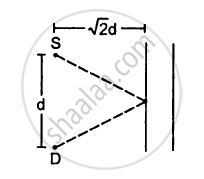
A source S and a detector D are placed at a distance d apart. A big cardboard is placed at a distance \[\sqrt{2}d\] from the source and the detector as shown in figure. The source emits a wave of wavelength = d/2 which is received by the detector after reflection from the cardboard. It is found to be in phase with the direct wave received from the source. By what minimum distance should the cardboard be shifted away so that the reflected wave becomes out of phase with the direct wave?
Advertisements
Solution
Given:
Distance between the source and detector = d
Distance of cardboard from the source =\[\sqrt{2d}\]
Wavelength of the source \[\lambda\]= d/2
Path difference between sound waves received by the detector before shifting the cardboard:
\[2\left( \sqrt{\left( \frac{d}{2} \right)^2 + \left( \sqrt{2}d \right)^2} \right) - d\]
\[ \Rightarrow 2 \times \frac{3d}{2} - d\]
\[ \Rightarrow 2d\]
If the cardboard is shifted by a distance x, the path difference will be :
\[2\left( \sqrt{\left( \frac{d}{2} \right)^2 + \left( \sqrt{2d} + x \right)^2} \right) - d\]
According to the question,
\[2\sqrt{\left( \frac{d}{2} \right)^2 + \left( \sqrt{2}d + x \right)^2} - d = 2d + \frac{d}{4}\]
\[ \Rightarrow 2\sqrt{\left( \frac{d}{2} \right)^2 + \left( \sqrt{2}d + x \right)^2} - d = \frac{9d}{4}\]
\[ \Rightarrow 2\sqrt{\left( \frac{d}{2} \right)^2 + \left( \sqrt{2}d + x \right)^2} = \frac{9d}{4} + d = \frac{13d}{4}\]
\[ \Rightarrow \left( \frac{d}{2} \right)^2 + \left( \sqrt{2}d + x \right)^2 = \frac{169}{64} d^2 \]
\[ \Rightarrow \left( \sqrt{2}d + x \right)^2 = \frac{(169 - 16)}{64} d^2 = \frac{153}{64} d^2 \]
\[ \Rightarrow \sqrt{2}d + x = 1 . 54d\]
\[ \Rightarrow x = \left( 1 . 54 - 1 . 41 \right)d = 0 . 13d\]
APPEARS IN
RELATED QUESTIONS
A wave is represented by an equation \[y = c_1 \sin \left( c_2 x + c_3 t \right)\] In which direction is the wave going? Assume that \[c_1 , c_2\] \[c_3\] are all positive.
The equation \[y = A \sin^2 \left( kx - \omega t \right)\]
represents a wave motion with
Two tuning forks vibrate with the same amplitude but the frequency of the first is double the frequency of the second. Which fork produces more intense sound in air?
A tuning fork of frequency 512 Hz is vibrated with a sonometer wire and 6 beats per second are heard. The beat frequency reduces if the tension in the string is slightly increased. The original frequency of vibration of the string is
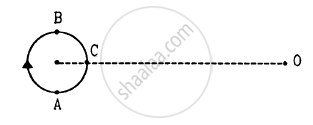
A small source of sounds moves on a circle as shown in figure and an observer is sitting at O. Let \[v_1, v_2, v_3\] be the frequencies heard when the source is at A, B and C respectively.
A man stands before a large wall at a distance of 50.0 m and claps his hands at regular intervals. Initially, the interval is large. He gradually reduces the interval and fixes it at a value when the echo of a clap merges every 3 seconds, find the velocity of sound in air.
A sound wave frequency 100 Hz is travelling in air. The speed of sound in air is 350 m s−1. (a) By how much is the phase changed at a given point in 2.5 ms? (b) What is the phase difference at a given instant between two points separated by a distance of 10.0 cm along the direction of propagation?
At what temperature will the speed of sound be double of its value at 0°C?
The absolute temperature of air in a region linearly increases from T1 to T2 in a space of width d. Find the time taken by a sound wave to go through the region in terms of T1, T2, d and the speed v of sound at 273 K. Evaluate this time for T1 = 280 K, T2 = 310 K, d = 33 m and v = 330 m s−1.
Sound with intensity larger than 120 dB appears pain full to a person. A small speaker delivers 2.0 W of audio output. How close can the person get to the speaker without hurting his ears?
The noise level in a classroom in absence of the teacher is 50 dB when 50 students are present. Assuming that on the average each student output same sound energy per second, what will be the noise level if the number of students is increased to 100?
A tuning fork produces 4 beats per second with another tuning fork of frequency 256 Hz. The first one is now loaded with a little wax and the beat frequency is found to increase to 6 per second. What was the original frequency of the tuning fork?
Show that if the room temperature changes by a small amount from T to T + ∆T, the fundamental frequency of an organ pipe changes from v to v + ∆v, where \[\frac{∆ v}{v} = \frac{1}{2}\frac{∆ T}{T} .\]
A traffic policeman standing on a road sounds a whistle emitting the main frequency of 2.00 kHz. What could be the apparent frequency heard by a scooter-driver approaching the policeman at a speed of 36.0 km h−1? Speed of sound in air = 340 m s−1.
Two electric trains run at the same speed of 72 km h−1 along the same track and in the same direction with separation of 2.4 km between them. The two trains simultaneously sound brief whistles. A person is situated at a perpendicular distance of 500 m from the track and is equidistant from the two trains at the instant of the whistling. If both the whistles were at 500 Hz and the speed of sound in air is 340 m s−1, find the frequencies heard by the person.
With propagation of longitudinal waves through a medium, the quantity transmitted is ______.
Equation of a plane progressive wave is given by `y = 0.6 sin 2π (t - x/2)`. On reflection from a denser medium its amplitude becomes 2/3 of the amplitude of the incident wave. The equation of the reflected wave is ______.
During propagation of a plane progressive mechanical wave ______.
- all the particles are vibrating in the same phase.
- amplitude of all the particles is equal.
- particles of the medium executes S.H.M.
- wave velocity depends upon the nature of the medium.
In an experiment to determine the velocity of sound in air at room temperature using a resonance tube, the first resonance is observed when the air column has a length of 20.0 cm for a tuning fork of frequency 400 Hz is used. The velocity of the sound at room temperature is 336 ms-1. The third resonance is observed when the air column has a length of ______ cm.
