Advertisements
Advertisements
प्रश्न
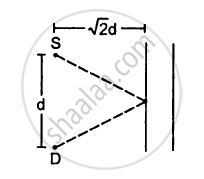
A source S and a detector D are placed at a distance d apart. A big cardboard is placed at a distance \[\sqrt{2}d\] from the source and the detector as shown in figure. The source emits a wave of wavelength = d/2 which is received by the detector after reflection from the cardboard. It is found to be in phase with the direct wave received from the source. By what minimum distance should the cardboard be shifted away so that the reflected wave becomes out of phase with the direct wave?
Advertisements
उत्तर
Given:
Distance between the source and detector = d
Distance of cardboard from the source =\[\sqrt{2d}\]
Wavelength of the source \[\lambda\]= d/2
Path difference between sound waves received by the detector before shifting the cardboard:
\[2\left( \sqrt{\left( \frac{d}{2} \right)^2 + \left( \sqrt{2}d \right)^2} \right) - d\]
\[ \Rightarrow 2 \times \frac{3d}{2} - d\]
\[ \Rightarrow 2d\]
If the cardboard is shifted by a distance x, the path difference will be :
\[2\left( \sqrt{\left( \frac{d}{2} \right)^2 + \left( \sqrt{2d} + x \right)^2} \right) - d\]
According to the question,
\[2\sqrt{\left( \frac{d}{2} \right)^2 + \left( \sqrt{2}d + x \right)^2} - d = 2d + \frac{d}{4}\]
\[ \Rightarrow 2\sqrt{\left( \frac{d}{2} \right)^2 + \left( \sqrt{2}d + x \right)^2} - d = \frac{9d}{4}\]
\[ \Rightarrow 2\sqrt{\left( \frac{d}{2} \right)^2 + \left( \sqrt{2}d + x \right)^2} = \frac{9d}{4} + d = \frac{13d}{4}\]
\[ \Rightarrow \left( \frac{d}{2} \right)^2 + \left( \sqrt{2}d + x \right)^2 = \frac{169}{64} d^2 \]
\[ \Rightarrow \left( \sqrt{2}d + x \right)^2 = \frac{(169 - 16)}{64} d^2 = \frac{153}{64} d^2 \]
\[ \Rightarrow \sqrt{2}d + x = 1 . 54d\]
\[ \Rightarrow x = \left( 1 . 54 - 1 . 41 \right)d = 0 . 13d\]
APPEARS IN
संबंधित प्रश्न
The wavelengths of two sound waves in air are `81/173`m and `81/170`m. They produce 10 beats per second. Calculate the velocity of sound in air
A tuning fork sends sound waves in air. If the temperature of the air increases, which of the following parameters will change?
When sound wave is refracted from air to water, which of the following will remain unchanged?
A source of sound moves towards an observer.
Two point sources of sound are kept at a separation of 10 cm. They vibrate in phase to produce waves of wavelength 5.0 cm. What would be the phase difference between the two waves arriving at a point 20 cm from one source (a) on the line joining the sources and (b) on the perpendicular bisector of the line joining the sources?
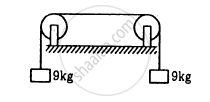
The length of the wire shown in figure between the pulley is 1⋅5 m and its mass is 12⋅0 g. Find the frequency of vibration with which the wire vibrates in two loops leaving the middle point of the wire between the pulleys at rest.
The intensity of sound from a point source is 1.0 × 10⁻⁸ W m−2 at a distance of 5.0 m from the source. What will be the intensity at a distance of 25 m from the source?
The sound level at a point 5.0 m away from a point source is 40 dB. What will be the level at a point 50 m away from the source?
A particular guitar wire is 30⋅0 cm long and vibrates at a frequency of 196 Hz when no finger is placed on it. The next higher notes on the scale are 220 Hz, 247 Hz, 262 Hz and 294 Hz. How far from the end of the string must the finger be placed to play these notes?
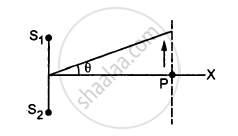
Two speakers S1 and S2, driven by the same amplifier, are placed at y = 1.0 m and y = −1.0 m(See figure). The speakers vibrate in phase at 600 Hz. A man stands at a point on the X-axis at a very large distance from the origin and starts moving parallel to the Y-axis. The speed of sound in air is 330 m s−1. (a) At what angle θ will the intensity of sound drop to a minimum for the first time? (b) At what angle will he hear a maximum of sound intensity for the first time? (c) If he continues to walk along the line, how many more can he hear?
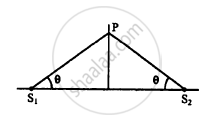
Two sources of sound S1 and S2 vibrate at same frequency and are in phase. The intensity of sound detected at a point P as shown in the figure is I0. (a) If θ equals 45°, what will be the intensity of sound detected at this point if one of the sources is switched off? (b) What will be the answer of the previous part if θ = 60°?
The fundamental frequency of a closed pipe is 293 Hz when the air in it is a temperature of 20°C. What will be its fundamental frequency when the temperature changes to 22°C?
A traffic policeman standing on a road sounds a whistle emitting the main frequency of 2.00 kHz. What could be the apparent frequency heard by a scooter-driver approaching the policeman at a speed of 36.0 km h−1? Speed of sound in air = 340 m s−1.
A small source of sound oscillates in simple harmonic motion with an amplitude of 17 cm. A detector is placed along the line of motion of the source. The source emits a sound of frequency 800 Hz which travels at a speed of 340 m s−1. If the width of the frequency band detected by the detector is 8 Hz, find the time period of the source.
A small source of sound S of frequency 500 Hz is attached to the end of a light string and is whirled in a vertical circle of radius 1.6 m. The string just remains tight when the source is at the highest point. (a) An observer is located in the same vertical plane at a large distance and at the same height as the centre of the circle. The speed of sound in air = 330 m s−1 and g = 10 m s−2. Find the maximum frequency heard by the observer. (b) An observer is situated at a large distance vertically above the centre of the circle. Find the frequency heard by the observer corresponding to the sound emitted by the source when it is at the same height as the centre.
During propagation of a plane progressive mechanical wave ______.
- all the particles are vibrating in the same phase.
- amplitude of all the particles is equal.
- particles of the medium executes S.H.M.
- wave velocity depends upon the nature of the medium.
In an experiment to determine the velocity of sound in air at room temperature using a resonance tube, the first resonance is observed when the air column has a length of 20.0 cm for a tuning fork of frequency 400 Hz is used. The velocity of the sound at room temperature is 336 ms-1. The third resonance is observed when the air column has a length of ______ cm.
A transverse wave is represented by y = 2sin (ωt - kx) cm. The value of wavelength (in cm) for which the wave velocity becomes equal to the maximum particle velocity, will be ______.
A small speaker delivers 2W of audio output. At what distance from the speaker will one detect 120 dB intensity sound?
[Given reference intensity of sound as 10-12W/m2]
