Advertisements
Advertisements
Question
A source of ac voltage v = v0 sin ωt, is connected across a pure inductor of inductance L. Derive the expressions for the instantaneous current in the circuit. Show that average power dissipated in the circuit is zero.
Advertisements
Solution
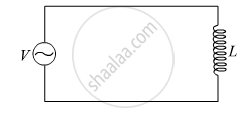
Using Kirchhoff’s loop rule in the above circuit,
\[V - L\frac{dI}{dt} = 0\]
\[\text { where, I is the instantaneous current flowing in the circuit }\]
\[ \Rightarrow L\frac{dI}{dt} = V_o \sin\omega t\]
\[ \Rightarrow \int dI = \frac{V_o}{L}\int\sin\omega tdt\]
\[ \Rightarrow I = \frac{V_o}{L}[ -\frac{\cos\omega t}{\omega}]\]
\[ \Rightarrow I = - \frac{V_o}{\omega L}\cos\omega t\]
\[ \Rightarrow I = \frac{V_o}{X_L}\sin(\omega t - \frac{\pi}{2})\]
\[\text { where, }X_L = \omega L = \text { inductance reactance }\]
\[ \therefore I = I_o \sin(\omega t - \frac{\pi}{2})\]
\[\text { where,} I_o = \frac{V_o}{X_L} =\text { peak value of ac}\]
\[\text { Now instantaneous power supplied by the source is } \]
\[P = VI = V_o I_o \sin\omega t \sin(\omega t - \frac{\pi}{2})\]
\[\text { Now the average power } ( P_{avg} ) \text { supplied over a complete cycle} ( 0 to 2\pi) \text { is }\]
\[ P_{avg} = \int_o^{2\pi} P = \int_o^{2\pi} V_o I_o \sin\theta \sin(\theta - \frac{\pi}{2})d\theta [\text { where } \theta = \omega t]\]
\[\text { Now over a complete cycle } \int_o^{2\pi} \sin\theta\sin(\theta - \frac{\pi}{2})d\theta = 0\]
\[\text { Therefore, }P_{avg} = \int_o^{2\pi} V_o I_o \text { sin }\theta\sin(\theta - \frac{\pi}{2})d\theta = 0\]
\[ P_{avg} = 0\]
Hence, the average power dissipated in the circuit is zero.
APPEARS IN
RELATED QUESTIONS
In a series LCR circuit, obtain the condition under which watt-less current flows in the circuit ?
Show that in an a.c. circuit containing a pure inductor, the voltage is ahead of current by π/2 in phase ?
The potential difference across the resistor is 160V and that across the inductor is 120V. Find the effective value of the applied voltage. If the effective current in the circuit be 1.0 A, calculate the total impedance of the circuit.
What will be the potential difference in the circuit when direct current is passed through the circuit?
Obtain the resonant frequency and Q-factor of a series LCR circuit with L = 3.0 H, C = 27 µF, and R = 7.4 Ω. It is desired to improve the sharpness of the resonance of the circuit by reducing its ‘full width at half maximum’ by a factor of 2. Suggest a suitable way.
In series combination of R, L and C with an A.C. source at resonance, if R = 20 ohm, then impedence Z of the combination is ______.
At resonant frequency the current amplitude in series LCR circuit is ______.
A series LCR circuit contains inductance 5 mH, capacitance 2µF and resistance ion. If a frequency A.C. source is varied, what is the frequency at which maximum power is dissipated?
A series LCR circuit (L = 10 H, C = 10 µF, R = 50 Ω) is connected to V = 200 sin (100t). If ν0 is the resonant frequency and ν is the source frequency, then ______.
