Advertisements
Advertisements
Question
A solid aluminium sphere and a solid copper sphere of twice the radius are heated to the same temperature and are allowed to cool under identically surrounding temperatures. Assume that the emissivity of both the spheres in the same. Find the ratio of (a) the rate of heat loss from the aluminium sphere to the rate of heat loss from the copper sphere and (b) the rate of fall of temperature of the aluminium sphere to the rate of fall of temperature of the copper sphere. The specific heat capacity of aluminium = 900 J kg−1°C−1 and that of copper = 390 J kg−1°C−1. The density of copper = 3.4 times the density of aluminium.
Advertisements
Solution
(a) Rate of loss of heat = eAσT4
`"(Rate of loss of heat)_Al"/"(Rate of loss of heat)" = (e_(Al) sigmaT^4pir^2)/("^eC sigma T^4 4pi (2r)^2 )`
`= 1 : 4 ( as e_Al = e_C)`
(b) Relation between the amount of heat loss by both the spheres in a small time `Delta`t is given by
`DeltaQ_1 = 4xx DeltaQ_2`
`⇒ m_1 s_1 DeltaT_1 = 4m_2s_2 DeltaT_2`
`rArr (DeltaT_1)/(DeltaT_2) = (4xx p_2xx4/3pi(2r)^3 xxs_2)/(p_1xx4/3pir^3xxs_1)`
`⇒ (DeltaT_1)/ (DeltaT_2) = (4xxp2xx4/3pi(2r)^3xxS2)/(p_1xx4/3pir^3 xx s_1) = 47.14 : 1`
APPEARS IN
RELATED QUESTIONS
Explain why an optical pyrometer (for measuring high temperatures) calibrated for an ideal black body radiation gives too low a value for the temperature of a red hot iron piece in the open but gives a correct value for the temperature when the same piece is in the furnace
Why does blowing over a spoonful of hot tea cools it? Does evaporation play a role? Does radiation play a role?
Standing in the sun is more pleasant on a cold winter day than standing in shade. Is the temperature of air in the sun considerably higher than that of the air in shade?
Why is a white dress more comfortable than a dark dress in summer?
A solid at temperature T1 is kept in an evacuated chamber at temperature T2 > T1. The rate of increase of temperature of the body is proportional to
A heated body emits radiation which has maximum intensity near the frequency v0. The emissivity of the material is 0.5. If the absolute temperature of the body is doubled.
(a) the maximum intensity of radiation will be near the frequency 2v0
(b) the maximum intensity of radiation will be near the frequency v0/2
(c) the total energy emitted will increase by a factor of 16
(d) the total energy emitted will increase by a factor of 8
A solid sphere and a hollow sphere of the same material and of equal radii are heated to the same temperature.
(a) Both will emit equal amount of radiation per unit time in the biginning
(b) Both will absorb equal amount of radiation from the surrounding in the biginning.
(c) The initial rate of cooling (dT/dt) will be the same for the two spheres
(d) The two spheres will have equal temperature at any instant
A cylindrical rod of length 50 cm and cross sectional area 1 cm2 is fitted between a large ice chamber at 0°C and an evacuated chamber maintained at 27°C as shown in the figure. Only small portions of the rod are inside the chamber and the rest is thermally insulated from the surrounding. The cross section going into the evacuated chamber is blackened so that it completely absorbs any radiation falling on it. The temperature of the blackened end is 17°C when steady state is reached. Stefan constant σ = 6 × 10⁻⁸ W m−2 K−4. Find the thermal conductivity of the material of the rod.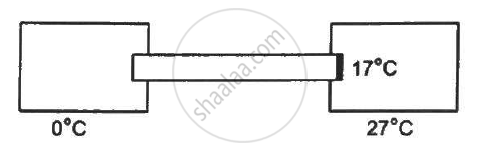
Calculate the amount of heat radiated per second by a body of surface area 12 cm2 kept in thermal equilibrium in a room at temperature 20°C. The emissivity of the surface = 0.80 and σ = 6.0 × 10⁻⁸ W m−2 K−4.
Wein's constant is 2892 × 10-6 SI unit and the value of λm for moon is 14.46 micron. The surface temperature of moon is ______.
A student says, "Heat from the Sun reaches Earth because air carries it across space." Which statement best explains why this is incorrect?
You place your hands near a burning candle and feel warmth on both sides of the flame. What does this observation mainly show?
Which statement best describes thermal radiation from everyday objects like trees, roads, and buildings at night?
Two identical metal tins with water are kept in sunlight. One is black and the other shiny. Why does water in the black tin become hotter?
Why are cooking utensils like pans made of metal but fitted with plastic or wooden handles?
A perfect black body has an emissivity value of ______.
Thermal radiation is described as a two-step process. Which of the following correctly identifies both steps in the correct order?
In the experiment where a test tube of water is heated from the top with ice at the bottom, the ice does not melt. What is the primary reason for this?
