Advertisements
Advertisements
Question
A saturated hydrocarbon has fifty hydrogen atom in its molecule. The number of carbon atoms in its molecule will be
(a) twenty five
(b) twenty four
(c) twenty six
(d) twenty seven
Advertisements
Solution
twenty four
Alkanes are saturated hydrocarbons that have the general formula CnH2n+2. According to the question, the number of hydrogen atoms is 50, i.e., 2n+2=50.
∴ n = 48/2 = 24
APPEARS IN
RELATED QUESTIONS
What type of bonds are present in Cl2 molecule? Draw their electron-dot structures.
Give two general properties of ionic compounds and two those of covalent compounds.
Draw the electron-dot structure of a hydrogen chloride molecule.
Using electron-dot diagrams which show only the outermost shell electrons, show how a molecule of nitrogen, N2, is formed from two nitrogen atoms. What name is given to this type of bonding? (Atomic number of nitrogen is 7)
State one use of diamond which depends on its 'extraordinary brilliance' and one use of graphite which depends on its being 'black and quite soft'.
The pencil leads are made of mainly:
(a) lithium
(b) charcoal
(c) lead
(d) graphite
State the type of bonding in the following molecule.
Water
State the type of bonding in the following molecule.
Hydroxyl ion
Draw an electron dot diagram for the formation of the following. State the type of bonding present in them.
Hydroxyl ion
Explain the following term with example.
Hetero atom in a carbon compound
Write answer as directed.
What causes the existance of very large number of carbon compound ?
Observe the straight chain hydrocarbons given below and answer the following
questions :
i) Which of the straight chain compounds from A and B is saturated and unsaturated straight chains?
ii) Name these straight chains.
iii) Write their chemical formulae and number of – CH2 - units.
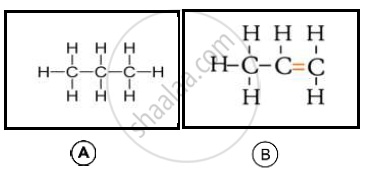
Give examples for the following:
Two gaseous non polar compounds.
Explain the following:
Polar covalent compounds are good conductors of electricity.
Explain the bonding in methane molecule using electron dot structure.
An element L consists of molecules.
What type of bonding is present in the particles that make up L?
Name two compounds that are covalent when taken pure but produce ions when dissolved in water.
In covalent bond formation, the sharing of ______ electrons takes place in their outermost shell.
"Carbon prefers to share its valence electrons with other atoms of carbon or with atoms of other elements rather than gaining or losing the valence electrons in order to attain noble gas configuration." Give reasons to justify this statement.
In covalent compounds, the bond is formed due to ______ of electrons.
