Advertisements
Advertisements
Question
A rectangular loop of size l × b carrying a steady current I is placed in a uniform magnetic field `vecB`. Prove that the torque `vectau`acting on the loop is give by `vectau =vecm xx vecB,`where `vecm` is the magnetic moment of the loop.
Advertisements
Solution
Plane of the loop is at an angle with the direction of the magnetic field,

Let the angle between the field and the normal is θ. The forces on BC and DA are equal and opposite and they cancel each other as they are collinear.
Force on AB is F1 and force on CD is F2, thus
F1 = F2 = IbB
Magnitude of torque on the loop as in the figure:

`because tau =F_1 1/2 sintheta +F_2 1/2 sintheta =IlBsintheta`
or, τ = IAB sin θ (Where area,A = lb)
If there are ‘n’ such turns the torque will be nIAB sinθ
Magnetic moment of the current, m = IA
`vectau=vecm xx vecB`
RELATED QUESTIONS
A rectangular loop of wire of size 4 cm × 10 cm carries a steady current of 2 A. A straight long wire carrying 5 A current is kept near the loop as shown. If the loop and the wire are coplanar, find
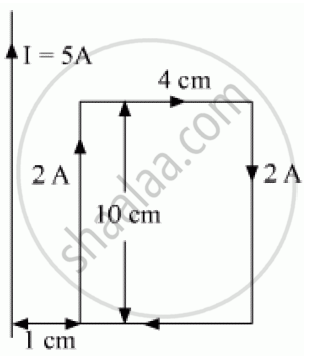
(i) the torque acting on the loop and
(ii) the magnitude and direction of the force on the loop due to the current carrying wire.
A rectangular loop of wire of size 2.5 cm × 4 cm carries a steady current of 1 A. A straight wire carrying 2 A current is kept near the loop as shown. If the loop and the wire are coplanar, find the (i) torque acting on the loop and (ii) the magnitude and direction of the force on the loop due to the current carrying wire.
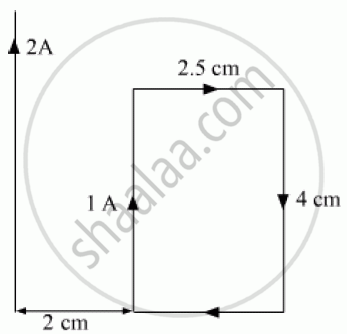
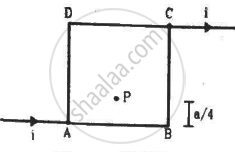
Figure shows a square loop of edge a made of a uniform wire. A current i enters the loop at the point A and leaves it at the point C. Find the magnetic field at the point P which is on the perpendicular bisector of AB at a distance a/4 from it.
A planar loop of rectangular shape is moved within the region of a uniform magnetic field acting perpendicular to its plane. What is the direction and magnitude of the current induced in it?
Consider the motion of a charged particle in a uniform magnetic field directed into the paper. If velocity v of the particle is in the plane of the paper the charged particle will ______.
- Assertion (A): The deflecting torque acting on a current-carrying loop is zero when its plane is perpendicular to the direction of the magnetic field.
- Reason (R): The deflecting torque acting on a loop of the magnetic moment `vecm` in a magnetic field `vecB` is given by the dot product of `vecm` and `vecB`.
A vector quantity that measures the strength and orientation of a current loop as a magnetic source is called the:
The magnetic dipole moment of a coil of N turns, carrying current I and enclosing area A, is:
In a rectangular loop in a uniform magnetic field, the sides BC and AD are perpendicular to \[\vec{B}\]. The magnitude of the force on each of these sides is:
