Advertisements
Advertisements
Question
A prism causes dispersion of white light while a rectangular glass block does not. Explain.
Advertisements
Solution
In a prism, the refraction of light takes place at the two slant surfaces. The dispersion of white light occurs at the first surface of the prism where its constituent colours have deviated through different angles. At the second surface, these split colours suffer the only refraction and they get further separated. But in a rectangular glass block, the refraction of light takes place at the two parallel surfaces. At the first surface, although the white light splits into its constituent colours on refraction, these split colours on suffering refraction at the second surface emerge out in form of a parallel beam, which gives an impression of white light.
RELATED QUESTIONS
Why is the colour red used as a sign of danger?
Name three factors on which the deviation produced by a prism depends and state how does it depend on the factors stated by you.
In following diagram shows a thin beam of white light from a source S striking on one face of a prism.
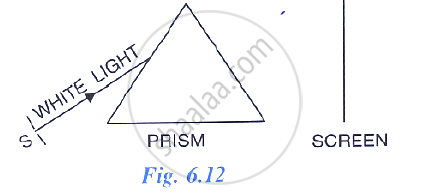
A slit is placed in between the prism and the screen to pass only the light of green colour. What will you then observe on the screen?
In following diagram shows a thin beam of white light from a source S striking on one face of a prism.
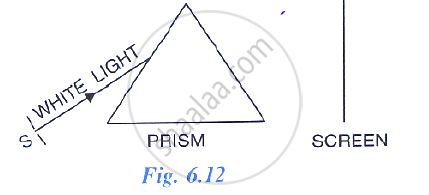
What conclusion do you draw from the observation in part (b) above?
If a monochromatic beam of light undergoes minimum deviation through an equiangular prism, how does the beam pass through the prism, with respect to its base?
Draw another diagram to show how the colours of spectrum of white light can be combined to give the effect of white light.
What is understood by the term dispersion of light? What is its cause?
Explain, why quartz prism is required for obtaining the spectrum of ultra-violet light?
Write the approximate wavelength for red light.
