Advertisements
Advertisements
Question
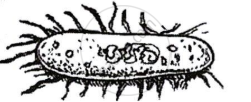
A photograph of a bacteria enlarged 50,000 times attains a length of 5 cm as shown in the diagram. What is the actual length of the bacteria? If the photograph is enlarged 20,000 times only, what would be its enlarged length?
Advertisements
Solution
Let the photograph of the bacteria be magnified 20,000 times, then the magnified length = x, ratio of the both
The given information, in the form of a table, is as follows:
Therefore, we obtain
Then 550000 = `x/(20,000)`
on multiplying thunderbolts
| Length of bacteria (in cm) | 5 | x |
| Bacteria enlarged | 50,000 | 20,000 |
50000 × x = 20000 × 5
`x = (20,000 × 5)/(50,000)`
x = 2
Hence, magnified length of bacteria = 2 cm
APPEARS IN
RELATED QUESTIONS
A loaded truck travels 14 km in 25 minutes. If the speed remains the same, how far can it travel in 5 hours?
Complite the following table given that x varies directly as y .
| x | 3 | 5 | 7 | 9 |
| y | ... | 20 | 28 | ... |
A and B can finish a work in 20 days. A alone can do \[\frac{1}{5}\] th of the work in 12 days. In how many days can B alone do it?
- How far will it travel in 20 minutes?
- Find the time required to cover a distance of 250 km.
A dozen bananas costs ₹ 20. What is the price of 48 bananas?
A truck requires 108 liters of diesel for covering a distance of 594 km. How much diesel will be required to cover a distance of 1650 km?
By travelling at a speed of 48 kilometres per hour, a car can finish a certain journey in 10 hours. To cover the same distance in 8 hours, the speed of the car should be ______.
It is given that l varies directly as m. Find l, when m is 33.
The mass of an aluminum rod varies directly with its length. If a 16 cm long rod has a mass of 192 g, find the length of the rod whose mass is 105 g.
Ms. Anita has to drive from Jhareda to Ganwari. She measures a distance of 3.5 cm between these villages on the map. What is the actual distance between the villages if the map scale is 1 cm = 10 km?
