Advertisements
Advertisements
Question
A particle moves in a closed orbit around the origin, due to a force which is directed towards the origin. The de Broglie wavelength of the particle varies cyclically between two values λ1, λ2 with λ1 > λ2. Which of the following statement are true?
- The particle could be moving in a circular orbit with origin as centre.
- The particle could be moving in an elliptic orbit with origin as its focus.
- When the de Broglie wavelength is λ1, the particle is nearer the origin than when its value is λ2.
- When the de Broglie wavelength is λ2, the particle is nearer the origin than when its value is λ1.
Options
b and d
a and c
b, c and d
a, c and d
Advertisements
Solution
b and d
Explanation:
According to the question, here given that the de-Broglie wavelength of the particle can be varying cyclically between two values λ1 and λ2, it is possible if particle is moving in an elliptical orbit with origin as its one focus.
As shown in the figure given alongside,
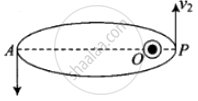
Let v1 and v2 be the speed of particle at A and B respectively and origin is at focus O. If λ1 and λ2 are the de-Broglie wavelengths associated with particle while moving at A and B respectively, then `λ_1 = h/(mv_1)`
And `λ_2 = h/(mv_2)`
∴ `λ_1/λ_2 = v_2/v_1`
Since `λ_1 > λ_2`
∴ `v_2 > v_1`
By the law of conservation of angular momentum, the particle moves faster when it is closer to focus.
From figure, we note that origin O is closed to P than A.
APPEARS IN
RELATED QUESTIONS
Describe the construction of photoelectric cell.
A proton and an α-particle have the same de-Broglie wavelength Determine the ratio of their speeds.
Calculate the de Broglie wavelength of the electrons accelerated through a potential difference of 56 V.
The wavelength of light from the spectral emission line of sodium is 589 nm. Find the kinetic energy at which
(a) an electron, and
(b) a neutron, would have the same de Broglie wavelength.
What is the de Broglie wavelength of a ball of mass 0.060 kg moving at a speed of 1.0 m/s?
What is the de Broglie wavelength of a dust particle of mass 1.0 × 10⁻⁹ kg drifting with a speed of 2.2 m/s?
An electron and a photon each have a wavelength of 1.00 nm. Find
(a) their momenta,
(b) the energy of the photon, and
(c) the kinetic energy of electron.
Crystal diffraction experiments can be performed using X-rays, or electrons accelerated through appropriate voltage. Which probe has greater energy? (For quantitative comparison, take the wavelength of the probe equal to 1 Å, which is of the order of inter-atomic spacing in the lattice) (me = 9.11 × 10⁻³¹ kg).
Obtain the de Broglie wavelength of a neutron of kinetic energy 150 eV. As you have an electron beam of this energy is suitable for crystal diffraction experiments. Would a neutron beam of the same energy be equally suitable? Explain. (mn= 1.675 × 10⁻²⁷ kg)
Obtain the de Broglie wavelength associated with thermal neutrons at room temperature (27°C). Hence explain why a fast neutron beam needs to be thermalised with the environment before it can be used for neutron diffraction experiments.
Compute the typical de Broglie wavelength of an electron in a metal at 27°C and compare it with the mean separation between two electrons in a metal which is given to be about 2 × 10⁻¹⁰ m.
The energy and momentum of an electron are related to the frequency and wavelength of the associated matter wave by the relations:
E = hv, p = `"h"/lambda`
But while the value of λ is physically significant, the value of v (and therefore, the value of the phase speed vλ) has no physical significance. Why?
A electron of mass me revolves around a nucleus of charge +Ze. Show that it behaves like a tiny magnetic dipole. Hence prove that the magnetic moment associated wit it is expressed as `vecμ =−e/(2 m_e)vecL `, where `vec L` is the orbital angular momentum of the electron. Give the significance of negative sign.
An electromagnetic wave of wavelength ‘λ’ is incident on a photosensitive surface of negligible work function. If ‘m’ mass is of photoelectron emitted from the surface has de-Broglie wavelength λd, then ______.
An electromagnetic wave of wavelength ‘λ’ is incident on a photosensitive surface of negligible work function. If ‘m’ mass is of photoelectron emitted from the surface has de-Broglie wavelength λd, then ______
A particle is dropped from a height H. The de Broglie wavelength of the particle as a function of height is proportional to ______.
A particle A with a mass m A is moving with a velocity v and hits a particle B (mass mB) at rest (one dimensional motion). Find the change in the de Broglie wavelength of the particle A. Treat the collision as elastic.
Given below are two statements:
Statement - I: Two photons having equal linear momenta have equal wavelengths.
Statement - II: If the wavelength of photon is decreased, then the momentum and energy of a photon will also decrease.
In the light of the above statements, choose the correct answer from the options given below.
The equation λ = `1.227/"x"` nm can be used to find the de Brogli wavelength of an electron. In this equation x stands for:
Where,
m = mass of electron
P = momentum of electron
K = Kinetic energy of electron
V = Accelerating potential in volts for electron
How will the de-Broglie wavelength associated with an electron be affected when the velocity of the electron decreases? Justify your answer.
