Advertisements
Advertisements
प्रश्न
A particle moves in a closed orbit around the origin, due to a force which is directed towards the origin. The de Broglie wavelength of the particle varies cyclically between two values λ1, λ2 with λ1 > λ2. Which of the following statement are true?
- The particle could be moving in a circular orbit with origin as centre.
- The particle could be moving in an elliptic orbit with origin as its focus.
- When the de Broglie wavelength is λ1, the particle is nearer the origin than when its value is λ2.
- When the de Broglie wavelength is λ2, the particle is nearer the origin than when its value is λ1.
विकल्प
b and d
a and c
b, c and d
a, c and d
Advertisements
उत्तर
b and d
Explanation:
According to the question, here given that the de-Broglie wavelength of the particle can be varying cyclically between two values λ1 and λ2, it is possible if particle is moving in an elliptical orbit with origin as its one focus.
As shown in the figure given alongside,
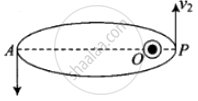
Let v1 and v2 be the speed of particle at A and B respectively and origin is at focus O. If λ1 and λ2 are the de-Broglie wavelengths associated with particle while moving at A and B respectively, then `λ_1 = h/(mv_1)`
And `λ_2 = h/(mv_2)`
∴ `λ_1/λ_2 = v_2/v_1`
Since `λ_1 > λ_2`
∴ `v_2 > v_1`
By the law of conservation of angular momentum, the particle moves faster when it is closer to focus.
From figure, we note that origin O is closed to P than A.
APPEARS IN
संबंधित प्रश्न
What is the
(a) momentum,
(b) speed, and
(c) de Broglie wavelength of an electron with kinetic energy of 120 eV.
An electron and a photon each have a wavelength of 1.00 nm. Find
(a) their momenta,
(b) the energy of the photon, and
(c) the kinetic energy of electron.
Obtain the de Broglie wavelength associated with thermal neutrons at room temperature (27°C). Hence explain why a fast neutron beam needs to be thermalised with the environment before it can be used for neutron diffraction experiments.
Describe briefly how the Davisson-Germer experiment demonstrated the wave nature of electrons.
Sodium and copper have work function 2.3 eV and 4.5 eV respectively. Then, the ratio of the wavelengths is nearest to ______.
Two particles A1 sand A2 of masses m1, m2 (m1 > m2) have the same de Broglie wavelength. Then ______.
- their momenta are the same.
- their energies are the same.
- energy of A1 is less than the energy of A2.
- energy of A1 is more than the energy of A2.
A proton and an α-particle are accelerated, using the same potential difference. How are the de-Broglie wavelengths λp and λa related to each other?
Assuming an electron is confined to a 1 nm wide region, find the uncertainty in momentum using Heisenberg Uncertainty principle (∆x∆p ≃ h). You can assume the uncertainty in position ∆x as 1 nm. Assuming p ≃ ∆p, find the energy of the electron in electron volts.
The De-Broglie wavelength of electron in the third Bohr orbit of hydrogen is ______ × 10-11 m (given radius of first Bohr orbit is 5.3 × 10⁻¹¹ m):
Which of the following graphs correctly represents the variation of a particle momentum with its associated de-Broglie wavelength?
E, c and `v` represent the energy, velocity and frequency of a photon. Which of the following represents its wavelength?
The graph which shows the variation of `(1/lambda^2)` and its kinetic energy, E is (where λ is de Broglie wavelength of a free particle):
Which phenomena support the wave model of light?
Which phenomena support the particle model of light?
Which relation gives the de Broglie wavelength of a particle with momentum \[p\]?
Which relation gives the de Broglie wavelength of a particle of mass \[m\] moving with speed \[v\]?
Why did de Broglie propose an associated wavelength for a moving particle?
