Advertisements
Advertisements
प्रश्न
A particle moves in a closed orbit around the origin, due to a force which is directed towards the origin. The de Broglie wavelength of the particle varies cyclically between two values λ1, λ2 with λ1 > λ2. Which of the following statement are true?
- The particle could be moving in a circular orbit with origin as centre.
- The particle could be moving in an elliptic orbit with origin as its focus.
- When the de Broglie wavelength is λ1, the particle is nearer the origin than when its value is λ2.
- When the de Broglie wavelength is λ2, the particle is nearer the origin than when its value is λ1.
पर्याय
b and d
a and c
b, c and d
a, c and d
Advertisements
उत्तर
b and d
Explanation:
According to the question, here given that the de-Broglie wavelength of the particle can be varying cyclically between two values λ1 and λ2, it is possible if particle is moving in an elliptical orbit with origin as its one focus.
As shown in the figure given alongside,
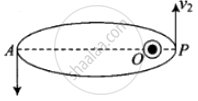
Let v1 and v2 be the speed of particle at A and B respectively and origin is at focus O. If λ1 and λ2 are the de-Broglie wavelengths associated with particle while moving at A and B respectively, then `λ_1 = h/(mv_1)`
And `λ_2 = h/(mv_2)`
∴ `λ_1/λ_2 = v_2/v_1`
Since `λ_1 > λ_2`
∴ `v_2 > v_1`
By the law of conservation of angular momentum, the particle moves faster when it is closer to focus.
From figure, we note that origin O is closed to P than A.
APPEARS IN
संबंधित प्रश्न
Calculate the de Broglie wavelength of the electrons accelerated through a potential difference of 56 V.
An electron and a photon each have a wavelength of 1.00 nm. Find
(a) their momenta,
(b) the energy of the photon, and
(c) the kinetic energy of electron.
Show that the wavelength of electromagnetic radiation is equal to the de Broglie wavelength of its quantum (photon).
What is the de Broglie wavelength of a nitrogen molecule in air at 300 K? Assume that the molecule is moving with the root-mean square speed of molecules at this temperature. (Atomic mass of nitrogen = 14.0076 u)
Crystal diffraction experiments can be performed using X-rays, or electrons accelerated through appropriate voltage. Which probe has greater energy? (For quantitative comparison, take the wavelength of the probe equal to 1 Å, which is of the order of inter-atomic spacing in the lattice) (me = 9.11 × 10⁻³¹ kg).
Describe briefly how the Davisson-Germer experiment demonstrated the wave nature of electrons.
Sodium and copper have work function 2.3 eV and 4.5 eV respectively. Then, the ratio of the wavelengths is nearest to ______.
A particle is dropped from a height H. The de Broglie wavelength of the particle as a function of height is proportional to ______.
The de Broglie wavelength of a photon is twice the de Broglie wavelength of an electron. The speed of the electron is `v_e = c/100`. Then ______.
- `E_e/E_p = 10^-4`
- `E_e/E_p = 10^-2`
- `p_e/(m_ec) = 10^-2`
- `p_e/(m_ec) = 10^-4`
An electron is accelerated from rest through a potential difference of 100 V. Find:
- the wavelength associated with
- the momentum and
- the velocity required by the electron.
The equation λ = `1.227/"x"` nm can be used to find the de Brogli wavelength of an electron. In this equation x stands for:
Where,
m = mass of electron
P = momentum of electron
K = Kinetic energy of electron
V = Accelerating potential in volts for electron
The ratio of wavelengths of proton and deuteron accelerated by potential Vp and Vd is 1 : `sqrt2`. Then, the ratio of Vp to Vd will be ______.
An electron of mass me, and a proton of mass mp = 1836 me are moving with the same speed. The ratio of the de Broglie wavelength `lambda_"electron"/lambda_"proton"` will be:
For which of the following particles will it be most difficult to experimentally verify the de-Broglie relationship?
Matter waves are ______.
Which phenomena support the particle model of light?
What are matter waves?
In the de Broglie relation, what does \[p\] represent?
Which moving matter particles have associated matter waves?
