Advertisements
Advertisements
Question
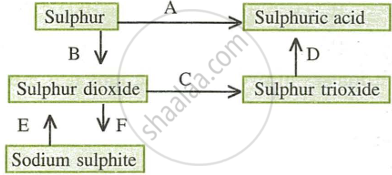
- Name the catalyst which helps in the conversion of sulphur dioxide to sulphur trioxide in step C.
- In the contact process for the manufacture of sulphuric acid, sulphur trioxide is not converted to sulphuric acid by reacting it with water. Instead a two-step procedure is used. Write the equations for the two steps involved in D.
- What type of substance will liberate sulphur dioxide from sodium sulphite in step E?
- Write the equation for the reaction by which sulphur dioxide is converted to sodium sulphite in step F.
Advertisements
Solution
- Platinum or Vanadium pentoxide
- \[\ce{SO3 + H2SO4 -> H2S2O7}\]
- \[\ce{H2S2O7 + H2O -> 2H2SO4}\]
- The substance that will liberate sulphur dioxide in step E is dilute sulphuric acid (H2SO4).
- \[\ce{SO2 + 2NaOH -> Na2SO3 + H2O}\]
- \[\ce{Na2O + SO2 -> Na2SO3}\]
RELATED QUESTIONS
Write a balanced chemical equation for the following:
Action of concentrated sulphuric acid on Sulphur.
State one relevant observation for given reactions:
Action of concentrated Sulphuric acid on hydrated copper sulfate
Name the products formed when hot and concentrated sulphuric acid reacts with Sugar.
Give reason for the following:
When concentrated sulphuric acid is exposed to air, its volume increases and it becomes slightly dilute.
Sulphuric acid can be used to prepare a number of gases in the laboratory. Write balanced equation for the reaction from which the folllowing gas are obtained, using dilute sulphuric acid as one of the reactant : Hydrogen
Copy and complete the following table.
Column 3 has the names of gases to be prepared using the substance you enter in column 1, along with dilute or concentrated sulphuric acid, as indicated in column 2.
| Column 1 | Column 2 | Column 3 |
| Substance reacted with acid | Dilute or concentrated sulphuric acid | Gas |
| Hydrogen | ||
| Carbon dioxide | ||
| Only chlorine |
Write the equation for the laboratory preparation of :
(i) Sodium sulphate using dilute sulphuric acid.
(ii) Lead sulphate using dilute sulphuric acid.
Write the equation for the laboratory preparation of the following salts, using sulphuric acid.
Sodium Sulphate from sodium carbonate.
Write balanced chemical equation to show :
The behavior of H2SO4 as an acid when it reacts with magnesium.
State your observation of the following case:
When dilute hydrochloric acid is added to sodium carbonate crystals.
Give a chemical test to distinguish between dilute sulphuric acid and dilute hydrochloric acid (using lead nitrate solution).
