Advertisements
Advertisements
प्रश्न
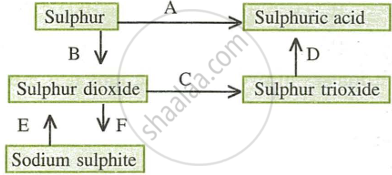
- Name the catalyst which helps in the conversion of sulphur dioxide to sulphur trioxide in step C.
- In the contact process for the manufacture of sulphuric acid, sulphur trioxide is not converted to sulphuric acid by reacting it with water. Instead a two-step procedure is used. Write the equations for the two steps involved in D.
- What type of substance will liberate sulphur dioxide from sodium sulphite in step E?
- Write the equation for the reaction by which sulphur dioxide is converted to sodium sulphite in step F.
Advertisements
उत्तर
- Platinum or Vanadium pentoxide
- \[\ce{SO3 + H2SO4 -> H2S2O7}\]
- \[\ce{H2S2O7 + H2O -> 2H2SO4}\]
- The substance that will liberate sulphur dioxide in step E is dilute sulphuric acid (H2SO4).
- \[\ce{SO2 + 2NaOH -> Na2SO3 + H2O}\]
- \[\ce{Na2O + SO2 -> Na2SO3}\]
संबंधित प्रश्न
Give balanced chemical equations for the action of sulphuric acid on the following:
Potassium hydrogen carbonate.
Give two balanced reactions of the type to show the following property of sulphuric acid:
Non-volatile nature
Name the products formed when hot and concentrated sulphuric acid reacts with Copper.
Name the following:
Products obtained by treating zinc with dilute sulphuric acid.
Give reason for the following:
Concentrated sulphuric acid should not be added to oxalic acid or formic acid in the open laboratory.
Describe the reaction that show
Concentrated sulphuric acid is a non-volatile acid.
Describe the reaction that show
Concentrated sulphuric acid is a dehydrating agent.
In the given equation identify the role played by concentrated sulphuric acid S + 2H2SO4→ 3SO2 + 2H2O
Give one equation to show the following property of sulphuric acid:
As a non-volatile acid
Write balanced chemical equation to show :
The dehydrating property of conc. sulphuric acid
