Advertisements
Advertisements
प्रश्न
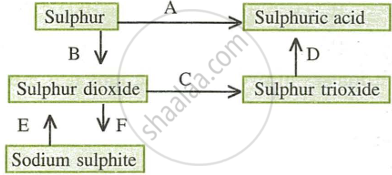
- Name the catalyst which helps in the conversion of sulphur dioxide to sulphur trioxide in step C.
- In the contact process for the manufacture of sulphuric acid, sulphur trioxide is not converted to sulphuric acid by reacting it with water. Instead a two-step procedure is used. Write the equations for the two steps involved in D.
- What type of substance will liberate sulphur dioxide from sodium sulphite in step E?
- Write the equation for the reaction by which sulphur dioxide is converted to sodium sulphite in step F.
Advertisements
उत्तर
- Platinum or Vanadium pentoxide
- \[\ce{SO3 + H2SO4 -> H2S2O7}\]
- \[\ce{H2S2O7 + H2O -> 2H2SO4}\]
- The substance that will liberate sulphur dioxide in step E is dilute sulphuric acid (H2SO4).
- \[\ce{SO2 + 2NaOH -> Na2SO3 + H2O}\]
- \[\ce{Na2O + SO2 -> Na2SO3}\]
संबंधित प्रश्न
In the contact process for the manufacture of sulphuric acid give the equations for the conversion of sulphur trioxide to sulphuric acid.
Name the following:
Gases obtained by treating carbon with hot concentrated sulphuric acid.
Give reason for the following:
When concentrated sulphuric acid is added to blue crystalline copper sulphate, it turns powdery white.
Give reason for the following:
Concentrated sulphuric acid is kept in airtight bottles.
What do you see when concentrated sulphuric acid is added to copper sulphate-5-water ( You are not required to say what is happing, nor is it necessary to name the products.)
Name the gas evolved in following case:
The gas produced by the action of concentrated sulphuric acid on sodium chloride.
State your observation for the following case:
Paper soaked in potassium permanganate solution is introduced into a gas jar of sulphur dioxide.
Give one equation to show the following property of sulphuric acid:
Dehydrating property
Identify the salts P and Q from the observation given below:
On performing the flame test salt P produces a lilac coloured flame and its solution gives a white precipitate with silver nitrate solution. Which is soluble in ammonium hydroxide solution.
Give two balanced reactions of the type to show the following property of sulphuric acid:
Dehydrating nature
