Advertisements
Advertisements
Question
A metal ball of mass 2 kg is allowed to fall freely from rest from a height of 5 m above the ground. Taking g = 10 m s−2, calculate:
- the potential energy possessed by the ball when it is initially at rest.
- the kinetic energy of the ball just before it hits the ground?
Advertisements
Solution
Mass of the ball m = 2 kg, g = 10 ms−2, h = 5 m
(i) Potential Energy possessed by the ball = mgh
= 2 × 10 × 5
= 100 J
(ii) K.E of ball = potential Energy = 100 J
or v2 = 2gh
v2 = 2 × 10 × 5
= 100 J
∴ K.E = `1/2 mv^2`
= `1/2 xx 2 xx 100`
= 100 J
APPEARS IN
RELATED QUESTIONS
A body falls freely under gravity from rest. Name the kind of energy it will possess while falling.
What type of energy is possessed : by the piece of stone which is thrown away on releasing the stretched rubber strings of catapult?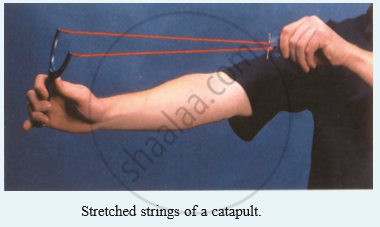
Define the term 'energy' of a body. What is the SI unit of energy.
Water stored in a dam possesses :
A stone is thrown upwards as shown in the diagram. When it reaches P, which of the following has the greatest value of the stone?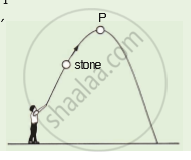
Name the device or machine which convert :
Mechanical energy into electrical energy.
Fill in the blanks with suitable words:
When a ball is thrown upwards, ___________ energy is transformed into ___________ energy.
What kind of energy transformations take place at a coal-based thermal power station?
Explain the transformation of energy in the following cases :
(i) A ball thrown upwards.
(ii) A stone dropped from the roof of a building.
A ball falls to the ground as shown below :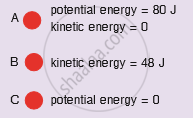
Which law you have made use of in answering this question?
