Advertisements
Advertisements
Question
A mechanical wave propagates in a medium along the X-axis. The particles of the medium
(a) must move on the X-axis
(b) must move on the Y-axis
(c) may move on the X-axis
(d) may move on the Y-axis.
Advertisements
Solution
(c) may move on the X-axis
(d) may move on the Y-axis
A mechanical wave is of two types: longitudinal and transverse. So, a particle of a mechanical wave may move perpendicular or along the direction of motion of the wave.
APPEARS IN
RELATED QUESTIONS
When longitudinal wave is incident at the boundary of denser medium, then............................
- compression reflects as a compression.
- compression reflects as a rarefaction.
- rarefaction reflects as a compression.
- longitudinal wave reflects as transverse wave.
Given below are some functions of x and t to represent the displacement (transverse or longitudinal) of an elastic wave. State which of these represent (i) a traveling wave, (ii) a stationary wave or (iii) none at all:
y = cos x sin t + cos 2x sin 2t
Explain why (or how) Solids can support both longitudinal and transverse waves, but only longitudinal waves can propagate in gases
You are walking along a seashore and a mild wind is blowing. Is the motion of air a wave motion?
Longitudinal waves cannot
A wave going in a solid
(a) must be longitudinal
(b) may be longitudinal
(c) must be transverse
(d) may be transverse.
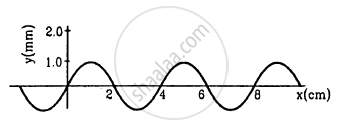
Figure shows a plot of the transverse displacements of the particles of a string at t = 0 through which a travelling wave is passing in the positive x-direction. The wave speed is 20 cm s−1. Find (a) the amplitude, (b) the wavelength, (c) the wave number and (d) the frequency of the wave.
A vertical rod is hit at one end. What kind of wave propagates in the rod if (a) the hit is made vertically (b) the hit is made horizontally?
Two wires of different densities but same area of cross section are soldered together at one end and are stretched to a tension T. The velocity of a transverse wave in the first wire is double of that in the second wire. Find the ratio of the density of the first wire to that of the second wire.
Consider the following statements about sound passing through a gas.
(A) The pressure of the gas at a point oscillates in time.
(B) The position of a small layer of the gas oscillates in time.
A transverse wave described by \[y = \left( 0 \cdot 02 m \right) \sin \left( 1 \cdot 0 m^{- 1} \right) x + \left( 30 s^{- 1} \right)t\] propagates on a stretched string having a linear mass density of \[1 \cdot 2 \times {10}^{- 4} kg m^{- 1}\] the tension in the string.
An organ pipe, open at both ends, contains
A transverse wave of amplitude 0⋅50 mm and frequency 100 Hz is produced on a wire stretched to a tension of 100 N. If the wave speed is 100 m s−1, what average power is the source transmitting to the wire?
The equation of a standing wave, produced on a string fixed at both ends, is
\[y = \left( 0 \cdot 4 cm \right) \sin \left[ \left( 0 \cdot 314 {cm}^{- 1} \right) x \right] \cos \left[ \left( 600\pi s^{- 1} \right) t \right]\]
What could be the smallest length of the string?
Given below are some functions of x and t to represent the displacement (transverse or longitudinal) of an elastic wave. State which of these represent (i) a traveling wave, (ii) a stationary wave or (iii) none at all:
y = 2 cos (3x) sin (10t)
Given below are some functions of x and t to represent the displacement (transverse or longitudinal) of an elastic wave. State which of these represent (i) a traveling wave, (ii) a stationary wave or (iii) none at all:
y = 3 sin (5x – 0.5t) + 4 cos (5x – 0.5t)
