Advertisements
Advertisements
Question
A mass of 10 kg is at a point A on a table. It is moved to a point B. If the line joining A and B is horizontal, what is the work done on the object by the gravitational force? Explain your answer.
Advertisements
Solution
- The mass of 10 kg is transported horizontally from point A to B. Gravity acts vertically downward. Thus, the mass moves at a right angle to the force of gravity. So,
- Work done on the item by the force of gravity = Fs cosθ = Fs cos90° = 0 (∵ cos 90 = 0).
- Therefore, the gravitational pull on the object does not work.
RELATED QUESTIONS
Gravitational potential energy U = mass × force of gravity on unit mass × ..........
A body of mass m is moved from ground to a height h. If the force of gravity on mass of 1 kg is g newton, find the force needed to lift the body.
Define the term potential energy of a body.
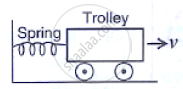
A spring is kept compressed by a small trolley of mass 0.5 kg lying on a smooth horizontal surface as shown in the adjacent fig. When the trolley is released, it is found to move at a speed v = 2 m s-1. What potential energy did the spring possess when compressed?
A boy weighing 50 kg climbs up a vertical height of 100 m. Calculate the amount of work done by him. How much potential energy does he gain? (g = 9.8 m/s2)
What is the difference between gravitational potential energy and elastic potential energy? Give one example of a body having gravitational potential energy and another having elastic potential energy.
If 784 J of work was done in lifting a 20 kg mass, calculate the height through which it was lifted. (g = 9.8 m/s2)
When a ball is thrown vertically upwards, its velocity goes on decreasing. What happens to its potential energy as its velocity becomes zero?
A body is falling from a height of h. After it has fallen a height `"h"/2`, it will possess
The potential energy is
