Advertisements
Advertisements
Question
A glass contains some water at room temperature 20°C. Refrigerated water is added to it slowly. when the temperature of the glass reaches 10°C, small droplets condense on the outer surface. Calculate the relative humidity in the room. The boiling point of water at a pressure of 17.5 mm of mercury is 20°C and at 8.9 mm of mercury it is 10°C.
Advertisements
Solution
Here ,
Dew point = `10^circ` C [∵ Dew appears at `10^circ`C]
At boiling point, SVP equals atmospheric pressure.
At `20^circ` C , SVP = 17.5 mmHg
At dew point , SVP = 8.9 mmHg
`"RH" = ("SVP at dew point") /("SVP at air temperature") xx 100%`
= `8.9/17.5 xx 100%`
= 51%
APPEARS IN
RELATED QUESTIONS
Consider a gas of neutrons. Do you expect it to behave much better as an ideal gas as compared to hydrogen gas at the same pressure and temperature?
Which of the following parameters is the same for molecules of all gases at a given temperature?
The mean square speed of the molecules of a gas at absolute temperature T is proportional to
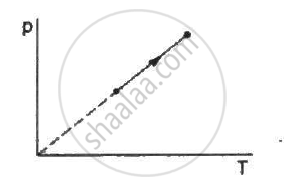
The process on an ideal gas, shown in figure, is
Find the number of molecules of an ideal gas in a volume of 1.000 cm3 at STP.
The average translational kinetic energy of air molecules is 0.040 eV (1 eV = 1.6 × 10⁻¹⁹J). Calculate the temperature of the air. Boltzmann constant k = 1.38 × 10⁻²³ J K−1.
Air is pumped into the tubes of a cycle rickshaw at a pressure of 2 atm. The volume of each tube at this pressure is 0.002 m3. One of the tubes gets punctured and the volume of the tube reduces to 0.0005 m3. How many moles of air have leaked out? Assume that the temperature remains constant at 300 K and that the air behaves as an ideal gas.
Use R = 8.3 J K-1 mol-1
The weather report reads, "Temperature 20°C : Relative humidity 100%". What is the dew point?
If a = 0.72 and r = 0.24, then the value of tr is ______.
Answer in brief:
A gas in a cylinder is at pressure P. If the masses of all the molecules are made one-third of their original value and their speeds are doubled, then find the resultant pressure.
If the density of oxygen is 1.44 kg/m3 at a pressure of 105 N/m2, find the root mean square velocity of oxygen molecules.
When a gas is heated, its temperature increases. Explain this phenomenon on the basis of the kinetic theory of gases.
Two vessels A and B are filled with the same gas where the volume, temperature, and pressure in vessel A is twice the volume, temperature, and pressure in vessel B. Calculate the ratio of the number of molecules of the gas in vessel A to that in vessel B.
The number of degrees of freedom, for the vibrational motion of a polyatomic molecule, depends on the ______
Why the temperature of all bodies remains constant at room temperature?
Average kinetic energy of H2 molecule at 300K is 'E'. At the same temperature, average kinetic energy of O2 molecule will be ______.
Assuming the expression for the pressure exerted by the gas on the wall of the container, it can be shown that pressure is ______.
An ideal gas in a container of volume 500 cc is at a pressure of 2 × 10⁵ N/m2. The average kinetic energy of each molecule is 6 × 10⁻²¹ J. The number of gas molecules in the container is ______.
Volume versus temperature graphs for a given mass of an ideal gas are shown in figure at two different values of constant pressure. What can be inferred about relation between P1 and P2?

Two molecules of a gas have speeds of 9 × 10 6 ms−1 and 1 × 10⁶ ms−1, respectively. What is the root mean square speed of these molecules?
