Advertisements
Advertisements
Question
A car is running at a speed of 15 km h-1 while another similar car is moving at a speed of 45 km h-1. Find the ratio of their kinetic energies.
Advertisements
Solution
Given, velocity of first car, v1 = 15 km/h
And velocity of second car, v2 = 45 km/h
Since masses are same, kinetic energy is directly proportional to the square of the velocity (Kav2)
Hence, ratio of their kinetic energies is:
`therefore k_1/k_2 = v_1^2/v_2^2`
`therefore k_1/k_2 =15^2/45^2`
`therefore k_1/k_2 = (cancel(15)^1 xx cancel(15)^1)/(cancel(45)_3 xx cancel(45)_3)`
`therefore k_1/k_2 = 1/(3 xx 3)`
`therefore k_1/k_2 = 1/9`
∴ k1 / k2 = 1 : 9
APPEARS IN
RELATED QUESTIONS
Work is said to be done by a forte only when ................
How much work is done when a body of mass m is raised to a height h above the ground?
Fill in the blank with suitable word :
Work is measured as a product of __________ and __________
A person of mass 50 kg climbs a tower of height 72 metres. Calculate the work done. (g = 9.8 m s−2).
A uniform circular motion is an accelerated motion. Justify it.
On what factors does the work done by a force depend?
Name the physical quantity whose MKS units are kgm2s-3.
A truck driver can load oil drums into the back of the truck by pushing them up a sloping plank, or by lifting them directly. Each drum has a mass of 80 kg, the plank is 3 m long, and the back of the truck is 0.8 m above the ground.
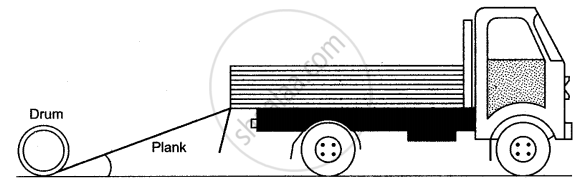
(i) How much force would be needed to lift a drum into the truck directly/without using the plank? (Take g = 10 m/s2)
(ii) How much energy would be required in lifting the drum into the truck without the plank?
(iii) If the force needed to push the drum up the plank is 300 N, why is this less than the answer to part (i)?
(iv) When the truck is loaded, the driver drives off. List the major energy changes that take place in moving the truck.
(v) The driver has to stop at the factory gates. What happens to the kinetic energy of the truck?
A coolie is pushing a box weighing 1500 N up an inclined plane 7.5 m long on to a platform, 2.5 m above the ground.
(i) Calculate the mechanical advantage of the inclined plane. (ii) Calculate the effort applied by the coolie.
(iii) In actual practice, the coolie needs to apply more effort than what is calculated. Give one reason why you think the coolie needs to apply more effort.
