Advertisements
Advertisements
Question
Define Translational motion.
Advertisements
Solution
When a force acts on a rigid body which is free to move, the body starts moving in a straight line in the direction of the force. This is called translational motion.
RELATED QUESTIONS
A coolie is moving on a road with a luggage on his head. Does he perform work against the force of gravity? Give reason for your answer.
1 J = ______ calorie.
Fill in the blank with suitable word :
The work done on a body moving in a circular path is __________
A force of 50 N acts on a body and moves it a distance of 4 m on horizontal surface. Calculate the work done if the direction of force is at an angle of 60° to the horizontal surface.
What is the ratio of SI units to CGS units of 'work'?
Give two examples of work done.
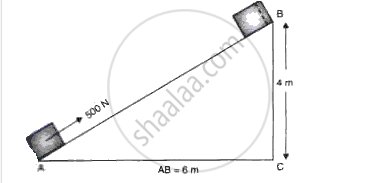
A block of mass 20 kg is pulled up a slope (fig.12) with a constant speed by applying a force of 500 N parallel to the slope. A and B are initial and final positions of the block.
(a) Calculate the work done by the force in moving the block from A and B.
(b) Calculate the potential energy gained by the block.
How much energy is gained by a box of mass 20 kg when a man, runs carrying the box with a speed of 3 m/s-1 to catch the bus?
Look at the activity below. Reason out whether or not work is done in the light of your understanding of the term ‘work’.
Suma is swimming in a pond.
