Advertisements
Advertisements
Question
A ball weighing 4 kg of density 4000 kg m–3 is completely immersed in water of density 103 kg m–3 Find the force of buoyancy on it. (Given g = 10 m s–2)
Advertisements
Solution
Here, Mass of the ball, m = 4 kg Density of ball, ρ = 4000 kg m–3 Density of water σ = 103 kg m–3
∴ Volume of ball = `"m"/"ρ" = (4"kg")/(4000 "kg m" ^-3)`
= 10–3 m3
So force to buoyney on the ball
= V σ g = 10–3 × 103 × 10
= 10 N
APPEARS IN
RELATED QUESTIONS
What is the density of a substance of mass 100 g and volume 10 cm3 ?
What is the difference between the density and relative density of a substance ?
A piece of steel has a volume of 12 cm3, and a mass of 96 g. What is its density in g/cm3 ?
When a golf ball is lowered into a measuring cylinder containing water, the water level rises by 30 cm3 when the ball is completely submerged. If the mass of ball in air is 33 g, find its density.
An object is put in three liquids having different densities, one by one. The object floats with `1/9` , `2/11` and `3/7` parts of its volume outside the surface of liquids of densities d1, d2 and d3 respectively. Which of the following is the correct order of the densities of the three liquids?
A solid of density 900 kg/m3 floats in oil as shown in the given diagram. The oil floats on water of density 1000 kg/m3 as shown. The density of oil kg/m3 could be :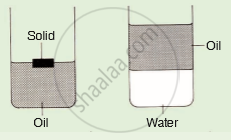
A cube of side 5 cm is immersed in water and then in a saturated salt solution. In which case will it experience a greater buoyant force. If each side of the cube is reduced to 4 cm and then immersed in water, what will be the effect on the buoyant force experienced by the cube as compared to the first case for water. Give a reason for each case.
To find out the relative density of the substance, with respect to the density of water ______C is taken.
The density Bottle is also called ______.
Describe the construction and working of the Pycnometer.
