Advertisements
Advertisements
प्रश्न
A ball weighing 4 kg of density 4000 kg m–3 is completely immersed in water of density 103 kg m–3 Find the force of buoyancy on it. (Given g = 10 m s–2)
Advertisements
उत्तर
Here, Mass of the ball, m = 4 kg Density of ball, ρ = 4000 kg m–3 Density of water σ = 103 kg m–3
∴ Volume of ball = `"m"/"ρ" = (4"kg")/(4000 "kg m" ^-3)`
= 10–3 m3
So force to buoyney on the ball
= V σ g = 10–3 × 103 × 10
= 10 N
APPEARS IN
संबंधित प्रश्न
5 kg of material A occupy 20 cm3 whereas 20 kg of materia! B occupy 90 cm3. Which has the greater density : A or B ? Support your answer with calculations.
Define density. What is the SI unit of density ?
Define relative density. What is the SI unit of relative density ?
A piece of steel has a volume of 12 cm3, and a mass of 96 g. What is its density in g/cm3 ?
A body floats in kerosene of density 0.8 x 10³ kg/m3 up to a certain mark. If the same body is placed in water of density 1.0 x 10³ kg/m3, will it sink more or less ? Give reason for your answer.
An object is put in three liquids having different densities, one by one. The object floats with `1/9` , `2/11` and `3/7` parts of its volume outside the surface of liquids of densities d1, d2 and d3 respectively. Which of the following is the correct order of the densities of the three liquids?
The diagrams represent four measuring cylinders containing liquids. The mass and volume of the liquid in each cylinder are stated. Which two measuring cylinder could contain an identical liquid?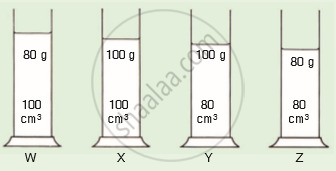
Why is it easier to swim in seawater than in river water?
Calculate the average density of the earth in terms of g, G and R
The density Bottle is also called ______.
