Advertisements
Advertisements
प्रश्न
A body floats in kerosene of density 0.8 x 10³ kg/m3 up to a certain mark. If the same body is placed in water of density 1.0 x 10³ kg/m3, will it sink more or less ? Give reason for your answer.
Advertisements
उत्तर
The body will sink less in water because the density of water (1,000 kg/m3) is more than the density of kerosene (800 kg/m3).
APPEARS IN
संबंधित प्रश्न
What is the difference between the density and relative density of a substance ?
Write down an equation that defines density.
A piece of steel has a volume of 12 cm3, and a mass of 96 g. What is its density in kg/m3 ?
The density of water is 1000 kg/m3 and the density of copper is 8900 kg/m3. Which of the following statements is incorrect?
The diagrams represent four measuring cylinders containing liquids. The mass and volume of the liquid in each cylinder are stated. Which two measuring cylinder could contain an identical liquid?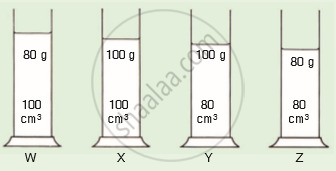
Why is it easier to swim in seawater than in river water?
Numerical Problem.
Density of mercury is 13600 kg m–3. Calculate the relative density.
Calculate the average density of the earth in terms of g, G and R
A cube of side 5 cm is immersed in water and then in a saturated salt solution. In which case will it experience a greater buoyant force. If each side of the cube is reduced to 4 cm and then immersed in water, what will be the effect on the buoyant force experienced by the cube as compared to the first case for water. Give a reason for each case.
The density Bottle is also called ______.
