Advertisements
Advertisements
प्रश्न
A piece of steel has a volume of 12 cm3, and a mass of 96 g. What is its density in kg/m3 ?
Advertisements
उत्तर
We know that 1 g/cm3 = 1,000 kg/m3
So, 8 g/cm3 = 8 × 1,000 kg/m3
= 8,000 kg/m3
Ans: Density of steel piece = 8,000 kg/m3.
APPEARS IN
संबंधित प्रश्न
The density of gold is 19 g/cm3. Find the volume of 95 g of gold.
What is the mass of 5 m3 of cement of density 3000 kg/m3 ?
If the relative density of a substance is 7.1, what will be its density in SI units ?
5 kg of material A occupy 20 cm3 whereas 20 kg of materia! B occupy 90 cm3. Which has the greater density : A or B ? Support your answer with calculations.
Define relative density. What is the SI unit of relative density ?
The relative densities of four liquids P, Q, R and S are 1.26, 1.0, 0.84 and 13.6 respectively. An object is floated in all these liquids, one by one. In which liquid the object will float with its maximum volume submerged under the liquid?
The diagrams represent four measuring cylinders containing liquids. The mass and volume of the liquid in each cylinder are stated. Which two measuring cylinder could contain an identical liquid?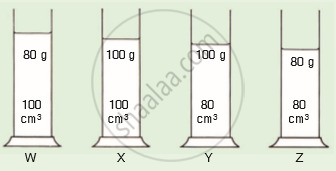
Numerical Problem.
Density of mercury is 13600 kg m–3. Calculate the relative density.
A ball weighing 4 kg of density 4000 kg m–3 is completely immersed in water of density 103 kg m–3 Find the force of buoyancy on it. (Given g = 10 m s–2)
The density Bottle is also called ______.
