Advertisements
Advertisements
Question
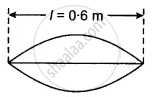
A 0.6 m long stretched wire is made to vibrate in two different modes as shown in figure
(a)
(b)
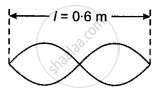
(i) If the frequency of the note produced in (b) is n, what is the frequency in case (a)?
(ii) In which case (a) or (b), is the note louder? Give reasons.
(iii) In which case is the pitch higher? Give reason.
Advertisements
Solution
(i) The frequency of the note represented by (n) is 2 times represented by (a). Since the frequency of the note in (b) is n, hence the frequency of a note in (i) is 1/2 or n/2.
(ii) The note in (a) is louder, the reason being its amplitude is greater than the amplitude of note represented in (b), as the loudness being directly proportional to amplitude.
(iii) Pitch is directly proportional to the frequency of the sound notes. The frequency of a note in figure (b) is more (double) than the frequency of a note in (a). So the pitch of the note (b) is higher than that of note (a).
RELATED QUESTIONS
A pendulum oscillates 40 times in 4 seconds. Find its time period and frequency.
An enemy plane is at a distance of 300 km from a radar. In how much time the radar will be able to detect the plane? Take velocity of radio waves as 3 × 10⁸ ms−1.
What is an echo
A person standing between two vertical cliffs and 480 m from the nearest cliff shouts. He hears the first echo after 3s and the second echo 2s later. Calculate:
- The speed of sound.
- The distance of the other cliff from the person
Decibel is the unit of pitch of a sound.
Match the following
| column A | column B |
| (A) Amplitude | (1) frequency |
| (B) Frequency | (2) amplitude |
| (C) Loudness | (3)maximum displacement on either side |
| (D) Pitch | (4) presence of other frequencies |
| (E) Waveform | (5) 1/ time period |
Two waves of the same pitch have amplitudes in the ratio 1 : 3 What will be the ratio of their
- loudness,
- pitch?
- Which of the following quality determines the loudness of a sound wave?
- wavelength
- frequency and
- amplitude
- How is loudness related to the quantity mentioned above in part (a)?
What is the noise? Give an example.
