Advertisements
Advertisements
प्रश्न
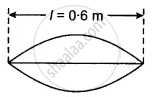
A 0.6 m long stretched wire is made to vibrate in two different modes as shown in figure
(a)
(b)
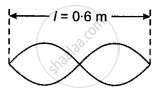
(i) If the frequency of the note produced in (b) is n, what is the frequency in case (a)?
(ii) In which case (a) or (b), is the note louder? Give reasons.
(iii) In which case is the pitch higher? Give reason.
Advertisements
उत्तर
(i) The frequency of the note represented by (n) is 2 times represented by (a). Since the frequency of the note in (b) is n, hence the frequency of a note in (i) is 1/2 or n/2.
(ii) The note in (a) is louder, the reason being its amplitude is greater than the amplitude of note represented in (b), as the loudness being directly proportional to amplitude.
(iii) Pitch is directly proportional to the frequency of the sound notes. The frequency of a note in figure (b) is more (double) than the frequency of a note in (a). So the pitch of the note (b) is higher than that of note (a).
संबंधित प्रश्न
If the amplitude of vibration is large, sound is feeble.
Name the phenomenon that causes a loud sound when the stem of a vibrating tuning fork is kept pressed on the surface of a table.
The pitch of a stringed instrument is increased by .................. tension in string.
What is longitudinal wave?
How is loudness related to the amplitude of wave?
State the factors that determine
(a) the pitch of a note.
(b) the loudness of the sound heard.
(c) the quality of the note.
Two waves of the same pitch have amplitudes in the ratio 1:3. What will be the ratio of frequencies?
State three factors on which loundess of sound heard by a listener depends.
How is it possible to detect the filling of a pitcher under a tap by hearing its sound at a distance?
What is meant by the ‘pitch’ of a note? Does it depend on the loudness or ‘quality’ of the ‘note’? How is pitch ‘related’ with frequency?
