Advertisements
Chapters
2: Locating Places on Earth
3: Movements of the Earth
4: Structure of the Earth
5: Rocks
6: Landforms of the Earth
7: Earthquakes
8: Volcanoes
9: Weathering and Denudation
10: Hydrosphere
11: Composition and Structure of Atmosphere
12: Insolation
13: Atmospheric Pressure and Winds
14: Humidity
15: Pollution-Types and Sources
16: Effects of Pollution
17: Pollution—Preventive Measures
▶ 18: Natural Regions of the World
*: Map Based Questions
![Rachna Sapra solutions for जॉग्रफी [इंग्रजी] इयत्ता ९ आईसीएसई chapter 18 - Natural Regions of the World - Shaalaa.com](/images/geography-english-class-9-icse_6:e1464ff004d844649e81e9e1e11e08a5.jpg "Rachna Sapra solutions for जॉग्रफी [इंग्रजी] इयत्ता ९ आईसीएसई chapter 18 - Natural Regions of the World")
Advertisements
Solutions for Chapter 18: Natural Regions of the World
Below listed, you can find solutions for Chapter 18 of CISCE Rachna Sapra for जॉग्रफी [इंग्रजी] इयत्ता ९ आईसीएसई.
Rachna Sapra solutions for जॉग्रफी [इंग्रजी] इयत्ता ९ आईसीएसई 18 Natural Regions of the World SOLVE AND SCORE [Pages 209 - 214]
Multiple Choice Questions (MCQs):
Which of the following is not one of the bases of classification of natural regions?
Location
Climate
Human life
Political boundaries
The Amazon basin is a typical example of which natural region?
Equatorial region
Taiga
Savannas
Steppes
Days and nights are almost equal in the equatorial region because:
The equator passes through it.
It receives direct rays of the Sun.
There is no effect of the tilted axis of the Earth.
All of these.
Which type of the rainfall is experienced in the equatorial region?
Convectional rainfall
Cyclonic rainfall
Orographic rainfall
All of these.
There is no winter season in the equatorial region. Why?
It lies in the centre of the Earth.
It receives direct rays of the Sun.
There is no effect of the tilted axis of the Earth.
All of these.
Which of the following is a typical characteristic of Equatorial forests?
They are multilayered.
They are evergreen.
They have hardwood trees.
All of these.
Why are the Equatorial forests called the lungs of the world?
They give out maximum oxygen.
They take in minimum carbon dioxide.
Both give out maximum oxygen, and they take in minimum carbon dioxide
Neither do they give out maximum oxygen, nor do they take in minimum carbon dioxide.
What is Cassava?
A tribe in the Congo basin.
A small boat used in the equatorial region.
A type of crop.
A type of house built by the Pygmies.
The Dayak tribe belongs to ______.
Amazon basin
Congo basin
Borneo island
Sahara desert
Shifting agriculture is called Ladang in ______.
Amazon basin
Congo basin
Indonesia
Malaysia
Which type of vegetation is a transition zone between equatorial forests and tropical deserts?
Tropical deserts
Tropical grasslands
Temperate grasslands
Mediterranean vegetation
Tropical grasslands are called Llanos in ______.
Sudan
Tanzania
Brazil
Venezuela
Elephant grass is a type of grass growing in ______.
Tropical deserts
Tropical grasslands
Temperate grasslands
Mediterranean vegetation.
The Babool tree is a typical tree of ______.
Tropical deserts
Tropical grasslands
Temperate grasslands
Mediterranean vegetation
The tribe Bushmen are found in ______.
Tropical deserts
Tropical grasslands
Temperate grasslands
Mediterranean vegetation
Tropical grasslands are called Savannas in ______.
Sudan
India
Brazil
Argentina
Tropical grasslands are found in ______.
10° N to 10 °S
10° to 20° N and S.
20° to 30° N and S.
30° to 40° N and S.
Tropical deserts lie in the zone of ______ winds.
Trade
Westerlies
Easterlies
Monsoon
Tropical deserts occupy the ______ margins of the continents.
Northern
Southern
Eastern
Western
Which of the following is not an African desert?
The Sahara
The Kalahari
The Atacama
The Namib
The diurnal range of temperature is very high in deserts. What do you think is the reason for it?
Lack of cloud cover
Presence of sand
Both Lack of cloud cover and Presence of sand.
Neither Lack of cloud cover nor Presence of sand.
The tropical deserts are located in the zone of which permanent pressure belt?
Equatorial low-pressure belt
Sub-tropical high-pressure belt
Subpolar low-pressure belt
Polar high-pressure belt
Which of the following is not a characteristics of desert vegetation?
Succulent
Long roots
Broad leaves
Presence of spikes
Bedouins is a local tribe of ______.
Savannas
North Canada
Sahara desert
Amazon basin
The Arabian Desert, unlike the other hot deserts, became one of the most prosperous regions of the world. This happened due to the discovery of ______ here.
Gold
Diamonds
Coal
Petroleum
India’s major part lies in which natural region?
Temperate grassland
Tropical grassland
Tropical monsoon region
Taiga
Which of the following vegetation types is called ‘All in One’ in which everything can be grown?
Temperate grassland
Tropical grassland
Tropical monsoon region
Taiga
Teak whose wood is known for best quality furniture belongs to ______.
Temperate grassland
Tropical grassland
Tropical monsoon region
Taiga
Which of the following natural regions is known to have a ‘resort-type climate’?
Temperate grassland
Tropical grassland
Mediterranean region
Taiga
In which of the following natural regions the climate is most affected by swinging pressure belts?
Mediterranean region
Tropical grassland
Tropical monsoon region
Taiga
Which region is often referred to as the ‘Orchard of the world’?
Temperate grassland
Tropical grassland
Mediterranean region
Taiga
Which type of climate supports the growth of temperate grasslands?
Maritime
Continental
Tundra
Equatorial
The temperate grasslands of North America are called ______.
Steppes
Pampas
Prairies
Downs
Which natural region is called the ‘granaries of the world’?
Temperate grassland
Tropical grassland
Tropical Monsoon region
Taiga
The animal farms called ranches are seen in ______.
Llanos
Selvas
Prairies
Campos
Taiga is absent in the southern hemisphere because:
The suitable climate conditions are absent there.
Taiga has been removed to make towns and cities.
No landmass in the latitudes of the Taiga climate.
None of the above.
Lumbering is an important occupation in the natural region of ______.
Temperate grassland
Tropical grassland
Tropical Monsoon region
Taiga
The trees of the taiga region provide soft wood for making ______.
Plywoop
Paper
Packing boxes
All of these
Poplar, Douglas Fir, Pine, Cedar trees are commonly seen in ______.
Temperate grassland
Tropical grassland
Tropical Monsoon region
Taiga
Aurora Borealis, the northern lights are seen at and beyond the latitudes of ______.
0°
23° 30’ N
66°30’ N
90° N
Norway becomes the ‘Land of Midnight Sun’ during the month of ______.
January
June
October
December
Which of the following are the features of the Taiga region?
Coniferous forests
Permafrost
Blizzards
All of these.
Tupics are the typical houses made by the tribes of ______.
Inuits
Bushmen
Bedouins
Pygmies
Which animal is called the Cow of the Far North?
Yak
Reindeer
Polar Bear
Buffalo
Harpoon is a weapon used by the local tribes in the ______.
Taiga
Tundra
Equatorial region
Savannas
Assertion-Reason Based Questions:
Assertion (A): Equatorial forests are called the lungs of the world.
Reason (R): Equatorial forests are the densest forests of the world.
Both A and R are true, and R is the correct reason for A.
Both A and R are true, but R is not the correct reason for A.
A is true, and R is false.
A is false, and R is true.
Assertion (A): Arctic plants are hardy and perennial.
Reason (R): Lichens can grow without soil, taking nourishment from air and bare rocks.
Both A and R are true, and R is the correct reason for A.
Both A and R are true, but R is not the correct reason for A.
A is true, and R is false.
A is false, and R is true.
Assertion (A): Temperate grasslands are found in the interior of the continent, away from the seas, in the mid latitudes.
Reason (R): Temperate grasslands experience a maritime climate.
Both A and R are true, and R is the correct reason for A.
Both A and R are true, but R is not the correct reason for A.
A is true, and R is false.
A is false, and R is true.
Assertion (A): Taiga forests have high commercial value.
Reason (R): Taiga forests grow in pure stands.
Both A and R are true, and R is the correct reason for A.
Both A and R are true, but R is not the correct reason for A.
A is true, and R is false.
A is false, and R is true.
Assertion (A): The Tundra region experiences the brilliant Aurora display of lights.
Reason (R): Aurora display occurs due to the presence of dust particles in the air.
Both A and R are true, and R is the correct reason for A.
Both A and R are true, but R is not the correct reason for A.
A is true, and R is false.
A is false, and R is true.
Assertion (A): Life in the Tundra region is very harsh and difficult.
Reason (R): In the Tundra region, people move southward in winters and northward in summers.
Both A and R are true, and R is the correct reason for A.
Both A and R are true, but R is not the correct reason for A.
A is true, and R is false.
A is false, and R is true.
Assertion (A): The Tundra region is called a cold desert.
Reason (R): The Tundra region experiences less than 50 cm of precipitation.
Both A and R are true, and R is the correct reason for A.
Both A and R are true, but R is not the correct reason for A.
A is true, and R is false.
A is false, and R is true.
Assertion (A): The Mediterranean region experiences rainfall only during the winter season.
Reason (R): The Mediterranean region experiences the maximum effect of the swinging pressure belts.
Both A and R are true, and R is the correct reason for A.
Both A and R are true, but R is not the correct reason for A.
A is true, and R is false.
A is false, and R is true.
Assertion (A): Tropical deserts are located on the western margins of the continents in the zone of trade winds.
Reason (R): Tropical deserts are the hottest places in the world.
Both A and R are true, and R is the correct reason for A.
Both A and R are true, but R is not the correct reason for A.
A is true, and R is false.
A is false, and R is true.
Assertion (A): The Equatorial region experiences oppressive weather conditions.
Reason (R): The equatorial region experiences high temperature and high humidity.
Both A and R are true, and R is the correct reason for A.
Both A and R are true, but R is not the correct reason for A.
A is true, and R is false.
A is false, and R is true.
Source-based Questions:
Read the given map/passage and answer the following questions.
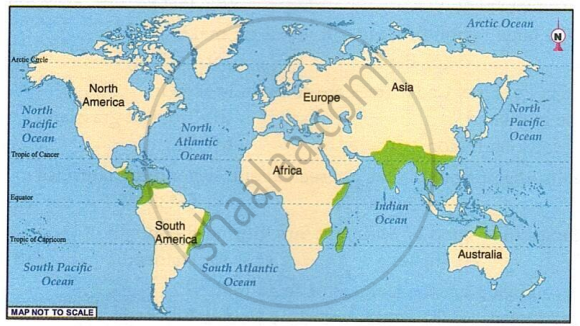
- Which natural region is shown in the given map?
- Name the four seasons experienced in this natural region.
- What is the natural vegetation of this region?
The most typical vegetation of the tropical grasslands is its grasses. The grasses are tall and coarse. The stiff, hard grasses range in height from 1 metre to 3 metres. The elephant grass is as high as 4.5 m.
- What is the term used for tropical grasslands in Africa?
- Name the two main occupations of the people living in the tropical grasslands.
- The removal of the grasses has adversely affected the environment. Explain how.
The area is known to have a resort-type climate as the temperature, rainfall, and relative humidity are considered suitable for spending vacations. The region is considered most suitable for growing citrus fruits and grapes.
- The passage is about which natural region of the world?
- Mention the most typical characteristic of the climate experienced here.
- Name the country which is the largest producer of grapes and wines in the world.
Answer the following questions.
Name the different natural climatic regions of the world.
Describe the location of the equatorial regions.
Why do the equatorial regions experience the hottest and wettest climate?
What type of rainfall occurs in the equatorial region, at what time, and why?
Describe the various layers of vegetation and trees in the equatorial region.
Name a few important trees found in the equatorial region and their importance. What type of wood do they have?
Why is it difficult to exploit the trees in the equatorial region?
Why are the equatorial forests mostly impenetrable?
What are the main areas of tropical grasslands?
Give the latitudes of tropical grasslands.
Name the typical trees and vegetation of tropical grasslands.
Give the importance of the baobab tree.
What are the adaptive features of trees of tropical grasslands where strong winds blow?
Which types of animals are found in tropical grasslands? Why do they migrate seasonally?
Give the location of the tropical monsoon region.
Give the regions of the tropical monsoon region.
Explain the importance of tropical monsoon winds, especially for India.
Mention the main occupations of the people of the Tropical Monsoon region.
What type of vegetation is found in the region of a tropical monsoon climate?
Why is teak considered the most useful tree?
Where will you find Sandalwood trees?
Give the importance of the sandalwood tree.
Give the uses of the sandalwood tree.
State a few important features of the tropical monsoon climate.
Name the tropical hot deserts of the world.
Which tropical hot desert is the largest in the world?
Which tropical hot desert is the driest in the world?
Describe the type of vegetation found in deserts.
What is the role of oasis in deserts?
Which nomadic tribes move in the desert? Which animals do they keep?
What type of dress do the natives wear in the Sahara Desert, and why?
What made the Middle East desert the richest and most prosperous pocket in the world?
Other than the area around the Mediterranean Sea, which other areas in the world experience a Mediterranean-type climate?
Why is the area around the Mediterranean Sea called “Orchard of the World”?
Name the fruits grown around the Mediterranean Sea.
Give reasons why Italy became the largest producer of grapes and wine, followed by France at second place.
What are the climatic features of the Mediterranean region?
When does the month get rain in the Mediterranean region?
Where do you find a continental or extreme type of climate?
What type of vegetation is found in tropical deserts?
Why are days very hot and nights very cold in tropical deserts?
Why are the diurnal and annual range of temperature high in tropical deserts?
Name the chief Taiga areas of the world.
Give an account of the winter conditions in the Taiga regions.
Which natural region is called the “Granary of the World”? Why is it so called?
Why is agriculture not the main occupation of the people in the Tundra region?
What is meant by a one-stand forest?
Give the commercial advantage of a one-stand forest.
Which types of minerals were found in Alaska?
Which types of minerals were found in Siberia?
Which is the coldest inhabited place in the world?
Name the country in which the coldest inhabited place in the world is situated.
What is the importance of Taiga trees?
Name the products which are derived from Taiga trees?
In Norway, one can see the midnight Sun during the summer. Explain.
What is meant by Aurora Borealis?
Where do Aurora Borealis occur?
Why are the major hot deserts of the world found on the western margins of the continent?
Why do the Mediterranean regions get their rainfall in winter?
There are many resorts located in the coastal regions of the Mediterranean Sea. Give reasons.
Reindeer is called “The Cow of the Far North”. For what purpose is it kept and utilised?
Name the animals from which fur is obtained.
Why is the mink coat so warm?
What are Igloos?
Where are Igloos found?
Why are Igloos used in winter?
What is Canoe?
Who is canoe used by?
What is so special about a canoe?
What are lichens?
Where do lichens grow?
What are mosses?
Where do mosses grow?
What are the various uses of olives?
Which area is suitable for growing olives?
Mention the climatic conditions of the Tundra region?
The tundra region has a very low density of population. Give reasons.
What are xerophytic plants?
Where do you find xerophytes?
What is the reason which made the Arabian Desert the most prosperous area in the world?
Name the tallest building in the Arabian Desert area.
What are oasis?
Which type of desert are oasis found in?
Where did the Bushmen and their families use to live in the Kalahari Desert?
Amazon forests are known as the “Lungs of the World”. Give a reason.
Name the major modes of transport in the Tundra region?
What is permafrost?
State the effect of permafrost on the soil of the Tundra region.
State the effect of permafrost on the vegetation of the Tundra region.
Mention two similarities between the cold deserts and the hot deserts of the world.
Distinguish between Cold desert and hot desert.
Why is the Tundra region classified as a desert?
Why is Taiga absent in the Southern Hemisphere?
Name any four trees which grow in the Taiga region.
Mention the names by which the temperate grasslands are known in different parts of the world.
What is the main occupation of people in the temperate grasslands?
Solutions for 18: Natural Regions of the World
Rachna Sapra solutions for जॉग्रफी [इंग्रजी] इयत्ता ९ आईसीएसई chapter 18 - Natural Regions of the World
Shaalaa.com has the CISCE Mathematics जॉग्रफी [इंग्रजी] इयत्ता ९ आईसीएसई CISCE solutions in a manner that help students grasp basic concepts better and faster. The detailed, step-by-step solutions will help you understand the concepts better and clarify any confusion. Rachna Sapra solutions for Mathematics जॉग्रफी [इंग्रजी] इयत्ता ९ आईसीएसई CISCE 18 (Natural Regions of the World) include all questions with answers and detailed explanations. This will clear students' doubts about questions and improve their application skills while preparing for board exams.
Further, we at Shaalaa.com provide such solutions so students can prepare for written exams. Rachna Sapra textbook solutions can be a core help for self-study and provide excellent self-help guidance for students.
Concepts covered in जॉग्रफी [इंग्रजी] इयत्ता ९ आईसीएसई chapter 18 Natural Regions of the World are .
Using Rachna Sapra जॉग्रफी [इंग्रजी] इयत्ता ९ आईसीएसई solutions Natural Regions of the World exercise by students is an easy way to prepare for the exams, as they involve solutions arranged chapter-wise and also page-wise. The questions involved in Rachna Sapra Solutions are essential questions that can be asked in the final exam. Maximum CISCE जॉग्रफी [इंग्रजी] इयत्ता ९ आईसीएसई students prefer Rachna Sapra Textbook Solutions to score more in exams.
Get the free view of Chapter 18, Natural Regions of the World जॉग्रफी [इंग्रजी] इयत्ता ९ आईसीएसई additional questions for Mathematics जॉग्रफी [इंग्रजी] इयत्ता ९ आईसीएसई CISCE, and you can use Shaalaa.com to keep it handy for your exam preparation.
