Advertisements
Advertisements
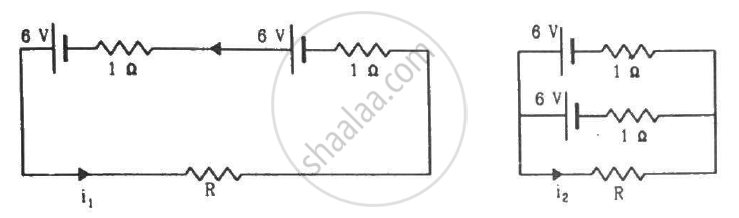
Find the value of i1/i2 in the following figure if (a) R = 0.1 Ω (b) R = 1 Ω and (c) R = 10 Ω. Note from your answers that in order to get more current from a combination of two batteries, they should be joined in parallel if the external resistance is small and in series if the external resistance is large, compared to the internal resistance.
Concept: undefined >> undefined
Consider N = n1n2 identical cells, each of emf ε and internal resistance r. Suppose n1 cells are joined in series to form a line and n2 such lines are connected in parallel.
The combination drives a current in an external resistance R. (a) Find the current in the external resistance. (b) Assuming that n1 and n2 can be continuously varied, find the relation between n1, n2, R and r for which the current in R is maximum.
Concept: undefined >> undefined
Advertisements
A battery of emf 100 V and a resistor of resistance 10 kΩ are joined in series. This system is used as a source to supply current to an external resistance R. If R is not greater than 100 Ω, the current through it is constant up to two significant digits.
Find its value. This is the basic principle of a constant-current source.
Concept: undefined >> undefined
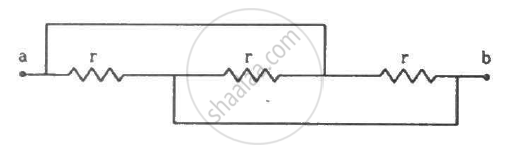
Find the equivalent resistance of the network shown in the figure between the points a and b.
Concept: undefined >> undefined
How many time constants will elapse before the power delivered by a battery drops to half of its maximum value in an RC circuit?
Concept: undefined >> undefined
Apply the first law of thermodynamics to a resistor carrying a current i. Identify which of the quantities ∆Q, ∆U and ∆W are zero, positive and negative.
Concept: undefined >> undefined
Do all thermocouples have a neutral temperature?
Concept: undefined >> undefined
Do the electrodes in an electrolytic cell have fixed polarity like a battery?
Concept: undefined >> undefined
A coil of resistance 100 Ω is connected across a battery of emf 6.0 V. Assume that the heat developed in the coil is used to raise its temperature. If the heat capacity of the coil is 4.0 J K−1, how long will it take to raise the temperature of the coil by 15°C?
Concept: undefined >> undefined
The temperatures of the junctions of a bismuth-silver thermocouple are maintained at 0°C and 0.001°C. Find the thermo-emf (Seebeck emf) developed. For bismuth-silver, a = − 46 × 10−6 V°C−1 and b = −0.48 × 10⁻⁶ V°C−2.
Concept: undefined >> undefined
A plate of area 10 cm2 is to be electroplated with copper (density 9000 kg m−3) to a thickness of 10 micrometres on both sides, using a cell of 12 V. Calculate the energy spent by the cell in the process of deposition. If this energy is used to heat 100 g of water, calculate the rise in the temperature of the water. ECE of copper = 3 × 10⁻⁷ kg C−1and specific heat capacity of water = 4200 J kg−1.
Concept: undefined >> undefined
When a boron nucleus `(""_5^10"B")` is bombarded by a neutron, a α-particle is emitted. Which nucleus will be formed as a result?
Concept: undefined >> undefined
The graph of ln `("R"/"R"_0)` versus ln A (R = radius of a nucleus and A = its mass number) is ______.
Concept: undefined >> undefined
Two lithium nuclei in a lithium vapour at room temperature do not combine to form a carbon nucleus because
Concept: undefined >> undefined
Electric charges are distributed in a small volume. The flux of the electric field through a spherical surface of radius 10 cm surrounding the total charge is 25 V m. The flux over a concentric sphere of radius 20 cm will be _____________ .
Concept: undefined >> undefined
Drive the expression for electric field at a point on the equatorial line of an electric dipole.
Concept: undefined >> undefined
Depict the orientation of the dipole in (i) stable, (ii) unstable equilibrium in a uniform electric field.
Concept: undefined >> undefined
Why is it necessary to introduce a radial magnetic field inside the coil of a galvanometer?
Concept: undefined >> undefined
Can a galvanometer as such be used for measuring the current? Explain.
Concept: undefined >> undefined
Derive the expression for the electric potential due to an electric dipole at a point on its axial line.
Concept: undefined >> undefined
