Please select a subject first
Advertisements
Advertisements
Charges (+q) and (–q) are placed at points A and B respectively which are a distance 2L apart. C is the midpoint between A and B. What is the work done in moving a charge +Q along the semicircle CRD?

Concept: undefined >> undefined
Two circular loops, one of small radius r and the other of larger radius R, such that R >> r, are placed coaxially with centres coinciding. Obtain the mutual inductance of the arrangement.
Concept: undefined >> undefined
Advertisements
Read the following paragraph and answer the questions that follow.
| A semiconductor diode is basically a pn junction with metallic contacts provided at the ends for the application of an external voltage. It is a two-terminal device. When an external voltage is applied across a semiconductor diode such that the p-side is connected to the positive terminal of the battery and the n-side to the negative terminal, it is said to be forward-biased. When an external voltage is applied across the diode such that the n-side is positive and the p-side is negative, it is said to be reverse-biased. An ideal diode is one whose resistance in forward biasing is zero and the resistance is infinite in reverse biasing. When the diode is forward biased, it is found that beyond forward voltage called knee voltage, the conductivity is very high. When the biasing voltage is more than the knee voltage the potential barrier is overcome and the current increases rapidly with an increase in forward voltage. When the diode is reverse biased, the reverse bias voltage produces a very small current of about a few microamperes which almost remains constant with bias. This small current is a reverse saturation current. |
- In the given figure, a diode D is connected to an external resistance R = 100 Ω and an emf of 3.5 V. If the barrier potential developed across the diode is 0.5 V, the current in the circuit will be:
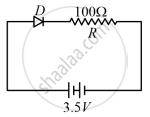
(a) 40 mA
(b) 20 mA
(c) 35 mA
(d) 30 mA - In which of the following figures, the pn diode is reverse biased?
(a)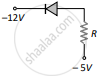
(b)
(c)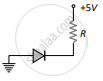
(d)
- Based on the V-I characteristics of the diode, we can classify the diode as:
(a) bilateral device
(b) ohmic device
(c) non-ohmic device
(d) passive element
OR
Two identical PN junctions can be connected in series by three different methods as shown in the figure. If the potential difference in the junctions is the same, then the correct connections will be:
(a) in the circuits (1) and (2)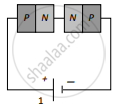

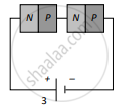
(b) in the circuits (2) and (3)
(c) in the circuits (1) and (3)
(d) only in the circuit (1) 
The V-I characteristic of a diode is shown in the figure. The ratio of the resistance of the diode at I = 15 mA to the resistance at V = -10 V is
(a) 100
(b) 106
(c) 10
(d) 10-6
Concept: undefined >> undefined
Write the S.I. unit of mutual inductance.
Concept: undefined >> undefined
How does the electric flux due to a point charge enclosed by a spherical Gaussian surface get affected when its radius is increased?
Concept: undefined >> undefined
Write Maxwell's generalization of Ampere's circuital law. Show that in the process of charging a capacitor, the current produced within the plates of the capacitor is `I=varepsilon_0 (dphi_E)/dt,`where ΦE is the electric flux produced during charging of the capacitor plates.
Concept: undefined >> undefined
Write Maxwell's generalization of Ampere's circuital law. Show that in the process of charging a capacitor, the current produced within the plates of the capacitor is `I=varepsilon_0 (dphi_E)/dt,`where ΦE is the electric flux produced during charging of the capacitor plates.
Concept: undefined >> undefined
Calculate the de-Broglie wavelength of the electron orbitting in the n = 2 state of hydrogen atom.
Concept: undefined >> undefined
Draw the circuit diagram of a full wave rectifier. Explain its working showing its input and output waveforms.
Concept: undefined >> undefined
Briefly explain how the output voltage/current is unidirectional.
Concept: undefined >> undefined
State Ampere’s circuital law.
Concept: undefined >> undefined
Electron drift speed is estimated to be of the order of mm s−1. Yet large current of the order of few amperes can be set up in the wire. Explain briefly.
Concept: undefined >> undefined
Define electric flux.
Concept: undefined >> undefined
Write S.I unit of electric flux.
Concept: undefined >> undefined
Find out the outward flux to a point charge +q placed at the centre of a cube of side ‘a’. Why is it found to be independent of the size and shape of the surface enclosing it? Explain.
Concept: undefined >> undefined
The equivalent wavelength of a moving electron has the same value as that of a photon of energy 6 × 10–17 J. Calculate the momentum of the electron.
Concept: undefined >> undefined
In a given coil of self-inductance of 5 mH, current changes from 4 A to 1 A in 30 ms. Calculate the emf induced in the coil.
Concept: undefined >> undefined
"The outward electric flux due to charge +Q is independent of the shape and size of the surface which encloses is." Give two reasons to justify this statement.
Concept: undefined >> undefined
What is the electric flux through a cube of side 1 cm which encloses an electric dipole?
Concept: undefined >> undefined
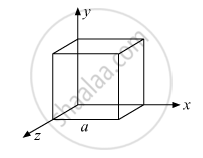
Given the electric field in the region `vecE=2xhati`, find the net electric flux through the cube and the charge enclosed by it.
Concept: undefined >> undefined
