Advertisements
Advertisements
A lens has a focal length of, −10 cm. What is the power of the lens and what is its nature?
Concept: undefined >> undefined
The focal length of a lens is +150 mm. What kind of lens is it and what is its power?
Concept: undefined >> undefined
Advertisements
Fill in the following blank with suitable words :
The reciprocal of the focal length in metres gives you the _________ of the lens, which is measured in ___________.
Concept: undefined >> undefined
Fill in the following blank with suitable word:
For converging lenses, the power is __________ while for diverging lenses, the power is ___________.
Concept: undefined >> undefined
An object of height 4 cm is placed at a distance of 15 cm in front of a concave lens of power, −10 dioptres. Find the size of the image.
Concept: undefined >> undefined
An object of height 4.25 mm is placed at a distance of 10 cm from a convex lens of power +5D. Find (i) the focal length of the lens, and (ii) the size of the image.
Concept: undefined >> undefined
A convex lens of power 5 D and a concave lens of power 7.5 D are placed in contact with each other. What is the :
(a) power of this combination of lenses?
(b) focal length of this combination of lenses?
Concept: undefined >> undefined
A convex lens of focal length 25 cm and a concave lens of focal length 10 cm are placed in close contact with one another.
(a) What is the power of this combination?
(b) What is the focal length of this combination?
(c) Is this combination converging or diverging?
Concept: undefined >> undefined
Two lenses A and B have focal lengths of +20 cm and, −10 cm, respectively.
(a) What is the nature of lens A and lens B?
(b) What is the power of lens A and lens B?
(c) What is the power of combination if lenses A and B are held close together?
Concept: undefined >> undefined
What do you understand by the power of a lens? Name one factor on which the power of a lens depends.
Concept: undefined >> undefined
What is the unit of power of a lens? Define the unit of power of a lens.
Concept: undefined >> undefined
A combination of lenses for a camera contains two converging lenses of focal lengths 20 cm and 40 cm and a diverging lens of focal length 50 cm. Find the power and focal length of the combination.A optical instrument in which the above arrangement of convex lens is used is a convex lens used to burn paper by focusing sunlight.
Concept: undefined >> undefined
A converging lens has a focal length of 50 cm. The power of this lens is:
Concept: undefined >> undefined
A diverging lens has a focal length of 0.10 m. The power of this lens will be:
Concept: undefined >> undefined
The power of a lens is +2.0D. Its focal length should be :
Concept: undefined >> undefined
Name the type of lens whose power is positive.
The image of an object formed by a lens is real, inverted and of the same size as the object. If the image is at a distance of 40 cm from the lens, what is the nature and power of the lens ? Draw ray diagram to justify your answer.
Concept: undefined >> undefined
Mohan obtained a sharp inverted image of a distant tree on the screen placed behind the lens. He then moved the screen and tried to look through the lens in the direction of the object. He would see:
(1) a blurred image on the wall of the laboratory.
(2) an erect image of the tree on the lens.
(3) no image as the screen has been removed
(4) an inverted image of the tree at the focus of the lens.
Concept: undefined >> undefined
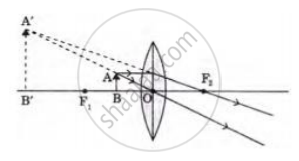
The above lens has a focal length of 10 cm. The object of height 2 mm is placed at a distance of 5 cm from the pole. Find the height of the image.
Concept: undefined >> undefined
Define power of a lens. What is its unit? One student uses a lens of focal length 50 cm and another of –50 cm. What is the nature of the lens and its power used by each of them?
Concept: undefined >> undefined
An object is kept at a distance of 1m from a lens of power +2D:
- Identify the type of lens.
- Calculate its focal length and distance of the image formed.
Concept: undefined >> undefined
