Advertisements
Advertisements
The intensity of the electric field at a perpendicular distance of 0·5 m from an infinitely long line charge having linear charge density (λ) is 3-6 × 10³ Vm-1. Find the value of λ.
Concept: Electric Lines of Force
The intensity of the electric field at a point at a perpendicular distance ‘r’ from an infinite line charge, having linear charge density ‘λ’ is given by:
Concept: Electric Field >> Electric Field Intensity Due to a Point-Charge
A charged oil drop weighing 1.6 x 10⁻¹⁵ N is found to remain suspended in a uniform electric field of intensity 2 x 10³ Nc-1. Find the charge on the drop.
Concept: Electric Field >> Electric Field Intensity Due to a Point-Charge
Two-point charges Q1 = 400 μC and Q2 = 100 μC are kept fixed, 60 cm apart in a vacuum. Find the intensity of the electric field at the midpoint of the line joining Q1 and Q2.
Concept: Electric Dipole
In an electric dipole, at which point is the electric potential zero ?
Concept: Electric Dipole
In an electric dipole, what is the locus of a point having zero potential?
Concept: Electric Dipole
In case of an infinite line charge, how does intensity of electric field at a point change, if at all, when.
- charge on it is doubled?
- distance of the point is halved?
Concept: Electric Field >> Electric Field Intensity Due to a Point-Charge
What is meant by the statement: "Relative permittivity of water is 81"?
Concept: Coulomb’s Law >> Coulomb's Law (Scalar Form): Force Between Two Point-Charges
Deduce an expression for equivalent capacitance C when three capacitors C1, C2 and C3 connected in parallel.
Concept: Combination of Capacitors
Figure 4 below shows a capacitor C, an inductor L and a resistor R, connected in series
to an a.c. supply of 220 V
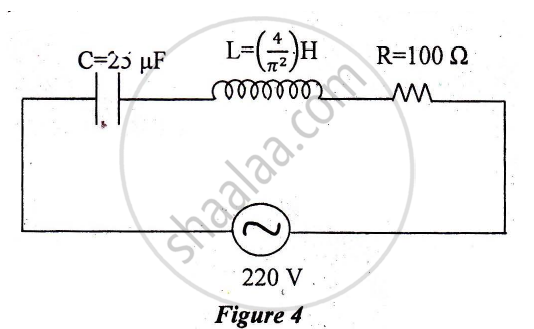
Calculate:
1) The resonant frequency of the given CLR circuit.
2) Current flowing through·the circuit.
3) Average power consumed by the circuit.
Concept: Combination of Capacitors
Define equipotential surface.
Concept: Equipotential Surfaces
Obtain an expression for electric potential ‘V’ at a point in an end-on position i.e. axial position of the electric dipole.
Concept: Electric Potential: A Quantitative Approach
Three capacitors of capacitance `C_1 = 3muf` , `C_2 = 6muf` , `C_3 = 10muf` , are connected to a 10V battery as shown in figure 3 below :
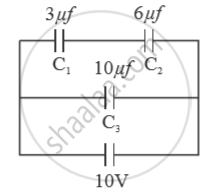
Calculate :
(a) Equivalent capacitance.
(b) Electrostatic potential energy stored in the system
Concept: Combination of Capacitors
A wire of resistance ‘R’ is cut into ‘n’ equal parts. These parts are then connected in parallel with each other. The equivalent resistance of the combination is:
Concept: Combination of Capacitors
What is meant by an equipotential surface?
Concept: Equipotential Surfaces
Calculate electric potential at a point P which is at a distance of 9 cm from a point charge of 50 μC.
Concept: Electric Potential: A Quantitative Approach
In a potentiometer experiment, balancing length is found to be 120 cm for a cell E1 of emf 2V. What will be the balancing length for another cell E2 of emf 1.5V? (No other changes are made in the experiment.)
Concept: Potentiometer
ε1 and ε2 are two batteries having emf of 34V and 10V respectively and internal resistance of 1Ω and 2Ω respectively. They are connected as shown in the figure below. Using Kirchhoff’s Laws of electrical networks, calculate the currents I1 and I2.
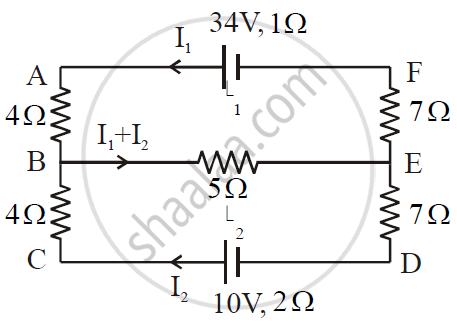
Concept: Kirchhoff’s Laws
An electrical bulb is marked 200V, 100W. Calculate the electrical resistance of its filament. If five such
bulbs are connected in series to a 200V supply, how much current will flow through them?
Concept: Ohm's Law
With the help of a labelled diagram, show that the balancing condition of a Wheatstone bridge is
`R_1/R_2 = R_3/R_4` where the terms have their usual meaning.
Concept: Wheatstone Bridge
