Advertisements
Advertisements
प्रश्न
In a potentiometer experiment, balancing length is found to be 120 cm for a cell E1 of emf 2V. What will be the balancing length for another cell E2 of emf 1.5V? (No other changes are made in the experiment.)
Advertisements
उत्तर
``E_1/E_2 = l_1/l_2`
`2/1.5 = 120/l_2`
`l_2 = 90 cm`
APPEARS IN
संबंधित प्रश्न
Figure 3.34 shows a potentiometer circuit for comparison of two resistances. The balance point with a standard resistor R = 10.0 Ω is found to be 58.3 cm, while that with the unknown resistance X is 68.5 cm. Determine the value of X. What might you do if you failed to find a balance point with the given cell of emf ε?
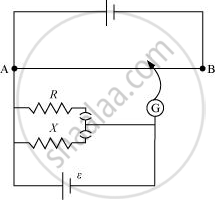
State the underlying principle of a potentiometer ?
Describe how a potentiometer is used to compare the EMFs of two cells by connecting the cells individually.
What is the SI unit of potential gradient?
What are the disadvantages of a potentiometer over a voltmeter?
In the given figure, battery E is balanced on 55 cm length of potentiometer wire but when a resistance of 10 `Omega` is connected in parallel with the battery, then it balances on 50 cm length of the potentiometer wire. The internal resistance r of the battery is ____________.

A potentiometer wire is 100 cm long and a constant potential difference is maintained across it. Two cells are connected in series first to support one another and then in opposite direction. The balance points are obtained at 50 cm and 10 cm from the positive end of the wire in the two cases. The ratio of emf's is ______.
A Daniel cell is balanced on 125 cm lengths of a potentiometer wire. Now the cell is short circuited by a resistance 2 Ω and the balance is obtained at 100 cm. The internal resistance of the Daniel cell is ______.
What is the value of resistance for an ideal voltmeter?
In a potentiometer, a cell is balanced against 110 cm when the circuit is open. A cell is balanced at 100 cm when short-circuited through a resistance of 10 Ω. Find the internal resistance of the cell.
