CBSE Science (English Medium) इयत्ता १२ Important Questions for Physics - Moving Charges and Magnetism
Advertisements
Advertisements
Chapter wise important questions with answers and solutions for Physics in CBSE Science (English Medium) इयत्ता १२.
State the two Kirchhoff’s rules used in electric networks. How are there rules justified?
पाठ: [4] Moving Charges and Magnetism
State Ampere’s circuital law.
पाठ: [4] Moving Charges and Magnetism
Write the underlying principle of a moving coil galvanometer.
पाठ: [4] Moving Charges and Magnetism
Derive an expression for the mutual inductance of two long co-axial solenoids of same length wound one over the other,
पाठ: [4] Moving Charges and Magnetism
Why is it necessary to introduce a cylindrical soft iron core inside the coil of a galvanometer?
पाठ: [4] Moving Charges and Magnetism
Obtain the expression for current sensitivity of moving coil galvanometer.
पाठ: [4] Moving Charges and Magnetism
Two infinitely long straight parallel wires, '1' and '2', carrying steady currents I1 and I2 in the same direction are separated by a distance d. Obtain the expression for the magnetic field `vecB`due to the wire '1' acting on wire '2'. Hence find out, with the help of a suitable diagram, the magnitude and direction of this force per unit length on wire '2' due to wire '1'. How does the nature of this force changes if the currents are in opposite direction? Use this expression to define the S.I. unit of current.
पाठ: [4] Moving Charges and Magnetism
Increasing the current sensitivity of a galvanometer may not necessarily increase its voltage sensitivity. Explain, giving reason.
पाठ: [4] Moving Charges and Magnetism
Define self-inductance of a coil.
पाठ: [4] Moving Charges and Magnetism
State how a moving coil galvanometer can be converted into an ammeter.
पाठ: [4] Moving Charges and Magnetism
How is current sensitivity increased?
पाठ: [4] Moving Charges and Magnetism
Use Kirchhoff's rules to obtain conditions for the balance condition in a Wheatstone bridge.
पाठ: [4] Moving Charges and Magnetism
A galvanometer of resistance G is converted into a voltmeter to measure upto V volts by connecting a resistance R1 in series with the coil. If a resistance R2 is connected in series with it, then it can measures upto V/2 volts. Find the resistance, in terms of R1 and R2, required to be connected to convert it into a voltmeter that can read upto 2 V. Also find the resistance G of the galvanometer in terms of R1 and R2
पाठ: [4] Moving Charges and Magnetism
Use this law to obtain the expression for the magnetic field inside an air cored toroid of average radius 'r', having 'n' turns per unit length and carrying a steady current I.
पाठ: [4] Moving Charges and Magnetism
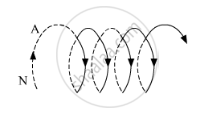
An observer to the left of a solenoid of N turns each of cross section area 'A' observes that a steady current I in it flows in the clockwise direction. Depict the magnetic field lines due to the solenoid specifying its polarity and show that it acts as a bar magnet of magnetic moment m = NIA.
पाठ: [4] Moving Charges and Magnetism
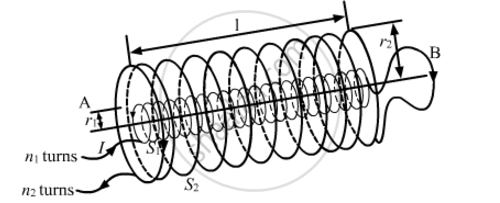
Two long coaxial insulated solenoids, S1 and S2 of equal lengths are wound one over the other as shown in the figure. A steady current "I" flow thought the inner solenoid S1 to the other end B, which is connected to the outer solenoid S2 through which the same current "I" flows in the opposite direction so as to come out at end A. If n1 and n2 are the number of turns per unit length, find the magnitude and direction of the net magnetic field at a point (i) inside on the axis and (ii) outside the combined system
पाठ: [4] Moving Charges and Magnetism
Using the concept of force between two infinitely long parallel current carrying conductors, define one ampere of current.
पाठ: [4] Moving Charges and Magnetism
Draw a labelled diagram of a moving coil galvanometer. Describe briefly its principle and working.
पाठ: [4] Moving Charges and Magnetism
Obtain the expression for mutual inductance of a pair of long coaxial solenoids each of length l and radii r1 and r2 (r2 >> r1). Total number of turns in the two solenoids are N1 and N2, respectively.
पाठ: [4] Moving Charges and Magnetism
Why is it necessary to introduce a radial magnetic field inside the coil of a galvanometer?
