Advertisements
Advertisements
प्रश्न
Use this law to obtain the expression for the magnetic field inside an air cored toroid of average radius 'r', having 'n' turns per unit length and carrying a steady current I.
Advertisements
उत्तर
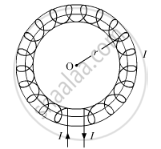
A toroid is a hollow circular ring on which a large number of turns of a wire are closely wound. Consider an air-cored toroid (as shown above) with centre O.
Given:
r = Average radius of the toroid
I = Current through the solenoid
n = Number of turns per unit length
To determine the magnetic field inside the toroid, we consider three amperian loops (loop 1, loop 2 and loop 3) as show in the figure below.
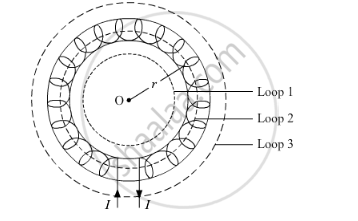
For loop 1:
According to Ampere's circuital law, we have
`ointvecB.vec(dl)=mu_0(`
Total current for loop 1 is zero because no current is passing through this loop.
So, for loop 1
`oint.vecB.vec(dl)=0`
For loop 3:
According to Ampere's circuital law, we have
`ointvecB.vec(dl)=mu_0(`
Total current for loop 3 is zero because net current coming out of this loop is equal to the net current going inside the loop.
For loop 2:
The total current flowing through the toroid is NI, where N is the total number of turns.
`ointvecB.vec(dl)=mu_0(NI)`
Now, `vecB `
`ointvecB.vec(dl)=Bointdl`
`=>ointvecB.vec(dl)=B(2pir)`
Comparing (i) and (ii), we get
B(2πr)=μ0NI
`=>B=(mu_0NI)/(2pir)`
Number of turns per unit length is given by
`n=N(2pir)`
∴B=μ0nI
This is the expression for magnetic field inside air-cored toroid.
APPEARS IN
संबंधित प्रश्न
A wire AB is carrying a steady current of 12 A and is lying on the table. Another wire CD carrying 5 A is held directly above AB at a height of 1 mm. Find the mass per unit length of the wire CD so that it remains suspended at its position when left free. Give the direction of the current flowing in CD with respect to that in AB. [Take the value of g = 10 ms−2]
Draw and compare the pattern of the magnetic field lines in the two cases ?
A long solenoid is fabricated by closely winding a wire of radius 0.5 mm over a cylindrical nonmagnetic frame so that the successive turns nearly touch each other. What would be the magnetic field B at the centre of the solenoid if it carries a current of 5 A?
A tightly-wound solenoid of radius a and length l has n turns per unit length. It carries an electric current i. Consider a length dx of the solenoid at a distance x from one end. This contains n dx turns and may be approximated as a circular current i n dx. (a) Write the magnetic field at the centre of the solenoid due to this circular current. Integrate this expression under proper limits to find the magnetic field at the centre of the solenoid. (b) verify that if l >> a, the field tends to B = µ0ni and if a >> l, the field tends to `B =(mu_0nil)/(2a)` . Interpret these results.
A tightly-wound, long solenoid is kept with its axis parallel to a large metal sheet carrying a surface current. The surface current through a width dl of the sheet is Kdl and the number of turns per unit length of the solenoid is n. The magnetic field near the centre of the solenoid is found to be zero. (a) Find the current in the solenoid. (b) If the solenoid is rotated to make its axis perpendicular to the metal sheet, what would be the magnitude of the magnetic field near its centre?
The length of a solenoid is 0.4 m and the number turns in it is 500. A current of 3 amp, is flowing in it. In a small coil of radius 0.01 m and number of turns 10, a current of 0.4 amp. is flowing. The torque necessary to keep the axis of this coil perpendicular to the axis of solenoid will be ______.
A solenoid has a total of \(N\) turns wound uniformly over a length \(l\). What is the expression for the number of turns per unit length?
In the working principle of a solenoid, how does each individual turn of the coil behave?
A solenoid has length \(l = 0.5\) m, radius \(r = 1\) cm \(= 0.01\) m, total turns \(N = 500\), and carries current \(I = 5\) A. What is the turns per unit length?
