Advertisements
Advertisements
Question
Use this law to obtain the expression for the magnetic field inside an air cored toroid of average radius 'r', having 'n' turns per unit length and carrying a steady current I.
Advertisements
Solution
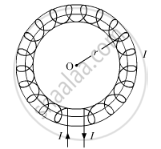
A toroid is a hollow circular ring on which a large number of turns of a wire are closely wound. Consider an air-cored toroid (as shown above) with centre O.
Given:
r = Average radius of the toroid
I = Current through the solenoid
n = Number of turns per unit length
To determine the magnetic field inside the toroid, we consider three amperian loops (loop 1, loop 2 and loop 3) as show in the figure below.
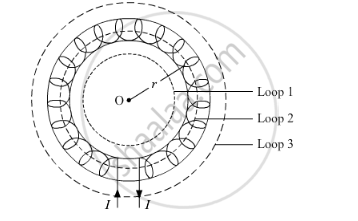
For loop 1:
According to Ampere's circuital law, we have
`ointvecB.vec(dl)=mu_0(`
Total current for loop 1 is zero because no current is passing through this loop.
So, for loop 1
`oint.vecB.vec(dl)=0`
For loop 3:
According to Ampere's circuital law, we have
`ointvecB.vec(dl)=mu_0(`
Total current for loop 3 is zero because net current coming out of this loop is equal to the net current going inside the loop.
For loop 2:
The total current flowing through the toroid is NI, where N is the total number of turns.
`ointvecB.vec(dl)=mu_0(NI)`
Now, `vecB `
`ointvecB.vec(dl)=Bointdl`
`=>ointvecB.vec(dl)=B(2pir)`
Comparing (i) and (ii), we get
B(2πr)=μ0NI
`=>B=(mu_0NI)/(2pir)`
Number of turns per unit length is given by
`n=N(2pir)`
∴B=μ0nI
This is the expression for magnetic field inside air-cored toroid.
APPEARS IN
RELATED QUESTIONS
Obtain an expression for the energy stored in a solenoid of self-inductance ‘L’ when the current through it grows from zero to ‘I’.
Derive an expression for the mutual inductance of two long co-axial solenoids of same length wound one over the other,
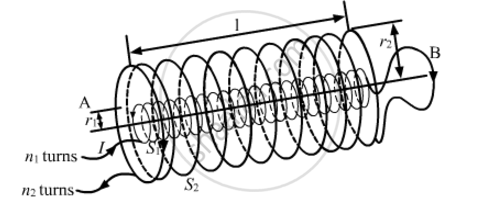
Two long coaxial insulated solenoids, S1 and S2 of equal lengths are wound one over the other as shown in the figure. A steady current "I" flow thought the inner solenoid S1 to the other end B, which is connected to the outer solenoid S2 through which the same current "I" flows in the opposite direction so as to come out at end A. If n1 and n2 are the number of turns per unit length, find the magnitude and direction of the net magnetic field at a point (i) inside on the axis and (ii) outside the combined system
Obtain the expression for mutual inductance of a pair of long coaxial solenoids each of length l and radii r1 and r2 (r2 >> r1). Total number of turns in the two solenoids are N1 and N2, respectively.
A closely wound solenoid 80 cm long has 5 layers of windings of 400 turns each. The diameter of the solenoid is 1.8 cm. If the current carried is 8.0 A, estimate the magnitude of B inside the solenoid near its centre.
A magnetic field of 100 G (1 G = 10−4 T) is required which is uniform in a region of linear dimension about 10 cm and area of cross-section about 10−3 m2. The maximum current-carrying capacity of a given coil of wire is 15 A and the number of turns per unit length that can be wound round a core is at most 1000 turns m−1. Suggest some appropriate design particulars of a solenoid for the required purpose. Assume the core is not ferromagnetic.
Define self-inductance of a coil.
A wire AB is carrying a steady current of 6 A and is lying on the table. Another wire CD carrying 4 A is held directly above AB at a height of 1 mm. Find the mass per unit length of the wire CD so that it remains suspended at its position when left free. Give the direction of the current flowing in CD with respect to that in AB. [Take the value of g = 10 ms−2]
The magnetic field B inside a long solenoid, carrying a current of 5.00 A, is 3.14 × 10⁻² T. Find the number of turns per unit length of the solenoid.
The length of a solenoid is 0.4 m and the number turns in it is 500. A current of 3 amp, is flowing in it. In a small coil of radius 0.01 m and number of turns 10, a current of 0.4 amp. is flowing. The torque necessary to keep the axis of this coil perpendicular to the axis of solenoid will be ______.
