Advertisements
Advertisements
Question
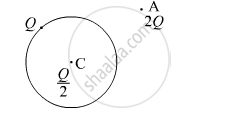
A thin metallic spherical shell of radius R carries a charge Q on its surface. A point charge`Q/2` is placed at its centre C and an other charge +2Q is placed outside the shell at a distance x from the centre as shown in the figure. Find (i) the force on the charge at the centre of shell and at the point A, (ii) the electric flux through the shell.
Advertisements
Solution
(i) At point C, inside the shell
The electric field inside a spherical shell is zero thus, the force experienced by the charge at the centre of the shell C will also be zero.
`.:vec(F_C)=qvecE `
`.:vec(F_C)=0`
At point A,
`|vec(F_A)|=2Q(1/(4piepsilon_0)((3Q)/2)/x^2)`
`vecF_A=(3Q^2)/(4piepsilon_0x^2),`
(ii) Electric flux through the shell
`phi=1/epsilon_0xx" magnitude of the charge enclosed by the shell"`
`phi=1/epsilon_0xxQ/2=Q/(2epsilon_0)`
APPEARS IN
RELATED QUESTIONS
A small conducting sphere of radius 'r' carrying a charge +q is surrounded by a large concentric conducting shell of radius Ron which a charge +Q is placed. Using Gauss's law, derive the expressions for the electric field at a point 'x'
(i) between the sphere and the shell (r < x < R),
(ii) outside the spherical shell.
Using Gauss’s law, prove that the electric field at a point due to a uniformly charged infinite plane sheet is independent of the distance from it.
How is the field directed if (i) the sheet is positively charged, (ii) negatively charged?
A charge Q is uniformly distributed on a spherical shell. What is the field at the centre of the shell? If a point charge is brought close to the shell, will the field at the centre change? Does your answer depend on whether the shell is conducting or non-conducting?
A rubber balloon is given a charge Q distributed uniformly over its surface. Is the field inside the balloon zero everywhere if the balloon does not have a spherical surface?
A positive point charge Q is brought near an isolated metal cube.
A large non-conducting sheet M is given a uniform charge density. Two uncharged small metal rods A and B are placed near the sheet as shown in the following figure.
(a) M attracts A.
(b) M attracts B.
(c) A attracts B.
(d) B attracts A.

A spherical volume contains a uniformly distributed charge of density 2.0 × 10 -4 Cm-3 Find the electric field at a point inside the volume at a distance 4⋅0 cm from the centre.
