CBSE Science (English Medium) इयत्ता १२ Important Questions for Physics - Current Electricity
Advertisements
Advertisements
Chapter wise important questions with answers and solutions for Physics in CBSE Science (English Medium) इयत्ता १२.
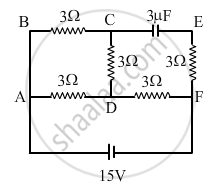
In the circuit shown in the figure, find the total resistance of the circuit and the current in the arm AD.
पाठ: [3] Current Electricity
A cell of emf ‘E’ and internal resistance ‘r’ draws a current ‘I’. Write the relation between terminal voltage ‘V’ in terms of E, I and r ?
पाठ: [3] Current Electricity
A heating element is marked 210 V, 630 W. What is the value of the current drawn by the element when connected to a 210 V dc source?
पाठ: [3] Current Electricity
A heating element is marked 210 V, 630 W. Find the resistance of the element when connected to a 210 V dc source.
पाठ: [3] Current Electricity
Calculate the value of the resistance R in the circuit shown in the figure so that the current in the circuit is 0.2 A. What would b the potential difference between points B and E?

पाठ: [3] Current Electricity
Calculate the value of the resistance R in the circuit shown in the figure so that the current in the circuit is 0.2 A. What would b the potential difference between points A and B?

पाठ: [3] Current Electricity
In the given circuit, assuming point A to be at zero potential, use Kirchhoff’s rules to determine the potential at point B.

पाठ: [3] Current Electricity
Plot a graph showing the variation of stopping potential with the frequency of incident radiation for two different photosensitive materials having work functions W1 and W2 (W1 > W2). On what factors does the (i) slope and (ii) intercept of the lines depend?
पाठ: [3] Current Electricity
A cell of emf ‘E’ and internal resistance ‘r’ is connected across a variable resistor ‘R’. Plot a graph showing the variation of terminal potential ‘V’ with resistance R. Predict from the graph the condition under which ‘V’ becomes equal to ‘E’.
पाठ: [3] Current Electricity
Derive an expression for drift velocity of free electrons in a conductor in terms of relaxation time.
पाठ: [3] Current Electricity
Obtain the expression for the current flowing through a conductor having number density of the electron n, area of cross-section A in terms of the drift velocity vd .
पाठ: [3] Current Electricity
How does the resistivity of a semiconductor change with rise of temperature ? Explain.
पाठ: [3] Current Electricity
Twelve wires each having a resistance of 3 Ω are connected to form a cubical network. A battery of 10 V and negligible internal resistance is connected across the diagonally opposite corners of this network. Determine its equivalent resistance and the current along each edge of the cube.
पाठ: [3] Current Electricity
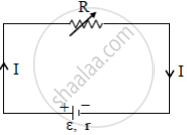
A variable resistor R is connected across a cell of emf ε and internal resistance r as shown in the figure. Draw a plot showing the variation of
(i) Terminal voltage V and
(ii) the current I, as a function of R.
पाठ: [3] Current Electricity
The temperature (T) dependence of resistivity of materials A and material B is represented by fig (i) and fig (ii) respectively. Identify material A and material B.
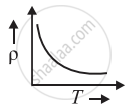 fig. (i) |
 fig. (ii) |
पाठ: [3] Current Electricity
State the two Kirchhoff’s rules used in the analysis of electric circuits and explain them.
पाठ: [3] Current Electricity
Derive the equation of the balanced state in a Wheatstone bridge using Kirchhoff’s laws.
पाठ: [3] Current Electricity
The potential difference applied across a given conductor is doubled. How will this affect (i) the mobility of electrons and (ii) the current density in the conductor? Justify your answers.
पाठ: [3] Current Electricity
A potential difference (V) is applied across a conductor of length 'L' and cross-sectional area 'A'.
How will the drift velocity of electrons and the current density be affected if another identical conductor of the same material were connected in series with the first conductor? Justify your answers.
पाठ: [3] Current Electricity
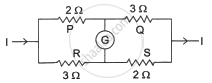
- Assertion (A): The given figure does not show a balanced Wheatstone bridge.
- Reason (R): For a balanced bridge small current should flow through the galvanometer.