Advertisements
Advertisements
प्रश्न
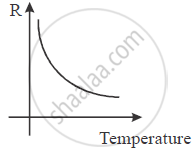
How does the resistivity of a semiconductor change with rise of temperature ? Explain.
Advertisements
उत्तर
As the temperature increase number of charge particle (holes and electrons) also increases. So, current increase and resistance decreases.
APPEARS IN
संबंधित प्रश्न
A negligibly small current is passed through a wire of length 15 m and uniform cross-section 6.0 × 10⁻⁷ m2, and its resistance is measured to be 5.0 Ω. What is the resistivity of the material at the temperature of the experiment?
Two wires of equal length, one of aluminium and the other of copper have the same resistance. Which of the two wires is lighter? Hence explain why aluminium wires are preferred for overhead power cables.
(ρAl = 2.63 × 10⁻⁸ Ω m, ρCu = 1.72 × 10⁻⁸ Ω m, Relative density of Al = 2.7, of Cu = 8.9.)
A heating element is marked 210 V, 630 W. What is the value of the current drawn by the element when connected to a 210 V dc source?
A heating element is marked 210 V, 630 W. Find the resistance of the element when connected to a 210 V dc source.
Two wires of equal length, one of copper and the other of manganin have the same resistance. Which wire is thicker?
What length of a copper wire of cross-sectional area 0.01 mm2 will be needed to prepare a resistance of 1 kΩ? Resistivity of copper = 1.7 × 10⁻⁸ Ωm
Fuse wire should have
What is the typical resistivity range for metals classified as conductors?
Which of the following describes the temperature dependence of semiconductors?
What is the primary reason copper is used in household wiring?
