Advertisements
Advertisements
Question
How does the resistivity of a semiconductor change with rise of temperature ? Explain.
Advertisements
Solution
As the temperature increase number of charge particle (holes and electrons) also increases. So, current increase and resistance decreases.
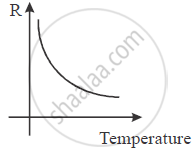
APPEARS IN
RELATED QUESTIONS
Plot a graph showing the variation of stopping potential with the frequency of incident radiation for two different photosensitive materials having work functions W1 and W2 (W1 > W2). On what factors does the (i) slope and (ii) intercept of the lines depend?
Two resistors A and B have resistances RA and RB, respectively, and RA < RB. The resistivities of their materials are ρA and ρB.
A uniform wire of resistance 100 Ω is melted and recast as a wire whose length is double that of the original. What would be the resistance of the wire?
What length of a copper wire of cross-sectional area 0.01 mm2 will be needed to prepare a resistance of 1 kΩ? Resistivity of copper = 1.7 × 10⁻⁸ Ωm
The electrochemical equivalent of a material depends on _______________ .
The resistivity of alloy manganin is ______.
What is approximately how many times greater is the resistivity of insulators compared to metals?
