Advertisements
Advertisements
Describe, with the help of a suitable diagram, the working principle of a step-up transformer. Obtain the relation between input and output voltages in terms of the number of turns of primary and secondary windings and the currents in the input and output circuits.
Concept: Transformers
Given the input current 15 A and the input voltage of 100 V for a step-up transformer having 90% efficiency, find the output power and the voltage in the secondary if the output current is 3 A.
Concept: Transformers
A 2 µF capacitor, 100 Ω resistor and 8 H inductor are connected in series with an AC source.
(i) What should be the frequency of the source such that current drawn in the circuit is maximum? What is this frequency called?
(ii) If the peak value of e.m.f. of the source is 200 V, find the maximum current.
(iii) Draw a graph showing variation of amplitude of circuit current with changing frequency of applied voltage in a series LRC circuit for two different values of resistance R1 and R2 (R1 > R2).
(iv) Define the term 'Sharpness of Resonance'. Under what condition, does a circuit become more selective?
Concept: AC Voltage Applied to a Capacitor
In a series LCR circuit, obtain the condition under which the impedance of the circuit is minimum ?
Concept: AC Voltage Applied to a Series LCR Circuit
In a series LCR circuit, obtain the condition under which watt-less current flows in the circuit ?
Concept: AC Voltage Applied to a Series LCR Circuit
State the principle of working of a transformer. Can a transformer be used to step up or step down a d.c. voltage? Justify your answer.
Concept: Transformers
Draw a labeled diagram of a full wave rectifier circuit. State its working principle. Show the input-output waveforms ?
Concept: Transformers
Show that in an a.c. circuit containing a pure inductor, the voltage is ahead of current by π/2 in phase ?
Concept: AC Voltage Applied to a Series LCR Circuit
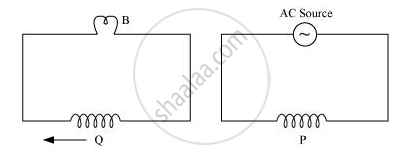
A coil Q is connected to low voltage bulb B and placed near another coil P as shown in the figure. Give reasons to explain the following observations:
(a) The bulb ‘B’ lights
(b) Bulb gets dimmer if the coil Q is moved towards left.
Concept: Representation of AC Current and Voltage by Rotating Vectors - Phasors
A series LCR circuit is connected to a source having voltage v = vm sin ωt. Derive the expression for the instantaneous current I and its phase relationship to the applied voltage.
Obtain the condition for resonance to occur. Define ‘power factor’. State the conditions under which it is (i) maximum and (ii) minimum.
Concept: AC Voltage Applied to a Series LCR Circuit
Derive an expression for the average power consumed in a series LCR circuit connected to a.c. source in which the phase difference between the voltage and the current in the circuit is Φ.
Concept: AC Voltage Applied to a Series LCR Circuit
Describe briefly, with the help of labelled diagram, working of a step-up transformer.
A step-up transformer converts a low voltage into high voltage. Does it not violate the principle of conservation of energy? Explain.
Concept: Transformers
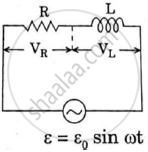
An ac circuit as shown in the figure has an inductor of inductance L and a resistor or resistance R connected in series. Using the phasor diagram, explain why the voltage in the circuit will lead the current in phase.
Concept: AC Voltage Applied to a Series LCR Circuit
The potential difference across the resistor is 160V and that across the inductor is 120V. Find the effective value of the applied voltage. If the effective current in the circuit be 1.0 A, calculate the total impedance of the circuit.
Concept: AC Voltage Applied to a Series LCR Circuit
What will be the potential difference in the circuit when direct current is passed through the circuit?
Concept: AC Voltage Applied to a Series LCR Circuit
Use the expression for Lorentz force acting on the charge carriers of a conductor to obtain the expression for the induced emf across the conductor of length l moving with velocity v through a magnetic field B acting perpendicular to its length.
Concept: AC Voltage Applied to a Series LCR Circuit
Using the phasor diagram, derive the expression for the current flowing in an ideal inductor connected to an a.c. source of voltage, v= vo sin ωt. Hence plot graphs showing the variation of (i) applied voltage and (ii) the current as a function of ωt.
Concept: AC Voltage Applied to a Series LCR Circuit
Derive an expression for the average power dissipated in a series LCR circuit.
Concept: AC Voltage Applied to a Series LCR Circuit
Choose the correct answer from given options
The phase difference between the current and the voltage in series LCR circuit at resonance is
Concept: AC Voltage Applied to a Series LCR Circuit
A 100 Ω resistor is connected to a 220 V, 50 Hz ac supply.
- What is the rms value of current in the circuit?
- What is the net power consumed over a full cycle?
Concept: AC Voltage Applied to a Resistor
