Please select a subject first
Advertisements
Advertisements
Obtain the expression for the cyclotron frequency.
Concept: Cyclotron
A deuteron and a proton are accelerated by the cyclotron. Can both be accelerated with the same oscillator frequency? Give reason to justify your answer.
Concept: Cyclotron
Write the expression for the force `vecF` acting on a particle of mass m and charge q moving with velocity `vecV` in a magnetic field `vecB` , Under what conditions will it move in (i) a circular path and (ii) a helical path?
Concept: Force on a Moving Charge in Uniform Magnetic and Electric Fields
Show that the kinetic energy of the particle moving in a magnetic field remains constant.
Concept: Force on a Moving Charge in Uniform Magnetic and Electric Fields
Obtain the expression for the magnetic energy stored in an inductor of self-inductance L to build up a current I through it.
Concept: Solenoid and the Toroid - the Solenoid
A proton and an α-particle move perpendicular to a magnetic field. Find the ratio of radii of circular paths described by them when both have (i) equal velocities, and (ii) equal kinetic energy.
Concept: Force on a Moving Charge in Uniform Magnetic and Electric Fields
Using Biot-Savart law, deduce the expression for the magnetic field at a point (x) on the axis of a circular current carrying loop of radius R. How is the direction of the magnetic field determined at this point?
Concept: Magnetic Field on the Axis of a Circular Current Loop
The figure shows three infinitely long straight parallel current carrying conductors. Find the
- magnitude and direction of the net magnetic field at point A lying on conductor 1,
- magnetic force on conductor 2.

Concept: Force Between Two Parallel Currents, the Ampere
Depict the behaviour of magnetic field lines in the presence of a diamagnetic material?
Concept: Motion in a Magnetic Field
Two identical coils P and Q each of radius R are lying in perpendicular planes such that they have a common centre. Find the magnitude and direction of the magnetic field at the common centre of the two coils, if they carry currents equal to I and \[\sqrt{3}\] I respectively.

Concept: Motion in a Magnetic Field
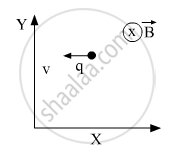
A point charge q moving with speed v enters a uniform magnetic field B that is acting into the plane of the paper as shown. What is the path followed by the charge q and in which plane does it move?
Concept: Motion in a Magnetic Field
How does the path followed by the charge get affected if its velocity has a component parallel to \[\vec{B}\] .
Concept: Motion in Combined Electric and Magnetic Fields >> Velocity Selector
If an electric field \[\vec{E}\] is also applied such that the particle continues moving along the original straight line path, what should be the magnitude and direction of the electric field \[\vec{E}\] ?
Concept: Motion in a Magnetic Field
With the help of a neat and labelled diagram, explain the principle and working of a moving coil galvanometer ?
Concept: Moving Coil Galvanometer
Define current sensitivity of a galvanometer.
Concept: Moving Coil Galvanometer
Velocity of light in glass is 2 × 10⁸ m/s and in air is 3 × 10⁸ m/s. If the ray of light passes from glass to air, calculate the value of critical angle.
Concept: Motion in Combined Electric and Magnetic Fields >> Velocity Selector
Why does a galvanometer when connected in series with a capacitor show a momentary deflection, when it is being charged or discharged?
How does this observation lead to modifying the Ampere's circuital law?
Hence write the generalised expression of Ampere's law.
Concept: Moving Coil Galvanometer
An electron moving horizontally with a velocity of 4 ✕ 104 m/s enters a region of uniform magnetic field of 10−5 T acting vertically upward as shown in the figure. Draw its trajectory and find out the time it takes to come out of the region of magnetic
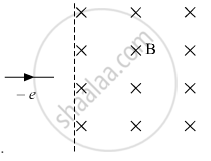
field.
Concept: Force on a Moving Charge in Uniform Magnetic and Electric Fields
A straight wire of mass 200 g and length 1.5 m carries a current of 2 A. It is suspended in mid air by a uniform magnetic field B. What is the magnitude of the magnetic field?
Concept: Force on a Moving Charge in Uniform Magnetic and Electric Fields
Use Biot-Savart's law to find the expression for the magnetic field due to a circular loop of radius 'r' carrying current 'I', at its centre ?
Concept: Magnetic Field on the Axis of a Circular Current Loop
