Advertisements
Advertisements
Two long straight parallel conductors 'a' and 'b', carrying steady currents Ia and Ib are separated by a distance d. Write the magnitude and direction of the magnetic field produced by the conductor 'a' at the points along the conductor 'b'. If the currents are flowing in the same direction, what is the nature and magnitude of the force between the two conductors?
Concept: Force Between Two Parallel Currents (Ampere’s Law)
Show with the help of a diagram how the force between the two conductors would change when the currents in them flow in the opposite directions?
Concept: Motion in a Magnetic Field
Two infinitely large plane thin parallel sheets having surface charge densities σ1 and σ2 (σ1 > σ2) are shown in the figure. Write the magnitudes and directions of the net fields in the regions marked II and III.
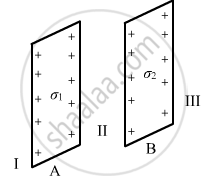
Concept: Force Between Two Parallel Currents (Ampere’s Law)
The motion of copper plate is damped when it is allowed to oscillate between the two poles of a magnet. What is the cause of this damping?
Concept: Motion in a Magnetic Field
Figure shows two circuits each having a galvanometer and a battery of 3V.
When the galvanometers in each arrangement do not show any deflection, obtain the ratio R1/R2.

Concept: Moving Coil Galvanometer
Define mutual inductance between two long coaxial solenoids. Find out the expression for the mutual inductance of inner solenoid of length l having the radius r1 and the number of turns n1 per unit length due to the second outer solenoid of same length and r2 number of turns per unit length.
Concept: Solenoid
A rectangular loop of size l × b carrying a steady current I is placed in a uniform magnetic field `vecB`. Prove that the torque `vectau`acting on the loop is give by `vectau =vecm xx vecB,`where `vecm` is the magnetic moment of the loop.
Concept: Torque on a Rectangular Current Loop in a Uniform Magnetic Field
Explain, giving reasons, the basic difference in converting a galvanometer into (i) a voltmeter and (ii) an ammeter?
Concept: Moving Coil Galvanometer
Two long straight parallel conductors carrying steady currents I1 and I2 are separated by a distance 'd'. Explain briefly, with the help of a suitable diagram, how the magnetic field due to one conductor acts on the other. Hence deduce the expression for the force acting between the two conductors. Mention the nature of this force.
Concept: Motion in a Magnetic Field
Draw a labelled diagram of a moving coil galvanometer and explain its working. What is the function of radial magnetic field inside the coil?
Concept: Moving Coil Galvanometer
Solve the following question.
Using Kirchhoff’s rules, calculate the current through the 40 Ω and 20 Ω resistors in the following circuit.
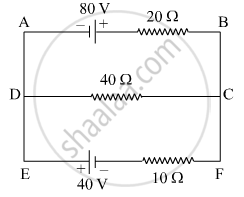
Concept: Kirchhoff’s Laws
Define the term ‘current sensitivity’ of a moving coil galvanometer.
Concept: Moving Coil Galvanometer
Beams of electrons and protons move parallel to each other in the same direction. They ______.
Concept: Force Between Two Parallel Currents (Ampere’s Law)
A long straight wire of radius 'a' carries a steady current 'I'. The current is uniformly distributed across its area of cross-section. The ratio of the magnitude of magnetic field `vecB_1` at `a/2` and `vecB_2` at distance 2a is ______.
Concept: Ampere’s Circuital Law
Two long parallel wires kept 2 m apart carry 3A current each, in the same direction. The force per unit length on one wire due to the other is ______.
Concept: Force Between Two Parallel Currents (Ampere’s Law)
Give two points to distinguish between a paramagnetic and a diamagnetic substance ?
Concept: Magnetisation and Magnetic Intensity
State Gauss’s law in electrostatics. A cube which each side ‘a’ is kept is an electric field given by `vecE` = C × l. (as is shown in the figure where C is a positive dimensional constant. Find out
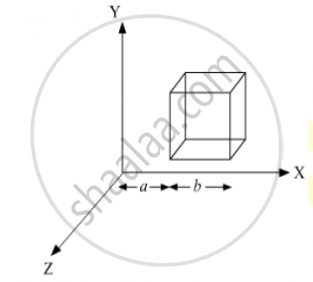
(i) The electric flux through the cube, and
(ii) The net charge inside the cube.
Concept: Magnetism and Gauss’s Law
Answer the following question.
Write three points of differences between para-, dia- and ferromagnetic materials, giving one example for each.
Concept: Magnetic Properties of Materials
- Assertion (A): Diamagnetic substances exhibit magnetism.
- Reason (R): Diamagnetic materials do not have a permanent magnetic dipole moment.
Concept: Magnetic Properties of Materials
Which of the following has a permeability less than that of free space?
Concept: Magnetic Properties of Materials
