Definitions [16]
A vector is any quantity that needs both magnitude (size) and direction to be completely described.
The square of a vector a, i.e., \[\vec{a^2}\] is a scalar which denotes the square of the length of a and is equal to the square of its modulus.
\[\vec{a^2}\] = \[|\vec{a}|^2\]
A directed line segment is a line segment with an arrowhead showing direction. Its two endpoints are distinguishable as the initial point and the terminal point
The vector is denoted by \[\overrightarrow{AB}\]
The vector drawn from the origin O(0,0,0)to a point P(x,y,z) is called the position vector of the point P.
It is denoted by: \[\vec{OP}=x\hat{i}+y\hat{j}+z\hat{k}\]
Magnitude of Position Vector: \[|\vec{OP}|=\sqrt{x^2+y^2+z^2}\]
When quantities can be represented by a certain number of units with no association with direction in space, they are called scalar quantities and numbers that represent them are called scalars.
The scalar product or inner product of two non-zero vectors written as like \[\mid a\mid\mid b\mid\cos\theta\]\[\vec{a}\], \[\vec{b}\] is defined to be the scalar \[\left|\vec{a}\right|\left|\vec{b}\right|\cos\theta\] = \[ab\cos\theta\]
where a \[=|\vec{a}|\], b = \[=|\vec{b}|\] and θ = (0 ≤ θ ≤ π) is the angle between\[\vec{a}\] and \[\vec{b}\].
Let \[\hat{i}\],\[\hat{j}\], \[\hat{k}\] be unit vectors in the positive direction of the three mutually perpendicular coordinate axes, x-axis, y-axis and z-axis, respectively. Then, these vectors are said to form an orthonormal triad of vectors.
Dot Products:
-
\[\hat{i}\cdot\hat{i}=\hat{j}\cdot\hat{j}=\hat{k}\cdot\hat{k}=1\]
-
\[\hat{i}\cdot\hat{j}=\hat{j}\cdot\hat{k}=\hat{k}\cdot\hat{i}=0\]
If a vector \[\overrightarrow{AB}\] is denoted by \[\overrightarrow{a}\], then \[\mid\overrightarrow{a}\mid\] denotes the positive length of the vector a, also called the magnitude or norm or modulus of the vector.
Thus \[\left|\vec{a}\right|\] = a, if a is the positive length of \[\overrightarrow{a}\].
\[\mid\overset{\rightarrow}{\operatorname*{\mathbf{AB}}}\mid=\mid\overset{\rightarrow}{\operatorname*{a}}\mid=a\]
A quantity which has both magnitude and direction is called a vector quantity, provided that two such quantities can be combined by vector addition.
A vector quantity can be represented in the plane by a directed line segment, whose length is proportional to the magnitude of the vector and whose direction is the direction of the vector.
When the direction of rotation is anticlockwise, then the rotation will move the screw upwards. It is called a right-handed orientation or a right-handed screw rule.
Two vectors \[\vec{a}\] and \[\vec{b}\] are parallel if one is a scalar multiple of the other.
\[\vec{a}=\lambda\vec{b}\] (λ is a scalar)
The cosines of the angles made by a vector with the positive directions of the coordinate axes are called the direction cosines of the vector.
If a vector \[\vec{a}\] makes angles α,β,γ with the positive x, y and z axes respectively, then:
l = cosα, m = cosβ, n = cosγ
are called the direction cosines of the vector.
In Cartesian Form:
\[l=\frac{x}{r},\quad m=\frac{y}{r},\quad n=\frac{z}{r}\]
For any three given vectors, the scalar product of one of the vectors and the cross product of the remaining two, is called a scalar triple product
Thus, \[\vec{a},\vec{b},\vec{c}\] are three vectors, then \[(\vec{a}\times\vec{b})\cdot\vec{c}\]is called the scalar triple product and is denoted by \[[\vec{a}\vec{b}\vec{c}]\mathrm{~or~}[a,b,c]\]
Any three numbers proportional to direction cosines are called direction ratios.
-
Denoted by a, b, c
-
A line has infinitely many direction ratios.
\[l=\frac{a}{\sqrt{a^2+b^2+c^2}}\], \[m=\frac{b}{\sqrt{a^2+b^2+c^2}}\], \[n=\frac{c}{\sqrt{a^2+b^2+c^2}}\]
Let\[\vec{a}\] and \[\vec{b}\]be two non-zero, non-parallel vectors, and let θ be the angle between them such that (0 < θ < π).
\[\vec{a}\times\vec{b}=\left|\vec{a}\right|\left|\vec{b}\right|\sin\theta\left.\hat{n}\right.\]
or
\[\vec{a}\times\vec{b}=ab\sin\theta\mathrm{~}\hat{n}\]
where \[\hat{n}\] is a unit vector perpendicular to both \[\vec{a}\] and\[\vec{b}\] such that\[\vec{a}\], \[\vec{b}\], \[\hat{n}\] form a righthanded triad of vectors.
Formulae [13]
\[P\left(\frac{m_1x_2+m_2x_1}{m_1+m_2},\frac{m_1y_2+m_2y_1}{m_1+m_2}\right)\]
\[(a\hat{i}+b\hat{j})+(x\hat{i}+y\hat{j})=(a+x)\hat{i}+(b+y)\hat{j}\]
\[\lambda(a\hat{i}+b\hat{j})=\lambda a\hat{i}+\lambda b\hat{j}\]

\[\vec{OR}=\frac{m\vec{q}+n\vec{p}}{m+n}\]

\[\vec{OR}=\frac{m\vec{q}-n\vec{p}}{m-n}\]
Projection vector of \[\vec{a} on \vec{b} = \left(\frac{\vec{a} \cdot \vec{b}}{|\vec{b}|^2}\right) \vec{b}, \vec{b} \neq \vec{0}\]
Projection vector of \[\vec{b} on \vec{a} = \left(\frac{\vec{a} \cdot \vec{b}}{|\vec{a}|^2}\right) \vec{a}, \vec{a} \neq \vec{0}\]
cosθ \[= \frac{ \vec{a} \cdot \vec{b} }{ | \vec{a} | \, | \vec{b} | } = \frac{ \text{scalar product of the two vectors} }{ \text{product of their moduli} }\]
\[\vec{AB}=(x_2-x_1)\hat{i}+(y_2-y_1)\hat{j}\]
\[|\vec{AB}|=\sqrt{(x_2-x_1)^2+(y_2-y_1)^2}\]
\[\vec{a}\times(\vec{b}+\vec{c})=\vec{a}\times\vec{b}+\vec{a}\times\vec{c}\]
In 2D:
If \[\vec{a}=a_1\hat{i}+a_2\hat{j},\quad\vec{b}=b_1\hat{i}+b_2\hat{j}\]
\[\vec{a}\cdot\vec{b}=a_1b_1+a_2b_2\]
Angle Between Two Vectors (2D):
\[\cos\theta=\frac{a_1b_1+a_2b_2}{\left|\vec{a}\right|\left|\vec{b}\right|}\]
In 3D
If \[\vec{a}=a_1\hat{i}+a_2\hat{j}+a_3\hat{k},\quad\vec{b}=b_1\hat{i}+b_2\hat{j}+b_3\hat{k}\]
\[\vec{a}\cdot\vec{b}=a_1b_1+a_2b_2+a_3b_3\]
1. Vector area of a triangle:
\[\text{Vector area of }\triangle ABC=\frac{1}{2}(\vec{AB}\times\vec{AC})\]
2. Collinearity condition
\[\vec{a}\times\vec{b}+\vec{b}\times\vec{c}+\vec{c}\times\vec{a}=\vec{0}\]
3. Area Parallelogram
\[\text{Area of parallelogram}=|\vec{a}\times\vec{b}|\]
If \[\mathrm{M}({\overline{m}})\] is the mid-point of the line segment joining the points \[\mathrm{A}({\overline{a}})\] and \[\mathrm{B}({\overline{b}})\] then \[\overline{m}=\frac{\left(\overline{a}+\overline{b}\right)}{2}\]
Scalar projection = \[\frac{\text{scalar product}}{\text{Modulus of vector}}\]
\[\text{Scalar Projection of }\overline{b}\mathrm{~on~}\overline{a}=\frac{\overline{a}\cdot\overline{b}}{|\overline{a}|}\]
\[\text{Vector Projection of }\overline{b}\mathrm{~on~}\overline{a}=\left(\overline{a}\cdot\overline{b}\right)\frac{\overline{a}}{\left|\overline{a}\right|^{2}}\]
Theorems and Laws [9]
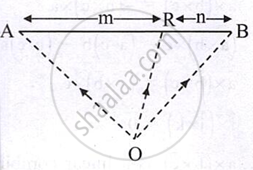
Let `A(bara)` and `B(barb)` are any two points in the space and `"R"(bar"r")` be a point on the line segment AB dividing it internally in the ratio m : n, then prove that `barr = (mbarb + nbara)/(m + n)`.
R is a point on the line segment AB(A – R – B) and `bar("AR")` and `bar("RB")` are in the same direction.
Point R divides AB internally in the ratio m : n
∴ `("AR")/("RB") = m/n`
∴ n(AR) = m(RB)
As `n(bar("AR"))` and `m(bar("RB"))` have same direction and magnitude,
`n(bar("AR")) = m(bar("RB"))`
∴ `n(bar("OR") - bar("OA")) = m(bar("OB") - bar("OR"))`
∴ `n(vecr - veca) = m(vecb - vecr)`
∴ `nvecr - nveca = mvecb - mvecr`
∴ `mvecr + nvecr = mvecb + nveca`
∴ `(m + n)vecr = mvecb + nveca`
∴ `vecr = (mvecb + nveca)/(m + n)`
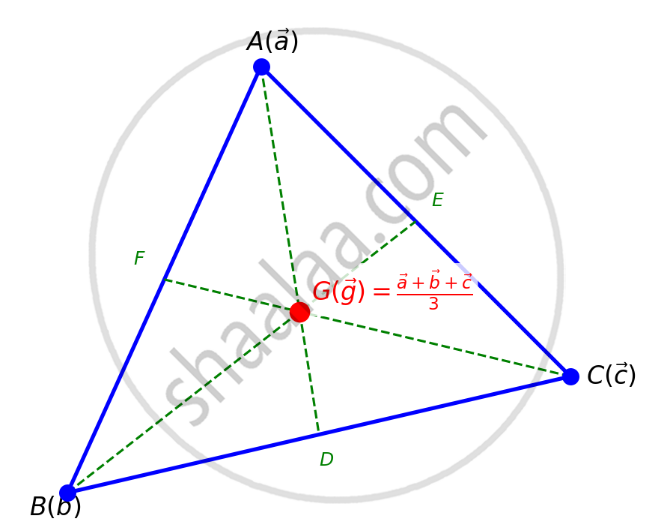
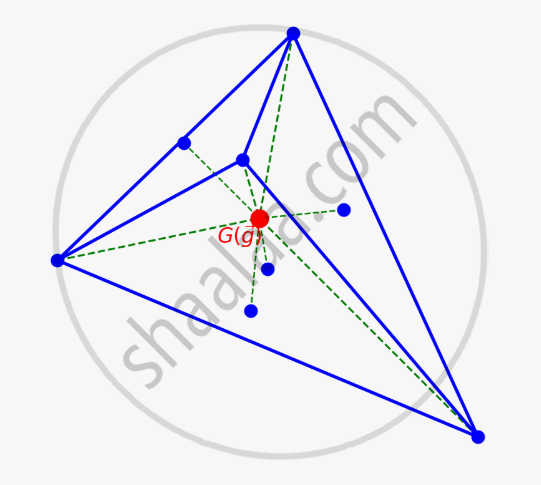
By vector method prove that the medians of a triangle are concurrent.

Let A, B and C be vertices of a triangle.
Let D, E and F be the mid-points of the sides BC, AC and AB respectively.
Let `bara, barb, barc, bard, bare` and `barf` be position vectors of points A, B, C, D, E and F respectively.
Therefore, by mid-point formula,
∴ `bard = (barb + barc)/2, bare = (bara + barc)/2` and `barf = (bara + barb)/2`
∴ `2bard = barb + barc, 2bare = bara + barc` and `2barf = bara + barb`
∴ `2bard + bara = bara + barb + barc`, similarly `2bare + barb = 2barf + barc = bara + barb + barc`
∴ `(2bard + bara)/3 = (2bare + barb)/3 = (2barf + barc)/3 = (bara + barb + barc)/3 = barg` ...(Say)
Then we have `barg = (bara + barb + barc)/3 = ((2)bard + (1)bara)/(2 + 1) = ((2)bare + (1)barb)/(2 + 1) = ((2)barf + (1)barc)/(2 + 1)`
If G is the point whose position vector is `barg`, then from the above equation it is clear that the point G lies on the medians AD, BE, CF and it divides each of the medians AD, BE, CF internally in the ratio 2 : 1.
Therefore, three medians are concurrent.
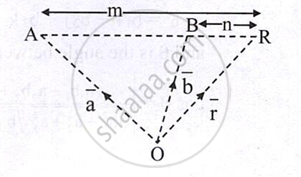
Let `A(bara)` and `B(barb)` be any two points in the space and `R(barr)` be the third point on the line AB dividing the segment AB externally in the ratio m : n, then prove that `barr = (mbarb - nbara)/(m - n)`.

As the point R divides the line segment AB externally, we have either A-B-R or R-A-B.
Assume that A-B-R and `bar(AR) : bar(BR)` = m : n
∴ `(AR)/(BR) = m/n` so n(AR) = m(BR)
As `n(bar(AR))` and `m(bar(BR))` have same magnitude and direction,
∴ `n(bar(AR)) = m(bar(BR))`
∴ `n(barr - bara) = m(barr - barb)`
∴ `nbarr - nbara = mbarr - mbarb`
∴ `mbarr - nbarr = mbarb - nbara`
∴ `(m - n)barr = mbarb - nbara`
∴ `barr = (mbarb - nbara)/(m - n)`
Hence proved.
Prove by vector method, that the angle subtended on semicircle is a right angle.
Let seg AB be a diameter of a circle with centre C and P be any point on the circle other than A and B.
Then ∠APB is an angle subtended on a semicircle.
Let `bar"AC" = bar"CB" = bar"a"` and `bar"CP" = bar"r"`
Then `|bar"a"| = |bar"r"|` ....(1)

`bar"AP" = bar"AC" + bar"CP"`
= `bar"a" + bar"r"`
= `bar"r" + bar"a"`
`bar"BP" = bar"BC" + bar"CP"`
= `- bar"CB" + bar"CP"`
= `- bar"a" + bar"r"`
∴ `bar"AP".bar"BP" = (bar"r" + bar"a").(bar"r" - bar"a")`
= `bar"r".bar"r" - bar"r".bar"a" + bar"a".bar"r" - bar"a".bar"a"`
= `|bar"r"|^2 - |bar"a"|^2`
= 0 ....`(∵ bar"r".bar"a" = bar"a".bar"r")`
∴ `bar"AP" ⊥ bar"BP"`
∴ ∠APB is a right angle.
Hence, the angle subtended on a semicircle is the right angle.
Consider the circle with the centre at O and AB is the diameter.
Let `bar(OA) = bar a, bar(OB) = bar b, bar(OC) = bar c`

∴ `|bar a| =|bar b| = |bar c| = r` ...(1)
and `bar a = -bar b` ...(2)
Consider:
`bar (AC) * bar (BC) = (bar c - bar a) * (bar c - bar b)`
= `(bar c - bar a) * (bar c + bar a)` ...[From (2)]
= `|bar c|^2 - |bar a|^2`
= r2 − r2 ...[From (1)]
= 0
∴ `bar(AC) * bar(BC) = 0`
∴ `bar(AC)` is perpendicular to `bar(BC)`
∴ ∠ACB = 90°
∴ Angle subtended on semi-circle is a right angle.
Using properties of scalar triple product, prove that `[(bar"a" + bar"b", bar"b" + bar"c", bar"c" + bar"a")] = 2[(bar"a", bar"b", bar"c")]`.
L.H.S = `[(bar"a" + bar"b", bar"b" + bar"c", bar"c" + bar"a")]`
= `(bar"a" + bar"b").[(bar"b" + bar"c") xx (bar"c" + bar"a")]`
= `(bar"a" + bar"b").[bar"b" xx bar"c" + bar"b" xx bar"a" + bar"c" xx bar"c" + bar"c" xx bar"a"]`
= `(bar"a" + bar"b").[bar"b" xx bar"c" + bar"b" xx bar"a" + bar"c" xx bar"a"] ...[∵ bar"c" xx bar"c" = bar"0"]`
= `bar"a".[(bar"b" xx bar"c") + (bar"b" xx bar"a") + (bar"c" xx bar"a")] + bar"b".[(bar"b" xx bar"c") + (bar"b" xx bar"a") + (bar"c" xx bar"a")]`
= `bar"a".(bar"b" xx bar"c") + bar"a".(bar"b" xx bar"a") + bar"a".(bar"c" xx bar"a") + bar"b".(bar"b" xx bar"c") + bar"b"(bar"b" xx bar"a") + bar"b"(bar"c" xx bar"a")`
= `[bar"a" bar"b" bar"c"] + [bar"a" bar"b" bar"a"] + [bar"a" bar"c" bar"a"] + [bar"b" bar"b" bar"c"] + [bar"b" bar"b" bar"a"] + [bar"b" bar"c" bar"a"]`
= `[bar"a" bar"b" bar"c"] + 0 + 0 + 0 + 0 + [bar"a" bar"b" bar"c"]`
= `2[bar"a" bar"b" bar"c"]`
= R.H.S
Statement:
If\[\vec{a},\vec{b},\vec{c},\] are three non-zero vectors and \[\vec{a}\times\vec{c}=\vec{b}\times\vec{c}\], then either \[\vec{a}=\vec{b}\mathrm{~or~}(\vec{a}-\vec{b})\] and \[\vec{c}\]are parallel vectors.
\[\vec{a}\times\vec{c}=\vec{b}\times\vec{c}\Rightarrow\vec{a}=\vec{b}\mathrm{~or~}(\vec{a}-\vec{b})\parallel\vec{c}\]
The cross product has no cancellation law

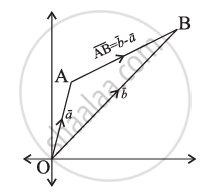
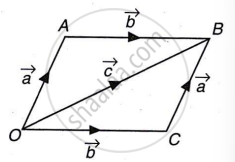
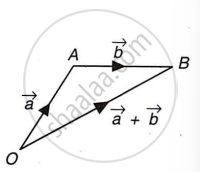
If three points O, A, and B are so chosen that \[\overrightarrow{OA}\] and \[\overrightarrow{AB}\] respectively represent \[\overrightarrow{a}\] and \[\overrightarrow{b}\], then \[\overrightarrow{OB}\] is defined as the sum of \[\overrightarrow{a}\] and \[\overrightarrow{b}\] and is written as \[\overrightarrow{c}=\overrightarrow{a}+\overrightarrow{b}\], where \[\overrightarrow{c}\] stands for the vector \[\overrightarrow{OB}\]. \[\overrightarrow{c}\] or \[\overrightarrow{a}\] + \[\overrightarrow{b}\] is also called the resultant of \[\overrightarrow{a}\] and \[\overrightarrow{b}\]. This is known as the Triangle law of vectors.

The result of adding two co-initial vectors is the vector represented by the diagonal of the parallelogram formed with the component vectors as adjacent sides. This is the Parallelogram Law of addition of vectors, which is thus a direct consequence of the triangle law.
Statement:
Two vectors in a plane are equal iff their x-components and y-components are equal.
If \[\vec{a}=a_1\hat{i}+a_2\hat{j},\quad\vec{b}=b_1\hat{i}+b_2\hat{j}\] Then \[\vec{a}=\vec{b}\] ⟺a1 = b1 and a2 = b2
Key Points
| Type | Meaning |
|---|---|
| Like vectors | Same direction |
| Unlike vectors | Opposite direction |
| Zero / Null vector | Magnitude = 0 |
| Unit vector | Magnitude = 1 |
| Proper vector | Magnitude ≠ 0 |
| Equal vectors | Same magnitude and direction |
| Negative vector | Same magnitude, opposite direction |
| Co-initial vectors | Same starting point |
| Reciprocal vectors | Same direction, reciprocal magnitudes |
| Localised vector | Fixed point of origin |
| Free vector | Origin anywhere |
| Collinear vectors | Parallel or same line |
| Non-collinear vectors | Not parallel |
| Coplanar vectors | Lie in the same plane |
| Non-coplanar vectors | Not in the same plane |
If\[\vec{a}\] and \[\vec{b}\] are two non-zero vectors, then \[\vec{a}\cdot\vec{b}=|\vec{a}||\vec{b}|\cos\theta\]
Cases:
-
Acute angle (0< θ < \[\frac{\pi}{2}\])
cosθ > 0 ⇒ \[\vec{a}\cdot\vec{b}>0\] -
Right angle (θ = \[\frac{\pi}{2}\]
cosθ = 0 ⇒ \[\vec{a}\cdot\vec{b}=0\] -
Obtuse angle (\[\frac{\pi}{2}\] < θ ≤ π)
cosθ < 0 ⇒ \[\vec{a}\cdot\vec{b}<0\]
-
Position of dot & cross doesn’t matter
\[(\vec{a}\times\vec{b})\cdot\vec{c}=\vec{a}\cdot(\vec{b}\times\vec{c})\] -
Cyclic order unchanged ⇒ STP unchanged
\[[\vec{a}\operatorname{\vec{b}}\vec{c}]=[\vec{b}\operatorname{\vec{c}}\vec{a}]=[\vec{c}\operatorname{\vec{a}}\vec{b}]\] -
Interchanging two vectors changes the sign
\[[\vec{a}\operatorname{\vec{b}}\vec{c}]=-\left[\vec{b}\operatorname{\vec{a}}\vec{c}\right]\] - If any two vectors are equal
\[[\vec{a}\operatorname{\vec{a}}\vec{b}]=0\]
- If any two vectors are parallel
\[[\vec{a}\operatorname{\vec{b}}\operatorname{\vec{c}}]=0\]
If: \[\vec{a}=a_1\hat{i}+a_2\hat{j}+a_3\hat{k}\]
Then:
Addition: \[\vec{a}+\vec{b}=(a_1+b_1)\hat{i}+(a_2+b_2)\hat{j}+(a_3+b_3)\hat{k}\]
Scalar Multiplication: \[\lambda\vec{a}=\lambda a_1\hat{i}+\lambda a_2\hat{j}+\lambda a_3\hat{k}\]
If \[\vec{a}\] and \[\vec{b}\] are two vectors,
\[\vec{a}-\vec{b}=\vec{a}+(-\vec{b})\]
Let\[\vec{a}\] be a vector and m a scalar. Then m\[\vec{a}\] is called the product of \[\vec{a}\] by the scalar m.
Properties:
-
The direction of m\[\overrightarrow{a}\] is the same as or parallel to that of \[\overrightarrow{a}\].
-
The magnitude of m\[\overrightarrow{a}\] is given by
\[|m\vec{a}|=|m||\vec{a}|\] -
The sense of m→a is:
-
same as \[\vec{a}\], if m is positive
-
opposite to \[\vec{a}\], if m is negative
-
Important Questions [91]
- If ˆ I + ˆ J + ˆ K , 2 ˆ I + 5 ˆ J , 3 ˆ I + 2 ˆ J − 3 ˆ K and ˆ I − 6 ˆ J − ˆ K Respectively Are the Position Vectors A, B, C and D, Then Find the Angle Between the Straight Lines Ab and Cd.
- If → a × → B = → C × → D and → a × → C = → B × → D , Show that → a − → D is Parallel to → B − → C Where → a ≠ → D and → B ≠ → C .
- Find the position vector of the foot of perpendicular and the perpendicular distance from the point P with position vector
- If points A, B and C have position vectors 2i^,j^ and 2k^ respectively, then show that ΔABC is an isosceles triangle.
- A line l passes through point (– 1, 3, – 2) and is perpendicular to both the lines x1=y2=z3 and x+2-3=y-12=z+15. Find the vector equation of the line l. Hence, obtain its distance from the origin.
- Find the position vector of a point which divides the join of points with position vectors a−2b and 2a+b externally in the ratio 2 : 1
- Assertion (A): If a line makes angles α, β, γ with positive direction of the coordinate axes, then sin2 α + sin2 β + sin2 γ = 2. Reason (R): The sum of squares of the direction cosines of a line is 1
- Find the value of 'p' for which the vectors 3i+2j+9k and i-2pj+3k are parallel
- Write the Position Vector of the Point Which Divides the Join of Points with Position Vectors
- Find the acute angle between the planes vec"r". (hat"i" - 2hat"j" - 2hat"k") = 1 and vec"r". (3hat"i" - 6hat"j" - 2hat"k") = 0
- If ∣a→| = 3, |b→| = 5, |c→| = 4 and a→+b→+c→ = 0→, then find the value of (a→.b→+b→.c→+c→.a→).
- If a→,b→,c→ are three vectors such that a→.b→=a→.c→ and a→×b→=a→×c→,a→≠0, then show that b→=c→.
- If | → a | = 4 , ∣ ∣ → B ∣ ∣ = 3 and → a . → B = 6 √ 3 , Then Find the Value of ∣ ∣ → a × → B ∣ ∣ .
- Write the number of vectors of unit length perpendicular to both the vectors a=2i+j+2k and b=j+k
- If a=4i-j+K Then Find a Unit Vector Parallel to the Vector A+B
- Two vectors a→=a1i^+a2j^+a3k^ and b→=b1i^+b2j^+b3k^ are collinear if ______.
- Find the Area of a Parallelogram Whose Adjacent Sides Are Represented by the Vectors 2 ^ I − 3 ^ K and 4 ^ J + 2 ^ K .
- Find the coordinate of the point P where the line through A(3, –4, –5) and B(2, –3, 1) crosses the plane passing through three p
- The position vectors of three consecutive vertices of a parallelogram ABCD are A(4i^+2j^-6k^),B(5i^-3j^+k^), and C(12i^+4j^+5k^). The position vector of D is given by ______.
- Find the area of a parallelogram whose adjacent sides are determined by the vectors a→=i^-j^+3k^ and b→=2i^-7j^+k^.
- If a→=i^+j^+k^ and b→=i^+2j^+3k^ then find a unit vector perpendicular to both a→+b→ and a→-b→.
- If anda→=2i^+2j^+3k^, b→=-i→+2j^+k^andc→=3i^+j^ are such that a→+λb→ is perpendicular to c→, then find the value of λ.
- Find a Unit Vector Perpendicular to Both the Vectors → a and → B , Where → a = ˆ I − 7 ˆ J + 7 ˆ K and → B = 3 ˆ I − 2 ˆ J + 2 ˆ K .
- Find a Unit Vector Perpendicular to Both the Vectors → a + → B and → a − → B ,Where → a = ^ I + ^ J + ^ K , → B = ^ I + 2 ^ J + 3 ^ K .
- The two adjacent sides of a parallelogram are represented by vectors 2i^-4j^+5k^ and i^-2j^-3k^. Find the unit vector parallel to one of its diagonals, Also, find the area of the parallelogram.
- Let `Veca = 4hati + 5hatj - Hatk`, `Vecb = Hati - 4hatj + 5hatk` and `Vecc = 3hati + Hatj - Hatk`. Find a Vector `Hatd` Which is Perpendicular to Both `Vecc` and `Vecb and Vecd.Veca = 21`
- If θ Is the Angle Between Two Vectors `Hati - 2hatj + `3hatk`And 3hati - 2hatj + Hatk` Find `Sin Theta`
- If the angle between a→ and b→ is ππ3 and |a→×b→|=33, then the value of a→.b→ is ______.
- Let a→=i^+j^,b→=i^-j^ and c→=i^+j^+k^. If n^ is a unit vector such that a→.n^ = 0 and b→.n^ = 0, then find |c→.n^|.
- If a→ and b→ are unit vectors inclined at an angle 30° to each other, then find the area of the parallelogram with (a→+3b→) and (3a→+b→) as adjacent sides.
- If |a→×b→|=3 and a→.b→ = – 3, then angle between a→ and b→ is ______.
- Find the projection of the vector i+3j+7k on the vector 2i-3j+6k
- If a and b are two unit vectors such that a+b is also a unit vector, then find the angle between a and b
- Vectors a, b and c are such that a+b+c=0 and |a| =3, |b|=5 and |c|=7 Find the angle between a and b
- If a and b are two vectors such that |a+b|=|a|, then prove that vector 2a+b is perpendicular to vector b
- Show that the vectors a,b are coplanar if a+b, b+c are coplanar.
- If a→,b→,c→ are unit vectors such that a→+b→+c→=0, then write the value of a→.b→+b→.c→+c→.a→
- If a=7i+j-4k and b=2i+6j+3k , then find the projection of a and b
- The scalar product of the vector a=i+j+k with a unit vector along the sum of vectors b=2i+4j−5k and c=λi+2j+3k is equal to one. Find the value of λ and hence, find the unit vector along b +c
- Find the Magnitude of Each of Two Vectors → a and → B Having the Same Magnitude Such that the Angle Between Them is 60° and Their Scalar Product is 9 2
- Write the projection of ^ i + ^ j + ^ k along the vector ^ j
- If the Vectors → a and → B Are Such that | → a | = 3 , ∣ ∣ → B ∣ ∣ = 2 3 and → a × → B is a Unit Vector, Then Write the Angle Between → a and → B
- Prove That, for Any Three Vectors → a , → B , → C [ → a + → B , → B + → C , → C + → a ] = 2 [ → a , → B , → C ] .
- Show that the Vectors → a , → B , → C Are Coplanar If and Only If → a + → B , → B + → C and → C + → a Are Coplanar.
- Let vec("a") = hat"i" + 2hat"j" - 3hat"k" and vec("b") = 3hat"i" -"j" +2hat("k") be two vectors. Show that the vectors (vec("a")+vec("b")) and (vec("a")-vec("b"))are perpendicular to each other.
- If a→,b→,c→ are three non-zero unequal vectors such that a→.b→=a→.c→, then find the angle between a→ and b→-c→.
- Three vectors a→,b→ and c→ satisfy the condition a→+b→+c→=0→. Evaluate the quantity μ = a→.b→+b→.c→+c→.a→, if |a→| = 3, |b→| = 4 and |c→| = 2.
- If a→.i^=a→.(i^+j^)=a→.(i^+j^+k^) = 1, then a→ is ______.
- Let →A,→B and →C Be Three Vectors Such that | → a | = 1 ,| ∣ → B ∣ ∣ = 2 and |→C|=3 .If the Projection of →B Along → a is Equal to the Projection of → C Along → a ; and → B, → C
- Projection of vector 2i^+3j^ on the vector 3i^-2j^ is ______.
- Find the Vector Equation of the Line Passing Through the Point A(1, 2, –1) and Parallel to the Line 5x – 25 = 14 – 7y = 35z
- Write the projection of the vector (b→+c→) on the vector a→, where a→=2i^-2j^+k^,b→=i^+2j^-2k^ and c→=2i^-j^+4k^.
- If a→ and b→ are two vectors such that |a→+b→|=|b→|, then prove that (a→+2b→) is perpendicular to a→.
- If a→ and b→ are unit vectors and θ is the angle between them, then prove that θsin θ2=12|a→ -b→|.
- A unit vector a^ makes equal but acute angles on the coordinate axes. The projection of the vector a^ on the vector b^=5i^+7j^-k^ is ______.
- The two adjacent sides of a parallelogram are and2i^-4j^-5k^and2i^+2j^+3j^ . Find the two unit vectors parallel to its diagonals. Using the diagonal vectors, find the area of the parallelogram.
- Find the Value of A, If Four Points with Position Vectors 3hati + 6hatj+9hatk, Hati + 2hatj + 3hatk,2hati + 3hatj + Hatk and 4hati + 6hatj + Lambdahatk Are Coplanar
- If a→=i^+j^+k^,a→.b→ = 1 and a→×b→=j^-k^, then find |b→|.
- Let `Veca = Hati + Hatj + Hatk = Hati` and `Vecc = C_1veci + C_2hatj + C_3hatk` Then Let `C_1 = 1` and `C_2 = 2`, Find `C_3` Which Makes `Veca, Vecb "And" Vecc`Coplanar
- Show that the four points A(4, 5, 1), B(0, –1, –1), C(3, 9, 4) and D(–4, 4, 4) are coplanar.
- Prove that, for any three vector a, b, c [a+b,b+c,c+a]=2[abc]
- Show that the Vectors ˆ I − 2 ˆ J + 3 ˆ K , − 2 ˆ I + 3 ˆ J − 4 ˆ K and ˆ I − 3 ˆ J + 5 ˆ K Are Coplanar.
- Find λ, if the vectors a=i+3j+k,b=2i−j−k and c=λj+3k are coplanar.
- Find the value of x such that the four-point with position vectors,"A"(3hat"i"+2hat"j"+hat"k"),"B" (4hat"i"+"x"hat"j"+5hat"k"),"c" (4hat"i"+2hat"j"-2hat"k")and"D"(6hat"i"+5hat"j"-hat"k")are coplaner.
- Find the Position Vector of the Point Which Divides the Join of Points with Position Vectors → a + 3 → B and → a − → B Internally in the Ratio 1 : 3.
- X and Y are two points with position vectors 3vec("a") + vec("b") and vec("a")-3vec("b")respectively. Write the position vector of a point Z which divides the line segment XY in the ratio 2 : 1
- Find the Image P' of the Point P Having Position Vector ˆ I + 3 ˆ J + 4 ˆ K in the Plane → R .
- The two vectors j+k and 3i−j+4k represent the two sides AB and AC, respectively of a ∆ABC. Find the length of the median through A
- Position vector of the mid-point of line segment AB is 3i^+2j^-3k^. If position vector of the point A is 2i^+3j^-4k^, then position vector of the point B is ______.
- If a→,b→,c→ are mutually perpendicular vectors of equal magnitudes, show that the vector a→+ b→+c→ is equally inclined to a→,b→ and c→.
- If the Sum of Two Unit Vectors is a Unit Vector Prove that the Magnitude of Their Difference is √ 3 .
- The magnitude of the vector 6i^-2j^+3k^ is ______.
- If →A,→B,→C Are Mutually Perpendicular Vectors of Equal Magnitudes, Find the Angle Which →A+→B+→Cmake with →Aor→Bor→
- Find a vector a of magnitude 5√2 , making an angle of π/4 with x-axis, π/2 with y-axis and an acute angle θ with z-axis.
- Find a Vector in the Direction of Vector 2 ^ I − 3 ^ J + 6 ^ K Which Has Magnitude 21 Units.
- If a=2i+j+3k and b=3i+5j-2k ,then find ∣a×b∣
- Using Vectors Find the Area of Triangle Abc with Vertices A(1, 2, 3), B(2, −1, 4) and C(4, 5, −1).
- If a=i+2j−k, b=2i+j+k and c=5i−4j+3k then find the value of (a+b).c
- Find a.(b x c), if a=2i+j+3k, b=-i+2j+k and c=3i+tj+2k
- Find the Angle Between the Vectors → a + → B and → a − → B If → a = 2 ˆ I − ˆ J + 3 ˆ K and → B = 3 ˆ I + ˆ J − 2 ˆ K , and Hence Find a Vector Perpendicular to Both → a + → B and → a − → B .
- if |axb|2+|a.b|2=400 then write the value of |b|
- A line passing through the point A with position vector a=4i+2j+2k is parallel to the vector b=2i+3j+6k . Find the length of the perpendicular drawn on this line from a point P with vector r1=i+2j+3k
- Write the Value of
- Find x such that the four points A(4, 1, 2), B(5, x, 6) , C(5, 1, -1) and D(7, 4, 0) are coplanar.
- If a unit vector a makes angles π/3 with i, π/4 with j and acute angles θ with k, then find the value of θ.
- Using vectors, find the area of the triangle ABC with vertices A(1, 2, 3), B(2, – 1, 4) and C(4, 5, – 1).
- If r=xi+yj+zk ,find (r x i).( r x j)+xy
- The Two Vectors ^ J + ^ K and 3 ^ I − ^ J + 4 ^ K Represents the Sides → a B and → a C Respectively of a Triangle Abc. Find the Length of the Median Through A.
- Show that the Points A, B, C with Position Vectors `2hati- Hatj + Hatk`, `Hati - 3hatj - 5hatk` and `3hati - 4hatj - 4hatk` Respectively, Are the Vertices of a Right-angled Triangle. Hence Find the Area of the Triangle
- If a and b are perpendicular vectors, |a+b| = 13 and |a| = 5 ,find the value of |b|.
- Find the angle between the vectors i−j and j−k
Concepts [19]
- Vector
- Basic Concepts of Vector Algebra
- Direction Cosines
- Vector Operations>Addition and Subtraction of Vectors
- Properties of Vector Addition
- Vector Operations>Multiplication of a Vector by a Scalar
- Components of Vector
- Vector Joining Two Points
- Section Formula
- Vector (Or Cross) Product of Two Vectors
- Scalar (Or Dot) Product of Two Vectors
- Projection of a Vector on a Line
- Geometrical Interpretation of Scalar
- Scalar Triple Product of Vectors
- Position Vector of a Point Dividing a Line Segment in a Given Ratio
- Magnitude and Direction of a Vector
- Vectors Examples and Solutions
- Introduction of Product of Two Vectors
- Overview of Vectors