Science (English Medium)
Academic Year: 2024-2025
Date & Time: 21st February 2025, 10:30 am
Duration: 3h
Advertisements
General Instructions:
Read the following instructions very carefully and follow them:
- This question paper contains 33 questions. All questions are compulsory.
- Question paper is divided into FIVE sections - Sections A, B, C, D and E.
- In Section A: Question numbers 1 to 16 are Multiple Choice (MCQ) type questions. Each question carries 1 mark.
- In Section B: Question numbers 17 to 21 are Very Short Answer (VSA) type questions. Each question carries 2 marks.
- In Section C: Question numbers 22 to 28 are Short Answer (SA) type questions. Each question carries 3 marks.
- In Section D: Question numbers 29 & 30 are Case Study-Based questions. Each question carries 4 marks.
- In Section E: Question numbers 31 to 33 are Long Answer (LA) type questions. Each question carries 5 marks.
- There is no overall choice given in the question paper. However, an internal choice has been provided in a few questions in all the Sections except Section A.
- Kindly note that there is a separate question paper for the Visually Impaired candidates.
- Use of calculators is NOT allowed.
You may use the following values of physical constants wherever necessary:
c = 3 × 10⁸ m/s
h = 6.63 × 10⁻³⁴ Js
e = 1.6 × 10⁻¹⁹ C
μ0 = 4π × 10−7 T m A−1
ε0 = 8.854 × 10⁻¹² C2 N−1 m−2
`1/(4 pi epsilon_0)` = 9 × 10⁹ N m2 C−2
Mass of electron (me) = 9.1 × 10⁻³¹ kg.
Mass of neutron = 1.675 × 10⁻²⁷ kg.
Mass of proton = 1.673 × 10⁻²⁷ kg.
Avogadro’s number = 6.023 × 10²³ per gram mole
Boltzmann’s constant = 1.38 × 10⁻²³ JK−1
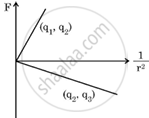
Figure shows variation of Coulomb force (F) acting between two point charges with `1/r^2`, r being the separation between the two charges (q1, q2) and (q2, q3). If q2 is positive and least in magnitude, then the magnitudes of q1, q2 and q3 are such that:
q2 < q3 < q1
q3 < q1 < q2
q1 < q2 < q3
q2 < q1 < q3
Chapter:
Two wires P and Q are made of the same material. The wire Q has twice the diameter and half the length as that of wire P. If the resistance of wire P is R, the resistance of the wire Q will be:
R
`R/2`
`R/8`
2R
Chapter:
A 1 cm segment of a wire lying along x-axis carries current of 0.5 A along +x direction. A magnetic field `vec B = (0.4 mT) hat j + (0.6 mT) hat k` is switched on, in the region. The force acting on the segment is ______.
`(2 hat j + 3 hat k)` mN
`(-3 hat j + 2 hat k)` μN
`(6 hat j + 4 hat k)` mN
`(-4 hat j + 6 hat k)` μN
Chapter:
A coil has 100 turns, each of area 0.05 m2 and total resistance 1.5 Ω. It is inserted at an instant in a magnetic field of 90 mT, with its axis parallel to the field. The charge induced in the coil at that instant is ______.
3.0 mC
0.30 C
0.45 C
1.5 C
Chapter:
You are required to design an air-filled solenoid of inductance 0.016 H having a length 0.81 m and radius 0.02 m. The number of turns in the solenoid should be ______.
2592
2866
2976
3140
Chapter:
A voltage v = v0 sin ωt applied to a circuit drives a current i = i0 sin (ωt + Φ) in the circuit. The average power consumed in the circuit over a cycle is ______.
Zero
i0 v0 cos Φ
`(i_0 v_0)/2`
`(i_0 v_0)/2 cos Phi`
Chapter:
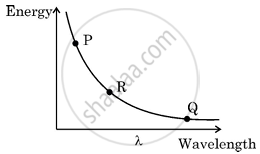
The given diagram exhibits the relationship between the wavelength of the electromagnetic waves and the energy of photon associated with them. The three points P, Q and R marked on the diagram may correspond respectively to:
X-rays, microwaves, UV radiation
X-rays, UV radiation, microwaves
UV radiation, microwaves, X-rays
Microwaves, UV radiation, X-rays
Chapter:
A beaker is filled with water (refractive index `4/3`) upto a height H. A coin is placed at its bottom. The depth of the coin, when viewed along the near normal direction, will be ______.
`H/4`
`(3 H)/4`
H
`(4 H)/3`
Chapter:
The stopping potential V0 measured in a photoelectric experiment for a metal surface is plotted against frequency v of the incident radiation. Let m be the slope of the straight line so obtained. Then the value of charge of an electron is given by: (h is the Planck’s constant.)
mh
`m/h`
`h/m`
`1/(mh)`
Chapter:
Let λe, λp and λd be the wavelengths associated with an electron, a proton and a deuteron, all moving with the same speed. Then the correct relation between them is:
λd > λp > λe
λe > λp > λd
λp > λe > λd
λe = λp = λd
Chapter:
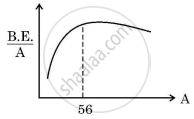
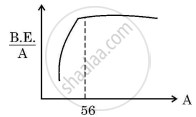
Which of the following figures correctly represent the shape of curve of binding energy per nucleon as a function of mass number?
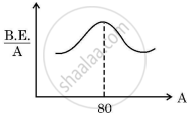
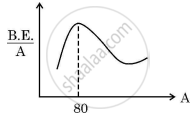
Chapter:
When a p-n junction diode is forward biased ______.
the barrier height and the depletion layer width both increase.
the barrier height increases and the depletion layer width decreases.
the barrier height and the depletion layer width both decrease.
the barrier height decreases and the depletion layer width increases.
Chapter:
Assertion (A): It is difficult to move a magnet into a coil of large number of turns when the circuit of the coil is closed.
Reason (R): The direction of induced current in a coil with its circuit closed, due to motion of a magnet, is such that it opposes the cause.
Both Assertion (A) and Reason (R) are true and Reason (R) is the correct explanation of Assertion (A).
Both Assertion (A) and Reason (R) are true, but Reason (R) is not the correct explanation of Assertion (A).
Assertion (A) is true, but Reason (R) is false.
Assertion (A) is false and Reason (R) is also false.
Chapter:
Assertion (A): The deflection in a galvanometer is directly proportional to the current passing through it.
Reason (R): The coil of a galvanometer is suspended in a uniform radial magnetic field.
Both Assertion (A) and Reason (R) are true and Reason (R) is the correct explanation of Assertion (A).
Both Assertion (A) and Reason (R) are true, but Reason (R) is not the correct explanation of Assertion (A).
Assertion (A) is true, but Reason (R) is false.
Assertion (A) is false and Reason (R) is also false.
Chapter:
Assertion (A): We cannot form a p-n junction diode by taking a slab of a p-type semiconductor and physically joining it to another slab of a n-type semiconductor.
Reason (R): In a p-type semiconductor ηe >> ηh while in a n-type semiconductor ηh >> ηe.
Both Assertion (A) and Reason (R) are true and Reason (R) is the correct explanation of Assertion (A).
Both Assertion (A) and Reason (R) are true, but Reason (R) is not the correct explanation of Assertion (A).
Assertion (A) is true, but Reason (R) is false.
Assertion (A) is false and Reason (R) is also false.
Chapter:
Assertion (A): The potential energy of an electron revolving in any stationary orbit in a hydrogen atom is positive.
Reason (R): The total energy of a charged particle is always positive.
Both Assertion (A) and Reason (R) are true and Reason (R) is the correct explanation of Assertion (A).
Both Assertion (A) and Reason (R) are true, but Reason (R) is not the correct explanation of Assertion (A).
Assertion (A) is true, but Reason (R) is false.
Assertion (A) is false and Reason (R) is also false.
Chapter:
A battery of emf E and internal resistance r is connected to a rheostat. When a current of 2 A is drawn from the battery, the potential difference across the rheostat is 5 V. The potential difference becomes 4 V when a current of 4 A is drawn from the battery. Calculate the value of E and r.
Chapter:
Advertisements
In a diffraction experiment, the slit is illuminated by light of wavelength 600 nm. The first minimum of the pattern falls at θ = 30°. Calculate the width of the slit.
Chapter:
In a Young’s double-slit experiment, two light waves, each of intensity I0, interfere at a point, having a path difference `lambda/8` on the screen. Find the intensity at this point.
Chapter:
A transparent solid cylindrical rod (refractive index `2/sqrt 3`) is kept in air. A ray of light incident on its face travels along the surface of the rod, as shown in figure. Calculate the angle θ.
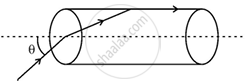
Chapter:
Prove that, in Bohr model of hydrogen atom, the time period of revolution of an electron in nth orbit is proportional to n3.
Chapter:
A p-type Si semiconductor is made by doping an average of one dopant atom per 5 × 10⁷ silicon atoms. If the number density of silicon atoms in the specimen is 5 × 1028 atoms m−3, find the number of holes created per cubic centimetre in the specimen due to doping. Also give one example of such dopants.
Chapter:
Two batteries of emfs 3 V and 6 V and internal resistances 0.2 Ω and 0.4 Ω are connected in parallel. This combination is connected to a 4 Ω resistor. Find:
- the equivalent emf of the combination.
- the equivalent internal resistance of the combination.
- the current drawn from the combination.
Chapter:
A conductor of length l is connected across an ideal cell of emf E. Keeping the cell connected, the length of the conductor is increased to 2l by gradually stretching it. If R and R' are initial and final values of resistance and vd and `v_d^'` are initial and final values of drift velocity, find the relation between
- R' and R and
- `v_d^'` and vd.
Chapter:
When electrons drift in a conductor from lower to higher potential, does it mean that all the ‘free electrons’ of the conductor are moving in the same direction?
Chapter:
Using Biot-Savart law, derive expression for the magnetic field `(vecB)` due to a circular current carrying loop at a point on its axis and hence at its centre.
Chapter:
Show that the energy required to build up the current I in a coil of inductance L is `1/2 LI^2`.
Chapter:
Considering the case of magnetic field produced by air-filled current carrying solenoid, show that the magnetic energy density of a magnetic field B is `B^2/(2mu_0)`.
Chapter:
- A parallel plate capacitor is charged by an ac source. Show that the sum of conduction current (Ic) and the displacement current (Id) has the same value at all points of the circuit.
- In case (a) above, is Kirchhoff’s first rule (junction rule) valid at each plate of the capacitor? Explain.
Chapter:
Answer the following giving reason:
- All the photo electrons do not eject with the same kinetic energy when monochromatic light is incident on a metal surface.
- The saturation current in case (a) is different for different intensity.
Chapter:
Answer the following giving reason:
If one goes on increasing the wavelength of light incident on a metal surface, keeping its intensity constant, emission of photoelectrons stop at a certain wavelength for this metal.
Chapter:
Describe the ‘Fission process’ on the basis of binding energy per nucleon.
Chapter:
Advertisements
A deuteron contains a proton and a neutron and has a mass of 2.013553 u. Calculate the mass defect for it in u and its energy equivalence in MeV.
(mp = 1.007277 u, mn = 1.008665 u, 1u = 931.5 MeV/c2)
Chapter:
- Draw a circuit arrangement for studying the V-I characteristics of a p-n junction diode.
- Show the shape of the characteristics of a diode.
- Mention two information that you can get from these characteristics.
Chapter:
Read the following paragraph and answer the questions that follow.
|
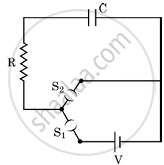
A circuit consisting of a capacitor C, a resistor of resistance R and an ideal battery of emf V, as shown in figure is known as RC series circuit.
As soon as the circuit is completed by closing key S1 (keeping S2 open) charges begin to flow between the capacitor plates and the battery terminals. The charge on the capacitor increases and consequently the potential difference `V_c (= q/C)` across the capacitor also increases with time. When this potential difference equals the potential difference across the battery, the capacitor is fully charged (Q = VC). During this process of charging, the charge q on the capacitor changes with time t as q = Q[1 − e−t/RC]. The charging current can be obtained by differentiating it and using `d/dx(e^(mx))` = memx. Consider the case when R = 20 kΩ, C = 500 μF and V = 10 V. |
(i) The final charge on the capacitor, when key S1 is closed and S2 is open, is ______.
- 5 μC
- 5 mC
- 25 mC
- 0.1 C
(ii) For sufficient time the key S1 is closed and S2 is open. Now key S2 is closed and S1 is open. What is the final charge on the capacitor?
- Zero
- 5 mC
- 2.5 mC
- 5 μC
(iii) The dimensional formula for RC is ______.
- [M L2 T−3 A−2]
- [M0 L0 T−1 A0]
- [M−1 L−2 T4 A2]
- [M0 L0 T A0]
(iv) The key S1 is closed and S2 is open. The value of current in the resistor after 5 seconds, is ______.
- `1/(2 sqrte)` mA
- `sqrt e` mA
- `1/sqrt e` mA
- `1/(2e)` mA
OR
(iv) The key S1 is closed and S2 is open. The initial value of charging current in the resistor, is ______.
- 5 mA
- 0.5 mA
- 2 mA
- 1 mA
Chapter:
Read the following paragraph and answer the questions that follow.
| A thin lens is a transparent optical medium bounded by two surfaces, at least one of which should be spherical. Applying the formula for image formation by a single spherical surface successively at the two surfaces of a lens, one can obtain the ‘lens maker formula’ and then the ‘lens formula’. A lens has two foci - called ‘first focal point’ and ‘second focal point’ of the lens, one on each side. |
(i)
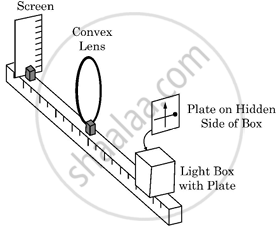
Consider the arrangement shown in figure. A black vertical arrow and a horizontal thick line with a ball are painted on a glass plate. It serves as the object. When the plate is illuminated, its real image is formed on the screen.
Which of the following correctly represents the image formed on the screen?


(ii) Which of the following statements is incorrect?
- For a convex mirror magnification is always negative.
- For all virtual images formed by a mirror magnification is positive.
- For a concave lens magnification is always positive.
- For real and inverted images, magnification is always negative.
(iii) A convex lens of focal length ‘f’ is cut into two equal parts perpendicular to the principal axis. The focal length of each part will be ______.
- f
- 2 f
- `f/2`
- `f/4`
OR
(iii) If an object in case (i) above is 20 cm from the lens and the screen is 50 cm away from the object, the focal length of the lens used is:
- 10 cm
- 12 cm
- 16 cm
- 20 cm
(iv) The distance of an object from first focal point of a biconvex lens is X1 and distance of the image from second focal point is X2. The focal length of the lens is ______.
- X1X2
- `sqrt(X_1 + X_2)`
- `sqrt(X_1 X_2)`
- `sqrt(X_2/X_1)`
Chapter:
Two point charges 5 μC and −1 μC are placed at points (−3 cm, 0, 0) and (3 cm, 0, 0) respectively. An external electric field `vec E = A/r^2 hat r` where A = 3 × 10⁵ Vm is switched on in the region. Calculate the change in electrostatic energy of the system due to the electric field.
Chapter:
A system of two conductors is placed in air and they have net charge of +80 μC and −80 μC which causes a potential difference of 16 V between them.
- Find the capacitance of the system.
- If the air between the capacitor is replaced by a dielectric medium of dielectric constant 3, what will be the potential difference between the two conductors?
- If the charges on two conductors are changed to +160 μC and −160 μC, will the capacitance of the system change? Give reason for your answer.
Chapter:
Consider three metal spherical shells A, B and C, each of radius R. Each shell is having a concentric metal ball of radius `R/10`. The spherical shells A, B and C are given charges +6q, −4q, and 14q respectively. Their inner metal balls are also given charges −2q, +8q and −10q respectively. Compare the magnitude of the electric fields due to shells A, B and C at a distance 3R from their centres.
Chapter:
A charge −6 μC is placed at the centre B of a semicircle of radius 5 cm, as shown in the figure. An equal and opposite charge is placed at point D at a distance of 10 cm from B. A charge +5 μC is moved from point ‘C’ to point ‘A’ along the circumference. Calculate the work done on the charge.
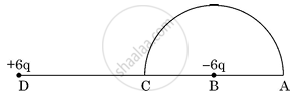
Chapter:
A proton moving with velocity `vec V` in a non-uniform magnetic field traces a path as shown in the figure.
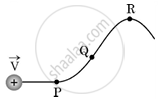
The path followed by the proton is always in the plane of the paper. What is the direction of the magnetic field in the region near points P, Q and R? What can you say about relative magnitude of magnetic fields at these points?
Chapter:
A current carrying circular loop of area A produces a magnetic field B at its centre. Show that the magnetic moment of the loop ia `(2 BA)/mu_0 sqrt(A/pi)`.
Chapter:
Derive an expression for the torque acting on a rectangular current loop suspended in a uniform magnetic field.
Chapter:
A charged particle is moving in a circular path with velocity `vec V` in a uniform magnetic field `vec B`. It is made to pass through a sheet of lead and as a consequence, it looses one half of its kinetic energy without change in its direction. How will
- the radius of its path
- its time period of revolution change?
Chapter:
Why are coherent sources necessary to produce a sustained interference pattern?
Chapter:
Lights from two independent sources are not coherent. Explain.
Chapter:
Two slits 0.1 mm apart are arranged 1.20 m from a screen. Light of wavelength 600 nm from a distant source is incident on the slits.
- How far apart will adjacent bright interference fringes be on the screen?
- Find the angular width (in degree) of the first bright fringe.
Chapter:
An incident plane wave falls on a convex lens and gets refracted through it. Draw a diagram to show the incident and refracted wavefront.
Chapter:
A beam of light coming from a distant source is refracted by a spherical glass ball (refractive index 1.5) of radius 15 cm. Draw the ray diagram and obtain the position of the final image formed.
Chapter:
Other Solutions
Submit Question Paper
Help us maintain new question papers on Shaalaa.com, so we can continue to help studentsonly jpg, png and pdf files
CBSE previous year question papers Class 12 Physics with solutions 2024 - 2025
Previous year Question paper for CBSE Class 12 Physics-2025 is solved by experts. Solved question papers gives you the chance to check yourself after your mock test.
By referring the question paper Solutions for Physics, you can scale your preparation level and work on your weak areas. It will also help the candidates in developing the time-management skills. Practice makes perfect, and there is no better way to practice than to attempt previous year question paper solutions of CBSE Class 12.
How CBSE Class 12 Question Paper solutions Help Students ?
• Question paper solutions for Physics will helps students to prepare for exam.
• Question paper with answer will boost students confidence in exam time and also give you an idea About the important questions and topics to be prepared for the board exam.
• For finding solution of question papers no need to refer so multiple sources like textbook or guides.
