Commerce (English Medium)
Science (English Medium)
Arts (English Medium)
Academic Year: 2024-2025
Date & Time: 8th March 2025, 10:30 am
Duration: 3h
Advertisements
NOTE
- Please check that this question paper contains 23 printed pages.
- Please check that this question paper contains 38 questions.
- QP. Code given on the right hand side of the question paper should be written on the title page of the answer-book by the candidate.
- Please write down the serial number of the question in the answer-book at the given place before attempting it.
- 15 minute time has been allotted to read this question paper. The question paper will be distributed at 10.15 a.m. From 10.15 a.m. to 10.30 am. the candidates will read the question paper only and will not write any answer on the answer book during this period.
General Instructions:
Read the following instructions very carefully and strictly follow them:
- This Question paper contains 38 questions. All questions are compulsory.
- Question paper is divided into FIVE Sections - Section A, B, C, D and E.
- In Section A - Question Number 1 to 18 are Multiple Choice Questions (MCQs) and Question Number 19 & 20 are Assertion-Reason based questions of 1 mark each.
- In Section B - Question Number 21 to 25 are Very Short Answer (VSA) type questions, carrying 2 marks each.
- In Section C - Question Number 26 to 31 are Short Answer (SA) type questions, carrying 3 marks each.
- In Section D - Question Number 32 to 35 are Long Answer (LA) type questions, carrying 5 marks each.
- In Section E - Question Number 36 to 38 are case study based questions, carrying 4 marks each.
- There is no overall choice. However, an internal choice has been provided in 2 questions in Section - B, 3 questions in Section - C, 2 questions in Section - D and 2 questions in Section - E.
- Use of calculator is NOT allowed.
The projection vector of vector `veca` on vector `vecb` is ______.
`((veca . vecb)/|vecb|^2)vecb`
`(veca . vecb)/|vecb|`
`(veca . vecb)/|veca|`
`((veca . vecb)/|veca|^2)vecb`
Chapter:
The function f(x) = x2 – 4x + 6 is increasing in the interval:
(0, 2)
(–∞, 2]
[1, 2]
[2, ∞)
Chapter:
If f(2a – x) = f(x), then `int_0^(2a)f(x) dx` is ______.
`int_0^(2a)f(x/2) dx`
`int_0^a f(x) dx`
`2int_a^0 f(x) dx`
`2int_0^a f(x) dx`
Chapter:
If A = `[(1, 12, 4y), (6x, 5, 2x), (8x, 4, 6)]` is a symmetric matrix, then (2x + y) is ______.
−8
0
6
8
Chapter:
If y = sin−1x, −1 ≤ x ≤ 0, then the range of y is ______.
`((-pi)/2, 0)`
`[(-pi)/2, 0]`
`[(-pi)/2, 0)`
`((-pi)/2, 0]`
Chapter:
If a line makes angles of `(3pi)/4, pi/3` and θ with the positive directions of x, y and z-axis respectively, then θ is ______.
`(-pi)/3 only`
`pi/3 only`
`pi/6`
`± pi/3`
Chapter:
If E and F are two events such that P(E) > 0 and P(F) ≠ 1, then `P(barE//barF)` is ______.
`(P(barE))/(P(barF))`
`1 - P(barE//F)`
1 − P(E/F)
`(1 - P(E ∪ F))/(P(barF)`
Chapter:
Which of the following can be both a symmetric and skew-symmetric matrix?
Unit Matrix
Diagonal Matrix
Null Matrix
Row Matrix
Chapter:
The equation of a line parallel to the vector `3hati + hatj + 2hatk`and passing through the point (4, −3, 7) is ______.
x = 4t + 3, y = −3t + 1, z = 7t + 2
x = 3t + 4, y = t + 3, z = 2t + 7
x = 3t + 4, y = t – 3, z = 2t + 7
x = 3t + 4, y = −t + 3, z = 2t + 7
Chapter:
Four friends Abhay, Bina, Chhaya and Devesh were asked to simplify 4AB + 3(AB + BA) − 4BA, where A and B are both matrices of order 2 × 2. It is known that A ≠ B ≠ I and A−1 ≠ B.
Their answers are given as:
Abhay: 6AB
Bina: 7AB − BA
Chhaya: 8 AB
Devesh: 7BA − AB
Who answered it correctly?
Abhay
Bina
Chhaya
Devesh
Chapter:
A cylindrical tank of radius 10 cm is being filled with sugar at the rate of 100π cm3/s. The rate, at which the height of the sugar inside the tank is increasing, is ______.
0.1 cm/s
0.5 cm/s
1 cm/s
1.1 cm/s
Chapter:
Let `vecp and vecq` be two unit vectors and α be the angle between them. Then `(vecp + vecq)` will be a unit vector for what value of α?
`pi/4`
`pi/2`
`(pi)/3`
`(2pi)/3`
Chapter:
The line x = 1 + 5μ, y = −5 + μ, z = −6 − 3μ passes through which of the following point?
(1, −5, 6)
(1, 5, 6)
(1, −5, −6)
(−1, −5, 6)
Chapter:
If A denotes the set of continuous functions and B denotes set of differentiable functions, then which of the following depicts the correct relation between set A and B?
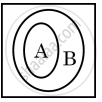
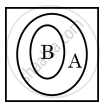
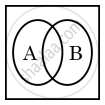
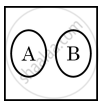
Chapter:
The area of the shaded region (figure) represented by the curves y = x2, 0 ≤ x ≤ 2 and y-axis is given by
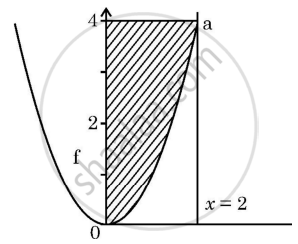
`int_0^2 x^2 dx`
`int_0^2 sqrty dy`
`int_0^4 x^2 dx`
`int_0^4 sqrty dy`
Chapter:
Advertisements
A factory produces two products X and Y. The profit earned by selling X and Y is represented by the objective function Z = 5x + 7y, where x and y are the number of units of X and Y respectively sold. Which of the following statement is correct?
The objective function maximizes the difference of the profit earned from products X and Y.
The objective function measures the total production of products X and Y.
The objective function maximizes the combined profit earned from selling X and Y.
The objective function ensures the company produces more of product X than product Y.
Chapter:
If A and B are square matrices of order m such that A2 − B2 = (A − B) (A + B), then which of the following is always correct?
A = B
AB = BA
A = 0 or B = 0
A = I or B = I
Chapter:
If p and q are respectively the order and degree of the differential equation `d/dx((dy)/(dx))^3 = 0`, then (p − q) is ______.
0
1
2
3
Chapter:
Assertion (A): A = diag [3 5 2] is a scalar matrix of order 3 × 3.
Reason (R): If a diagonal matrix has all non-zero elements equal, it is known as a scalar matrix.
Both Assertion (A) and Reason (R) are true and the Reason (R) is the correct explanation of the Assertion (A).
Both Assertion (A) and Reason (R) are true, but Reason (R) is not the correct explanation of the Assertion (A).
Assertion (A) is true but Reason (R) is false.
Assertion (A) is false but Reason (R) is true.
Chapter:
Assertion (A): Every point of the feasible region of a Linear Programming Problem is an optimal solution.
Reason (R): The optimal solution for a Linear Programming Problem exists only at one or more corner point(s) of the feasible region.
Both Assertion (A) and Reason (R) are true and the Reason (R) is the correct explanation of the Assertion (A).
Explanation:
Both Assertion (A) and Reason (R) are true, but Reason (R) is not the correct explanation of the Assertion (A).
Assertion (A) is true but Reason (R) is false.
Assertion (A) is false but Reason (R) is true.
Chapter:
A vector `veca` makes equal angles with all the three axes. If the magnitude of the vector is `5sqrt3` units, then find `veca`.
Chapter:
If `vecα and vecβ` are position vectors of two points P and Q respectively, then find the position vector of a point R in QP produced such that QR = `3/2` QP.
Chapter:
Find the values of ‘a’ for which f(x) = sin x − ax + b is increasing on R.
Chapter:
If `veca and vecb` are two non-collinear vectors, then find x, such that `vecα = (x - 2)veca + vecb and vecβ = (3 + 2x)veca - 2vecb` are collinear.
Chapter:
If x = `e^(x/y)`, then prove that `dy/dx = (x - y)/(xlogx)`.
Chapter: [5] Continuity and Differentiability
If f(x) = `{(2x - 3",", -3 ≤ x ≤ -2), (x + 1",", -2 ≤ x ≤ 0):}`
Check the differentiability of f(x) at x = -2.
Chapter:
Solve:
`2(y + 3) - xy (dy)/(dx)` = 0, given that y(1) = – 2.
Chapter:
Solve the following differential equation:
`(1 + x^2) dy/dx + 2xy = 4x^2`
Chapter:
Let R be a relation defined over N, where N is set of natural numbers, defined as “mRn if and only if m is a multiple of n, m, n ∈ N.” Find whether R is reflexive, symmetric and transitive or not.
Chapter:
Advertisements
Solve the following linear programming problem graphically:
Minimise Z = x − 5y
subject to the constraints:
x − y ≥ 0
− x + 2y ≥ 2
x ≥ 3, y ≤ 4, y ≥ 0
Chapter:
If y = `log(sqrtx + 1/sqrtx)^2`, then show that x(x + 1)2 y2 + (x + 1)2 y1 = 2.
Chapter:
If `xsqrt(1+y) + y sqrt(1+x) = 0`, for, −1 < x < 1, prove that `dy/dx = -1/(1+ x)^2`.
Chapter:
A die with number 1 to 6 is biased such that P(2) = `3/10` and probability of other numbers is equal. Find the mean of the number of times number 2 appears on the dice, if the dice is thrown twice.
Chapter:
Two dice are thrown. Defined are the following two events A and B:
A={(x, y) : x + y = 9}, B = {(x, y) : x ≠ 3}, where (x, y) denote a point inthe sample space.
Check if events A and B are independent or mutually exclusive.
Chapter:
Using integration, find the area of the region bounded by the line y = 5x + 2, the x−axis and the ordinates x = −2 and x = 2.
Chapter:
Find the shortest distance between the lines:
`(x + 1)/2 = (y - 1)/1 = (z - 9)/3 and (x - 3)/2 = (y + 15)/(-7) = (z - 9)/5`
Chapter:
Find the image A' of the point A(2, 1, 2) in the line `l : vecr = 4hati + 2hatj + 2hatk + λ(hati - hatj - hatk)`. Also, find the equation of line joining AA'. Find the foot of prependicular form A on the line l.
Chapter:
Given `A = [(-4, 4, 4), (-7, 1, 3), (5, -3, -1)] and B = [(1, -1, 1), (1, -2, -2), (2, 1, 3)]`, find AB. Hence, solve the system of linear equations:
x − y + z = 4
x − 2y − 2z = 9
2x + y + 3z = 1
Chapter:
If A = `[(1, 2, 0), (-2, -1, -2), (0, -1, 1)]`, find A−1. Using A−1, solve the system of linear equations x − 2y = 10, 2x − y − z = 8, −2y + z = 7.
Chapter:
|
A school is organizing a debate competition with participants as speakers S = {S1, S2, S3, S4} and these are judged by judges J = {J1, J2, J3}. Each speaker can be assigned one judge. Let R be a relation from set S to J defined as R = {(x, y): speaker x is judged by judge y, x ∈ S, y ∈ J}.
|
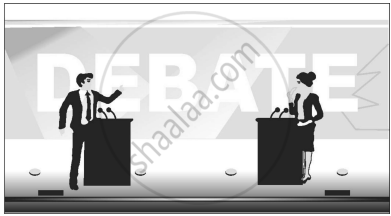
Based on the above, answer the following:
- How many relations can be there from S to J? [1]
- A student identifies a function from S to J as f = {(S1, J1), (S2, J2), (S3, J2), (S4, J3)} Check if it is bijective. [1]
- How many one-one functions can be there from set S to set J? [2]
OR - Another student considers a relation R1 = {(S1, S2), (S2, S4)} in set S. Write the minimum ordered pairs to be included in R1 so that R1 is reflexive but not symmetric. [2]
- How many one-one functions can be there from set S to set J? [2]
Chapter:
|
Three persons viz. Amber, Bonzi and Comet are manufacturing cars which run on petrol and on battery as well. Their production share in the market is 60%, 30% and 10% respectively. Of their respective production capacities, 20%, 10% and 5% cars respectively are electric (or battery operated).
|
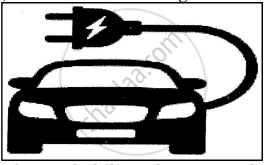
Based on the above, answer the following questions:
-
- What is the probability that a randomly selected car is an electric car? [2]
- What is the probability that a randomly selected car is a petrol car? [2]
- A car is selected at random and is found to be electric. What is the probability that it was manufactured by Comet? [1]
- A car is selected at random and is found to be electric. What is the probability that it was manufactured by Amber or Bonzi? [1]
Chapter:
|
A small town is analyzing the pattern of a new street light installation. The lights are set up in such a way that the intensity of light at any point x metres from the start of the street can be modelled by f(x) = ex sin x, where x is in metres. |
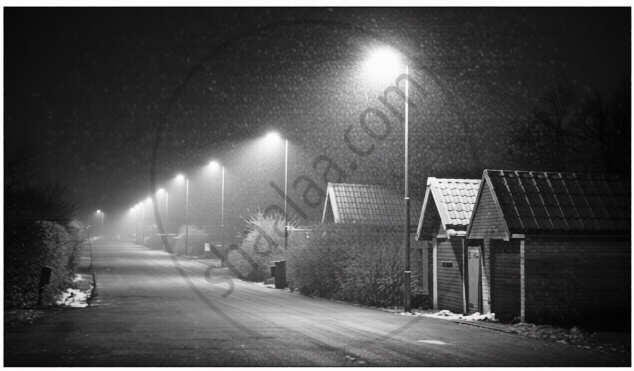
Based on the above, answer the following:
- Find the intervals on which the f(x) is increasing or decreasing, x ∈ [0, π]? [2]
- Verify, whether each critical point when x ∈ [0, π] is a point of local maximum or local minimum or a point of inflexion. [2]
Chapter:
Other Solutions
Submit Question Paper
Help us maintain new question papers on Shaalaa.com, so we can continue to help studentsonly jpg, png and pdf files
CBSE previous year question papers Class 12 Mathematics with solutions 2024 - 2025
Previous year Question paper for CBSE Class 12 Maths-2025 is solved by experts. Solved question papers gives you the chance to check yourself after your mock test.
By referring the question paper Solutions for Mathematics, you can scale your preparation level and work on your weak areas. It will also help the candidates in developing the time-management skills. Practice makes perfect, and there is no better way to practice than to attempt previous year question paper solutions of CBSE Class 12.
How CBSE Class 12 Question Paper solutions Help Students ?
• Question paper solutions for Mathematics will helps students to prepare for exam.
• Question paper with answer will boost students confidence in exam time and also give you an idea About the important questions and topics to be prepared for the board exam.
• For finding solution of question papers no need to refer so multiple sources like textbook or guides.
