Advertisements
Advertisements
प्रश्न
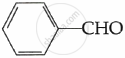
Which of the following does not give aldol condensation reaction?
पर्याय
CH3 – CHO

CH3COCH3
Advertisements
उत्तर
Explanation:
Aldehydes and ketones with at least one α-hydrogen undergo a reaction in the presence of dilute alkali as a catalyst to create β-hydroxy aldehydes (aldol) or β-hydroxy ketones (ketol), respectively. This is known as an Aldol reaction.
Due to the lack of α-hydrogen, benzaldehyde does not undergo aldol reaction.
APPEARS IN
संबंधित प्रश्न
A compound 'A' of molecular formula C2H3OCl undergoes a series of reactions as shown below. Write the structures of A, B, C and D in the following reactions :

Describe the following:
Cross aldol condensation
Write a chemical equation for the following reaction:
Propanone is treated with dilute Ba( OH)2.
Which product is formed when the compound  is treated with concentrated aqueous \[\ce{KOH}\] solution?
Why is there a large difference in the boiling points of butanal and butan-1-ol?
Compound ‘A’ was prepared by oxidation of compound ‘B’ with alkaline \[\ce{KMnO4}\]. Compound ‘A’ on reduction with lithium aluminium hydride gets converted back to compound ‘B’. When compound ‘A’ is heated with compound B in the presence of \[\ce{H2SO4}\] it produces fruity smell of compound C to which family the compounds ‘A’, ‘B’ and ‘C’ belong to?
Which of the following gives aldol con~ensation reaction?
Identify A and B from the following reaction:
\[\begin{array}{cc}
\ce{CH3}\phantom{.................}\\
|\phantom{....................}\\
\phantom{}\ce{2CH3 - C = O ->[Ba(OH)2] A ->[Δ] B + H2O}
\end{array}\]
Why is the α-hydrogens of aldehydes and ketones are acidic in nature?
Assertion (A): The final product in Aldol condensation is always α, β-unsaturated carbonyl compound.
Reason (R): α, β-unsaturated carbonyl compounds are stabilised due to conjugation.
