Advertisements
Advertisements
Question
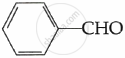
Which of the following does not give aldol condensation reaction?
Options
CH3 – CHO

CH3COCH3
Advertisements
Solution
Explanation:
Aldehydes and ketones with at least one α-hydrogen undergo a reaction in the presence of dilute alkali as a catalyst to create β-hydroxy aldehydes (aldol) or β-hydroxy ketones (ketol), respectively. This is known as an Aldol reaction.
Due to the lack of α-hydrogen, benzaldehyde does not undergo aldol reaction.
APPEARS IN
RELATED QUESTIONS
How will you convert ethanal into the following compound?
Butane-1, 3-diol
How will you convert ethanal into the following compound?
But-2-enal
How will you bring about the following conversion in not more than two steps?
Benzaldehyde to 3-Phenylpropan-1-ol
Why is alpha (α) hydrogen of carbonyl compounds acidic in nature?
Write chemical equations of the following reaction :
Benzoyl chloride is hydrogenated in the presence of `"Pd"/(BaSO_4)`
Cannizaro’s reaction is not given by ______.
Predict the reagent for carrying out the following transformations:
Ethanal to 3-hydroxy butanal
Assertion (A): The final product in Aldol condensation is always α, β-unsaturated carbonyl compound.
Reason (R): α, β-unsaturated carbonyl compounds are stabilised due to conjugation.
When acetaldehyde is treated with dilute NaOH, the following reaction is observed.
\[\begin{array}{cc}
\ce{2CH3 - CHO ->[dil.NaOH] CH3 - CH - CH2 - CHO}\\
\phantom{...............}|\\
\phantom{.................}\ce{OH}
\end{array}\]
- What are the functional groups in the product?
- Can another product be formed during the same reaction? (Deduce the answer by doing atomic audit of reactant and product).
- Is this an addition reaction or condensation reaction?
Which one of the following undergoes reaction with 50% sodiumhydroxide solution to give the corresponding alcohol and acid:
