Advertisements
Advertisements
प्रश्न
Which of the following functions form Z to itself are bijections?
पर्याय
\[f\left( x \right) = x^3\]
\[f\left( x \right) = x + 2\]
\[f\left( x \right) = 2x + 1\]
\[f\left( x \right) = x^2 + x\]
Advertisements
उत्तर
f is not onto because for y = 3∈Co-domain(Z), there is no value of x∈Domain(Z)
\[ x^3 = 3\]
\[ \Rightarrow x = \sqrt[3]{3} \not\in Z\]
⇒ f is not onto
So, f is not a bijection
(b) Injectivity:
Let x and y be two elements of the domain (Z), such that
\[x + 2 = y + 2\]
\[ \Rightarrow x = y\]
Surjectivity:
Let y be an element in the co-domain (Z), such that
\[ \Rightarrow y = x + 2\]
\[ \Rightarrow x = y - 2 \in Z \left( Domain \right)\]
So, f is a bijection.
\[ \Rightarrow 4 = 2x + 1\]
\[ \Rightarrow 2x = 3\]
\[ \Rightarrow x = \frac{3}{2} \not\in Z\]
So,f is not a bijection.
\[\]
\[\left( d \right) f\left( 0 \right) = 0^2 + 0 = 0\]
\[and f\left( - 1 \right) = \left( - 1 \right)^2 + \left( - 1 \right) = 1 - 1 = 0\]
⇒ 0 and -1 have the same image.
⇒ f is not one-one.
So,fis not a bijection.
APPEARS IN
संबंधित प्रश्न
Let f : R → R be defined as f(x) = x4. Choose the correct answer.
Give examples of two functions f: N → Z and g: Z → Z such that g o f is injective but gis not injective.
(Hint: Consider f(x) = x and g(x) =|x|)
Classify the following function as injection, surjection or bijection : f : Z → Z given by f(x) = x2
Classify the following function as injection, surjection or bijection :
f : Q → Q, defined by f(x) = x3 + 1
Show that the function f : R − {3} → R − {2} given by f(x) = `(x-2)/(x-3)` is a bijection.
Let A = [-1, 1]. Then, discuss whether the following function from A to itself is one-one, onto or bijective : g(x) = |x|
If f : R → R be the function defined by f(x) = 4x3 + 7, show that f is a bijection.
If A = {1, 2, 3}, show that a onto function f : A → A must be one-one.
Consider f : N → N, g : N → N and h : N → R defined as f(x) = 2x, g(y) = 3y + 4 and h(z) = sin z for all x, y, z ∈ N. Show that ho (gof) = (hog) of.
Find fog and gof if : f (x) = ex g(x) = loge x .
Let
f (x) =`{ (1 + x, 0≤ x ≤ 2) , (3 -x , 2 < x ≤ 3):}`
Find fof.
Let f : R `{- 4/3} `- 43 →">→ R be a function defined as f(x) = `(4x)/(3x +4)` . Show that f : R - `{-4/3}`→ Rang (f) is one-one and onto. Hence, find f -1.
If f : R → (−1, 1) defined by `f (x) = (10^x- 10^-x)/(10^x + 10 ^-x)` is invertible, find f−1.
Which of the following graphs represents a one-one function?
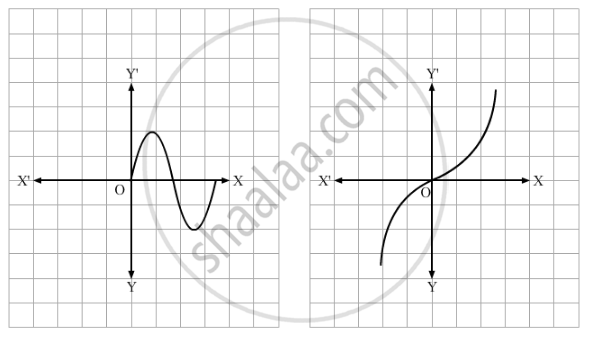
Write the domain of the real function
`f (x) = sqrtx - [x] .`
Let A = {1, 2, 3}, B = {4, 5, 6, 7} and let f = {(1, 4), (2, 5), (3, 6)} be a function from A to B. State whether f is one-one or not.
Write the domain of the real function f defined by f(x) = `sqrt (25 -x^2)` [NCERT EXEMPLAR]
The function
f : A → B defined by
f (x) = - x2 + 6x - 8 is a bijection if
Which of the following functions from
to itself are bijections?
A function f from the set of natural numbers to the set of integers defined by
\[f\left( n \right)\begin{cases}\frac{n - 1}{2}, & \text{when n is odd} \\ - \frac{n}{2}, & \text{when n is even}\end{cases}\]
\[f : Z \to Z\] be given by
` f (x) = {(x/2, ", if x is even" ) ,(0 , ", if x is odd "):}`
Then, f is
Let
\[A = \left\{ x \in R : x \leq 1 \right\} and f : A \to A\] be defined as
\[f\left( x \right) = x \left( 2 - x \right)\] Then,
\[f^{- 1} \left( x \right)\] is
Let \[f\left( x \right) = \frac{1}{1 - x} . \text{Then}, \left\{ f o \left( fof \right) \right\} \left( x \right)\]
Let \[f\left(x\right) = x^3\] be a function with domain {0, 1, 2, 3}. Then domain of \[f^{-1}\] is ______.
Let A = R − (2) and B = R − (1). If f: A ⟶ B is a function defined by`"f(x)"=("x"-1)/("x"-2),` how that f is one-one and onto. Hence, find f−1.
Write about strcmp() function.
Let N be the set of natural numbers and the function f: N → N be defined by f(n) = 2n + 3 ∀ n ∈ N. Then f is ______.
For sets A, B and C, let f: A → B, g: B → C be functions such that g o f is surjective. Then g is surjective.
If f: R → R is defined by f(x) = x2 – 3x + 2, write f(f (x))
Let f: R → R be the functions defined by f(x) = x3 + 5. Then f–1(x) is ______.
The number of bijective functions from set A to itself when A contains 106 elements is ____________.
Raji visited the Exhibition along with her family. The Exhibition had a huge swing, which attracted many children. Raji found that the swing traced the path of a Parabola as given by y = x2.
Answer the following questions using the above information.
- Let : N → R be defined by f(x) = x2. Range of the function among the following is ____________.
Consider a function f: `[0, pi/2] ->` R, given by f(x) = sinx and `g[0, pi/2] ->` R given by g(x) = cosx then f and g are
The domain of the function `cos^-1((2sin^-1(1/(4x^2-1)))/π)` is ______.
Let f: R→R be defined as f(x) = 2x – 1 and g: R – {1}→R be defined as g(x) = `(x - 1/2)/(x - 1)`. Then the composition function f (g(x)) is ______.
The solution set of the inequation log1/3(x2 + x + 1) + 1 > 0 is ______.
Let x is a real number such that are functions involved are well defined then the value of `lim_(t→0)[max{(sin^-1 x/3 + cos^-1 x/3)^2, min(x^2 + 4x + 7)}]((sin^-1t)/t)` where [.] is greatest integer function and all other brackets are usual brackets.
Let f(x) = ax (a > 0) be written as f(x) = f1(x) + f2(x), where f1(x) is an even function and f2(x) is an odd function. Then f1(x + y) + f1(x – y) equals ______.
Let f: R→Rbe defined as f (x) = `(x^2 + 1)/2`, then ______.
