Advertisements
Advertisements
प्रश्न
What is a tight corner? What happens when one finds oneself in a tight corner?
Advertisements
उत्तर
Tight comer is a difficult situation. When one finds oneself in a tight comer, one worries and thinks seriously about the ways of getting out of it.
APPEARS IN
संबंधित प्रश्न
Nuclear Family or Joint Family
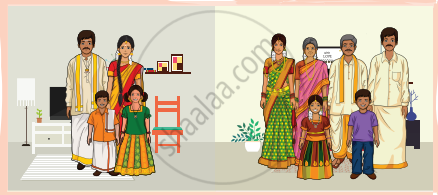
Based on the visuals given above, give five words/phrases each, to describe these two family types.
| Nuclear family | Joint family | ||
In India, the number of women pursuing careers in sports is considerably less, when compared to men. What do you think are the reasons? Discuss with a partner and share the ideas with the class.
How forgetful are you?
How sharp is your memory?
Take this five-minute memory test. The teacher will read out a series of 30 words, one by one. Some of them will be repeated. Whenever you hear a word for the first time, write ‘N’ (for New) in the corresponding box, and when you hear a repeated word write ‘R’. After completing this task, check your results. Compare it with your friends and see where you stand.
| 1 | N | 11 | 21 | ||
| 2 | 12 | 22 | |||
| 3 | 13 | 23 | |||
| 4 | 14 | 24 | |||
| 5 | 15 | 25 | |||
| 6 | 16 | 26 | |||
| 7 | 17 | 27 | |||
| 8 | 18 | 28 | |||
| 9 | 19 | 29 | |||
| 10 | 20 | 30 |
Name a few things that a person remembers easily.
What is the commonest type of forgetfulness, according to Lynd?
What are the articles the writer forgets most often?
What is common about the ‘angler’ and the ‘poet’?
When does human memory work with less than its usual capacity?
Will you sympathize or ridicule someone who is intensely forgetful? Write an essay justifying your point of view.
What made the author ignore his friend’s warning?
What did the falling of the hammer indicate?
What made the friend laugh heartily?
The narrator would not forget two things about his friend. What are they?
What was the bidder’s offer to the narrator?
How did the narrator take advantage of the situation?
Trace the thoughts that went on in the mind of the narrator when picture after picture was put up and sold at the auction.
Work in pairs. Look at the mind map below and add a few other features of democracy you can think of. Share your answers with the class.
- e.g. sharing and caring
Who provides these common facilities? Tick the appropriate source.
- Parents
- Educational institutions
- The Department of Education
- Social Service Organizations
- Other agencies
According to the speaker, how should Universities mould the students of the present day?
What are the hindrances graduates face in their task of serving the society?
You were one of the fresh graduates at the convocation function of the University. You had the rare privilege of listening to the enlightening speech of Dr. Arignar Anna. Write a letter to your friend highlighting the core ideas of his speech and the impact of the speech on you.
Often on formal occasions, we admire friends and strangers who appear elegant, who are pleasant to converse with, and who conduct themselves gracefully. At times, we also see people who are awkward, nervous, and doubtful about their next move. Recall a few examples of awkward actions that can cause discomfort or disturbance to others like spilling a cup of a hot drink on someone nearby.
Give a few instances of Bryson’s confused acts.
What were the contents of Bryson’s bag?
What did Bryson wish to avoid in his life?
What was the reaction of Bryson’s wife to his antics?
‘… But, when it’s my own - well, I think hysterics are fully justified’ – How?
