Advertisements
Advertisements
प्रश्न
Think about the Text
Discuss in pairs and answer question below in a short paragraph (30 − 40 words).
“I looked into the mirror and smiled,” says the doctor. A little later he says, “I forgot my danger and smiled feebly at myself.” What is the doctor’s opinion about himself when:
(i) he first smiles, and
(ii) he smiles again? In what way do his thoughts change in between, and why?
Advertisements
उत्तर
(i) When the doctor first smiles, he has an inflated opinion of himself, admiring his
looks and profession.
(ii) In the second instance, the doctor smiles at his foolishness and helplessness.
His thoughts change after his encounter with the snake—from being a proud doctor he
moves on to accept his stupidity.
संबंधित प्रश्न
Answer the following question in 30 to 40 words.
Was Bruno a loving and playful pet? Why, then, did he have to be sent away?
Thinking about the poem
Where does the traveller find himself? What problem does he face?
What do Prashant and other volunteers resist the plan to set up institutions for orphans and widows? What alternatives do they consider?
Discuss with your partner the similarities and differences between your dream houses.
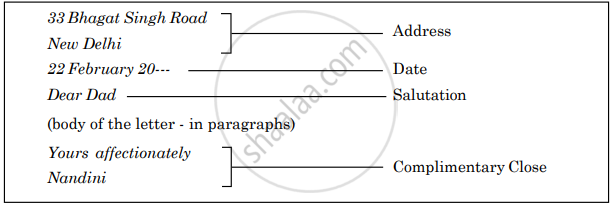
When we write informal letters (to a friend, or to a member of our family), we use this layout.
The black man's face bespoke revenge
As the fire passed from his sight.
For all he saw in his stick of wood
Was a chance to spite the white.
The last man of this forlorn group
Did nought except for gain.
Giving only to those who gave
Was how he played the game.
Their logs held tight in death's still hands
Was proof of human sin.
They didn't die from the cold without
They died from the cold within.
Read the lines given above and answer the question that follow.
What were the logs in their hands ? What was their significance ?
Bangle sellers are we who bear
Our shining loads to the temple fair...
Who will buy these delicate, bright
Rainbow-tinted circles of light?
Lustrous tokens of radiant lives,
For happy daughters and happy wives.
Read the lines given above and answer the question that follow.
What is the tone in this stanza? Quote.
“You haven’t brought home that sick brat!” Anger and astonishment were in the tones of Mrs. Joe Thompson; her face was in a flame.
“I think women’s hearts are sometimes very hard,” said Joe. Usually Joe Thompson got out of his wife’s way, or kept rigidly silent and non-combative when she fired up on any subject; it was with some surprise, therefore, that she now encountered a firmly-set countenance and a resolute pair of eyes.
“Women’s hearts are not half so hard as men’s!”
Joe saw, by a quick intuition, that his resolute bearing h«d impressed his wife and he answered quickly, and with real indignation, “Be that as it may, every woman at the funeral turned her eyes steadily from the sick child’s face, and when the cart went off with her dead mother, hurried away, and left her alone in that old hut, with the sun not an hour in the sky.”
“Where were John and Kate?” asked Mrs. Thompson.
“Farmer Jones tossed John into his wagon, and drove off. Katie went home with Mrs. Ellis; but nobody wanted the poor sick one. ‘Send her to the poorhouse,’ was the cry.”
“Why didn’t you let her go, then. What did you bring her here for?”
“She can’t walk to the poorhouse,” said Joe; “somebody’s arms must carry her, and mine are strong enough for that task.”
Read the extract given below and answer the question that follow.
Does the attitude of the villagers convey some truth about society at large?
In which situation is the lead held high? What does he mean by 'knowledge is free'? What are 'narrow domestic walls'?
Give an account of the trip to The Victoria am Albert Museum that was planned by Braithwaif, for his class.
Read the extract given below and answer the questions that follow :
One Sunday morning, which the animals assembled to receive their orders,
Napoleon announced that he had decided upon a new policy.
"From now onwards Animal Farm would engage in trade with the
neighboring farms: not, of course, for any commercial purpose, but
simply in order to obtain certain materials which were urgently necessary."
(i) Why did the animals need 'certain materials'? What arrangement had Napolean made to engage in trade with the neighboring farms?
(ii) Why did Napoleon's announcement make the animals uneasy?
(iii) What did Squealer say to the animals to ease their doubts and fears?
(iv) Who was Mr. Whymper? What had the agreed to do?
Why had he entered into this agreement with Napoleon?
(v) There was a change in the attitude of humans towards Animal Farm.
Comment on this change. What were the signs and symptoms of this change?
The king forgave the bearded man. What did he do to show his forgiveness?
How fire is a good servant?
Why do you think he had come to the shop?
How did the old clock give a timeless message through Ray?
What is the significance of dream?
Who do you think or understand what the talking fan wished to convey?
What is the butterfly busy doing?
Why is it a great pleasure to walk through the meadows?
What role does Ariel play in Act IV of the play, The Tempest?
